
Making real friends as an adult is less about meeting the greatest possible number of people and more about finding people with whom mutual interest, values, openness and effort can develop over time.
You might want friends who are queer-friendly, curious, funny, happy to talk about books or travel, and willing to give the same energy they receive. That is not asking for a perfect person.
You are looking for compatibility.
And that may explain why having people around you does not necessarily feel the same as having your people.
Key takeaways
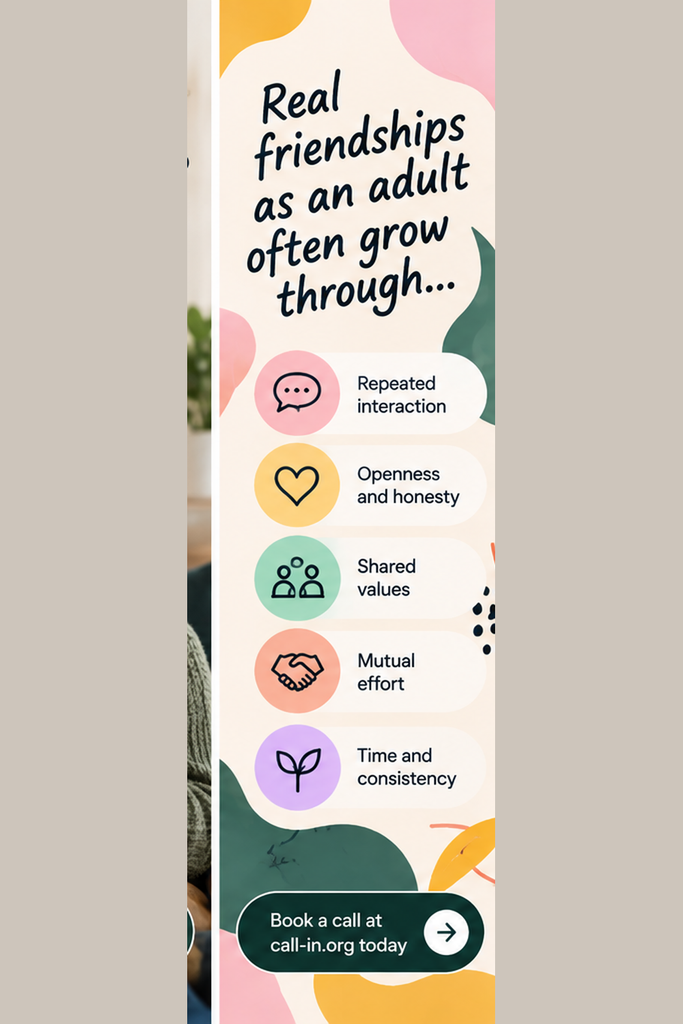
- Adult friendship usually becomes close through repeated interaction, openness, support and mutual effort, not through instant chemistry alone.
- Reciprocity matters, but healthy reciprocity does not require both friends to behave identically or contribute exactly 50 percent at every moment.
- Shared values can matter more than sharing every hobby, particularly when those values affect whether you feel respected and safe.
- Long-distance friendships can be genuine friendships when both people maintain contact and make room for one another.
- The best friendship strategy is often to look for environments where people you are likely to enjoy already gather, then give promising connections enough repeated contact to develop.
Why is it so hard to make real friends as an adult?
Childhood and university do a lot of the work for us.
You repeatedly see the same people. There is lunch tomorrow, class again on Thursday, a party at the weekend and another six months of being in roughly the same place. Friendship gets hundreds of small opportunities to develop without anyone having to formally organize it.
Adult life removes much of that structure.
People work different hours. Some have children, partners, caring responsibilities or long commutes. People move cities and countries, and even people who live nearby can somehow require a six-week calendar negotiation for coffee.
The result is that making friends as an adult often requires more intention than it once did.
That does not mean adults have lost the ability to form deep friendships.
It means friendship now needs logistics.
Real friendship is not simply having things in common
“I love books too” is a beginning.
It is not yet a friendship.
Two people can love reading, travel, horror films, dogs and exactly the same music while being completely incompatible as friends. Another pair might have few hobbies in common but share humour, loyalty, curiosity, respect and the ability to have honest conversations.
Research on adult friendship helps explain why.
A systematic review of 38 studies found that friendship quality, socializing, perceived support, feeling that one matters to a friend, and efforts to maintain friendships were among the friendship factors associated with wellbeing.
The authors also noted substantial limitations in the literature, including the heavy use of younger samples, so these findings should not be treated as a universal friendship formula. PubMed Central (PMC)
The useful distinction is simple.
Shared interests help people meet. Shared relational values help people stay.
What does “give the same energy back” actually mean?
This phrase appears everywhere because it describes something many people have struggled to name.
You do not necessarily want someone to send exactly one message for every message you send. You want evidence that you are not single-handedly manufacturing the friendship.
Research on friendship maintenance has identified behaviors such as positivity, supportiveness, openness and interaction as important ways people maintain relationships. In studies of friendship pairs, both people’s maintenance behaviors were related to satisfaction and commitment within the friendship. Guilford Journals
That is much closer to what “matching energy” means.
It is not arithmetic.
It is participation.
Reciprocity does not have to be perfectly equal
This distinction can prevent friendship from turning into bookkeeping.
Perhaps you are the person who usually makes plans.
Your friend may be the person who notices immediately when something is wrong.
You send memes.
They remember birthdays.
You book the trip.
They call you before the difficult appointment because they remembered you mentioned it three weeks ago.
Research on close friendships suggests that mutuality and supportive behavior matter, but relationships do not necessarily need to operate as exact exchanges to be satisfying. Studies of autonomy support in friendships, for example, have found mutual patterns of support associated with relationship quality and psychological need satisfaction. PubMed
So instead of asking, “Did they give exactly what I gave?”, ask:
“Does this relationship make room for both of us?”
What if I want queer-friendly friends?
That is not an insignificant preference.
If your sexuality, gender expression, relationships or community are parts of your life, a friendship where those things must constantly be translated, defended or concealed can feel very different from one in which you can simply exist.
You do not necessarily need every friend to be LGBTQ+.
But wanting friends who are genuinely queer-friendly can mean wanting people around whom you do not have to brace yourself before mentioning who you date, who you love, how you identify or where you spent Pride weekend.
Research into LGBTQ+ social networks shows why this distinction can matter.
A study examining diverse lesbian, gay and bisexual adults found that friends and coworkers were important sources of everyday social support, and support providers were often people who shared participants’ sexual orientation or other social characteristics.
The findings do not mean LGBTQ+ people can only receive meaningful support from other LGBTQ+ people, but they highlight the role that affirming social networks can play. PubMed
More recent research with LGBT adults aged 50 and above found that larger social networks were associated with emotional wellbeing partly through perceived social support, with LGBT network connections showing a particularly strong relationship with perceived support. PubMed
Sometimes being understood without explaining everything is its own form of ease.
Chosen family can begin as ordinary friendship
For some LGBTQ+ people, friendship eventually becomes something much bigger than having someone to go out with.
Friends may become the people who celebrate relationships, show up during difficult periods, provide practical support, know your history and remain part of your life through several different versions of you.
That is part of what people mean by chosen family.
Research on LGBTQ+ chosen families has described forms of emotional, social, cultural and practical support that can contribute to belonging and perceived wellbeing. The role of chosen family differs enormously between people and communities, and it should not be romanticized as though every queer friendship automatically becomes family. PubMed
Still, many chosen families begin in an extremely ordinary way.
Someone says hello.
Then they say hello again.
It is reasonable to care about someone’s worldview
You may want friends who are open-minded.
Perhaps you want people who can disagree without becoming hostile. You might want friends who are curious about people unlike themselves and who do not treat your identity, relationships or way of living as something requiring approval.
Religion can also be part of compatibility.
The useful distinction is often not whether somebody is religious, but how they relate to people who believe or live differently.
A deeply religious person can be respectful, curious and accepting. A non-religious person can be judgmental and closed-minded.
So if you find yourself saying, “I don’t want overly religious friends,” the underlying preference may actually be something like:
I want people whose beliefs leave room for mine.
That is much more precise.
You do not need identical beliefs to feel safe with someone
Good friendships can contain disagreement.
You might disagree on religion, politics, relationships, spirituality, parenting, food, lifestyle or whether a book’s ending was terrible.
The question is what happens when disagreement appears.
Can they remain curious?
Can you say, “I see this differently,” without the whole friendship becoming a referendum on your character?
Can both people change their minds?
Can some disagreements remain unresolved without either person needing to dominate the other?
Open-mindedness is not having no convictions.
It is having convictions without requiring every friend to become a copy of you.
Humour is more important than it sounds
Wanting friends who can laugh and joke around may look trivial compared with words such as “support” and “connection.”
It is not.
The systematic review of adult friendship research describes stimulating companionship as one of the functions of friendship, including participating in enjoyable activities, relaxed interaction, joking and teasing. PubMed Central (PMC)
Some friendships are built through intense conversations.
Others begin because two people keep sending each other increasingly ridiculous videos until one day they realize they talk every day.
Depth and silliness are not opposites.
Some of the safest relationships contain both.
Books can be a surprisingly useful friendship filter
If you love reading, use it.
Not because you need every friend to have identical literary taste, but because books create conversation without demanding immediate vulnerability.
“What are you reading?”
“What book made you furious?”
“What fictional character would you absolutely refuse to date?”
Those questions can reveal humour, values, curiosity and personality surprisingly quickly.
Book clubs also solve one of the biggest practical problems in adult friendship: repeated exposure.
Instead of meeting someone once and hoping one of you remembers to arrange another meeting, you already know you will probably see each other next month.
The same principle applies to hobbies
Friendship often grows more easily around recurring activities than one-off networking events.
A walking group meets again.
A volunteer shift happens again.
The same people return to the climbing gym, queer book club, choir, gaming group, language class, community garden or monthly dinner.
You do not have to approach a stranger and announce that you are currently accepting applications for emotionally reciprocal friendship.
You just keep showing up.
Familiarity gets a chance to do some work.
How do you turn an acquaintance into a real friend?
Someone has to make a move.
Not a dramatic one.
You have spoken three times after book club and discovered you are both obsessed with the same writer.
Say:
“I’ve really enjoyed talking to you. Want to grab coffee sometime?”
That sentence is frightening mostly because adulthood has convinced us that openly wanting friendship is somehow more embarrassing than openly wanting romance.
It is not.
The other person may have been wondering exactly the same thing.
Stop waiting for friendship chemistry to do all the work
We talk about “clicking” with someone as though every close friendship should begin with instant recognition.
Some do.
Others are slow burns.
The first conversation is pleasant.
The third is funny.
By the sixth, you tell them something real.
A year later, they are the person whose house you can arrive at in terrible clothes while announcing that your entire week has been ridiculous.
Adult friendship research emphasizes maintenance partly because relationships develop through behavior over time, not only an initial feeling of compatibility. Guilford Journals
Do not dismiss every promising person because fireworks did not occur over the first coffee.
Be slightly more open than feels automatic
Closeness needs information.
If every conversation stays at “How’s work?” and “Weather’s awful,” neither person gets much opportunity to know the other.
You do not have to reveal your deepest trauma during lunch.
Try increasing vulnerability gradually.
“I’ve actually found it surprisingly hard to make friends since moving here.”
“I really want more queer friends.”
“I love travelling, but I sometimes wish I had more people to do it with.”
“I’ve been trying to build a better social life.”
Those statements give the other person somewhere to meet you.
If you regularly become everybody else’s listener while revealing almost nothing about yourself, you may recognize the pattern in Why Can’t I Open Up Even Though I Listen to Everyone Else?.
But friendship should not require instant oversharing
There is another extreme.
You meet someone twice and exchange every painful thing that has happened since childhood.
That can create a powerful feeling of intimacy, but intensity and established trust are not always the same thing.
Let friendship earn access gradually.
Notice what someone does with smaller disclosures before giving them larger ones.
Do they listen?
Do they make everything about themselves?
Do they gossip about other people’s private lives?
Do they remember what you told them?
Trust grows partly through accumulated evidence.
Long-distance friendships are still real friendships
Location does not necessarily have to be a deal-breaker.
If you love travelling, a friendship with somebody in another city or country may actually fit your life surprisingly well.
Research specifically examining long-distance friendships among women found that people maintained those relationships through a mixture of telephone calls, email, cards and visits. The study was small and qualitative, so it should not be treated as a prescription for how frequently friends must communicate, but it demonstrates that geographic distance does not automatically end meaningful friendship. PubMed
Modern friendships have even more communication options.
Voice notes.
Video calls.
Group chats.
Flights.
Trains.
Three-hour conversations that begin with “quick question.”
A person can live five minutes away and never show up for you.
Another can live 2,000 miles away and somehow remain deeply present in your life.
Geography influences friendship.
It does not completely define closeness.
Do not mistake constant messaging for reciprocity
Some friendships involve daily contact.
Others do not.
A person replying to every meme within 30 seconds is not automatically a better friend than somebody who takes two days to answer but shows up consistently when it matters.
Look at the pattern.
Do they express interest in your life?
Do conversations have room for both people?
Do they occasionally initiate?
Do they follow through?
Do they remember things?
Can they celebrate something good happening to you without making it about themselves?
These are often better signs than message frequency alone.
Look for people who are interested, not merely interesting
This distinction can change the people you choose.
An interesting person has brilliant stories.
They have travelled everywhere.
They read everything.
They are funny.
They know fascinating people.
They dominate dinner beautifully.
An interested person asks you a question and stays long enough to hear the answer.
Ideally, your friends can be both.
But if you repeatedly leave interactions knowing everything about someone while they know almost nothing about you, pay attention.
Connection requires curiosity travelling in both directions.
You are allowed to notice one-sided friendship early
Do not immediately condemn someone because you initiated the first three plans.
New friendships can be awkward, and people have different levels of confidence.
But notice patterns.
If you always message first, plan everything, listen to every crisis, accommodate every schedule and keep the friendship moving while the other person simply receives, your exhaustion is useful information.
That does not necessarily mean the person is malicious.
It may mean the relationship is not reciprocal enough for what you want.
If you repeatedly become the emotional caretaker in friendships, How Do You Recover From Emotional Labour? explores what happens when caring for relationships becomes disproportionately your responsibility.
Do not become endlessly accommodating just to keep someone
When you really want friends, it can become tempting to make yourself exceptionally easy to keep.
Any time works.
Any venue works.
You never complain.
You forgive every cancellation.
You listen for three hours and apologize for talking about yourself for 10 minutes.
You become low maintenance to the point of disappearing inside your own friendships.
But friendship that requires you to have no needs is not the same thing as belonging.
A boundary might simply be:
“I’d love to see you, but I can’t do another last-minute change this week. Let’s plan for another day.”
If saying something like that immediately makes you fear that someone will decide you are difficult, How Can I Set Healthy Boundaries Without Seeming Like a Bad Person? may help.
Your friends do not all need to play the same role
One reason people struggle to find “real friends” is that they sometimes imagine one friendship must provide everything.
Travel partner.
Emergency contact.
Reading buddy.
Night-out friend.
Deep emotional confidant.
Gym partner.
Person who answers at 2 am.
Someone may become many of those things.
But friendships can also form a network.
One person may be wonderful for long philosophical conversations.
Another makes you laugh until you cannot breathe.
Someone else will happily wander around another country with you for two weeks.
Another friend sends you voice notes about books.
This is one reason adult emotional needs increasingly exceed traditional relationship categories.
A rich social life does not necessarily mean finding one perfect best friend.
It can mean allowing different forms of connection to matter.
Cross-cultural friendship may require curiosity
If location genuinely does not matter to you, you may make friends with people whose cultural assumptions differ significantly from yours.
Humour may work differently.
People may disclose emotions differently.
Religious beliefs may occupy a different place in everyday life.
Family expectations, hospitality, timekeeping, privacy and friendship obligations can all vary.
That does not mean cultural differences make deep friendship impossible.
It means curiosity becomes more important than assuming your preferred communication style is universal.
Our article Why Shifting Emotional Expression Is a Sociological Necessity explores why people can care about one another while expressing emotion, closeness and support in very different ways.
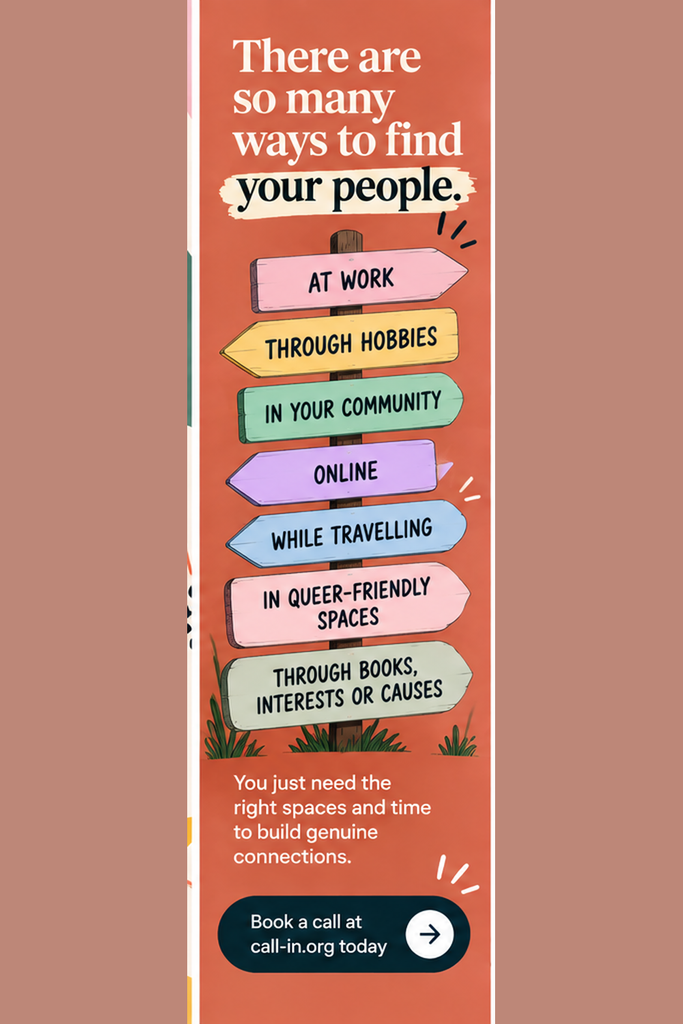
Where can you actually find people like you?
Start with places where your preferences are already partly filtered.
If queer-friendliness matters, LGBTQ+ community groups and affirming spaces remove some uncertainty.
If books matter, book clubs give you an immediate shared topic.
If travelling matters, travel communities, walking groups and language exchanges can make sense.
If open-minded conversation matters, discussion groups, volunteering, arts communities and multicultural social groups may attract people who enjoy interacting across differences.
Online communities can work too.
The crucial step is eventually moving from being in the same community to forming an individual relationship.
Thousands of people can share a Discord server, Facebook group, Reddit community or local meetup.
Friendship begins when two people start remembering each other.
Do not advertise yourself as though friendship is a job vacancy
There is nothing wrong with knowing what you value.
But friendship gets strange when every new person is being silently scored against a 17-point specification.
Queer-friendly.
Funny.
Reads.
Travels.
Open-minded.
Reciprocal.
Not judgmental.
Replies properly.
Emotionally intelligent.
Likes cats.
Available Thursday evenings.
At some point, we are recruiting senior management.
Use preferences as a compass rather than a checklist.
People will surprise you.
Someone who shares almost none of your hobbies may become your closest friend because of how you feel around them.
Pay attention to how your body feels after spending time with someone
Not in a mystical way.
In a practical one.
Did you spend the entire conversation performing?
Were you monitoring every word?
Did you leave feeling drained because they never stopped talking?
Did you feel respected?
Could you joke without worrying they would deliberately humiliate you?
Did you feel more like yourself as the conversation went on?
Compatibility is partly something you observe.
Not every person who seems impressive is somebody you will feel peaceful around.
Making friends also means tolerating small risks
Someone has to text first.
Someone has to suggest another meeting.
Someone has to admit, “I really like talking to you.”
Someone has to be the first person to move the relationship slightly closer.
That creates the possibility of rejection.
They may be busy.
They may not respond enthusiastically.
They may like you perfectly well but not want another close friendship.
That can sting.
But protecting yourself from every possible rejection also protects you from being known.
Some attempts will not become friendships
That is normal.
A promising conversation may remain a promising conversation.
Someone you like may be too busy.
A person may already have a full social life.
Another connection will quietly fade.
That does not mean you are bad at friendship.
You are looking for mutual fit, which means both people get a vote.
The goal is not to make everybody choose you.
It is to notice who keeps choosing the relationship too.
What if you are trying and still feel lonely?
Building adult friendship takes time.
Unfortunately, loneliness exists in the meantime.
You might be joining groups, sending messages and meeting new people while still having evenings when you think, “I just want someone I can actually talk to.”
That does not mean your efforts are failing.
New social connections often begin wider before they become deeper.
While that depth develops, it can help to have multiple forms of support.
Friends.
Family or chosen family.
Community.
A therapist or counselor where appropriate.
A coach for goal-specific support.
And sometimes a dedicated human listener.
Callin’s LGBTQ+ non-clinical mental health support provides a confidential place to talk about loneliness, relationships, identity, life changes and the ordinary emotional experiences that can feel heavier when you do not yet have the social circle you want.
Callin is not a friendship or dating service.
We cannot find your future best friend.
But we can give you somewhere human to talk while you are building the connections you want.
If you prefer writing, you can also use online emotional support chat with a real person.
You are not looking for everyone
This can make the search feel much less impossible.
You do not need every person at the meetup to like you.
You do not need 500 friends.
You do not need an enormous social calendar.
You need a few relationships in which you can relax, laugh, talk, disagree, disappear into a book recommendation, plan a trip, share something difficult and trust that effort moves in both directions.
Friendship quality has been repeatedly associated with wellbeing in adult friendship research, although the literature does not support one universal number of friends people need. PubMed Central (PMC)
So perhaps the goal is not to become more socially successful.
It is to become easier to find by the people who are compatible with the real you.
Say what you like.
Go where those people gather.
Ask someone for coffee.
Send the second message.
Travel when you can.
Keep your standards for mutuality without demanding perfection.
And give promising people enough time to stop being strangers.
That is often how “I wish I had real friends” quietly becomes:
“I found my people.”
FAQs
Why is it so hard to make real friends as an adult?
Adult life provides fewer automatic opportunities for repeated contact than school, university or childhood environments. Work schedules, relationships, caregiving, relocation and other responsibilities can also make friendship harder to maintain.
Research on adult friendship suggests that quality, interaction, support and maintenance effort all matter. That means meeting somebody is only the first stage. PubMed Central (PMC)
Where can queer adults make genuine friends?
LGBTQ+ community groups, queer book clubs, Pride organizations, volunteering, online communities, sports groups, arts spaces and other affirming social activities can create opportunities to meet people. You do not need every friend to be LGBTQ+, but some people value friendships where their identity and relationships are understood without repeated explanation.
Research on LGBTQ+ social support networks suggests that affirming friendships and peer connections can play meaningful roles in everyday support and wellbeing. PubMed
How do I find friends who give the same energy back?
Look for participation rather than perfect equality. Notice whether the person sometimes initiates, asks about you, follows through, remembers what matters to you, offers support and makes room for the friendship.
Research on friendship maintenance identifies openness, supportiveness, positivity and interaction as important relationship-maintaining behaviors. Guilford Journals
Can long-distance friendships be real friendships?
Yes. Distance changes how a friendship is maintained, but it does not automatically determine its depth.
Research on long-distance friendship has documented people maintaining meaningful relationships through communication and visits over time. The frequency required will differ considerably between friendships. PubMed
How do I turn someone I like into an actual friend?
Create repeated opportunities for contact and gradually increase the level of personal conversation. If you enjoy speaking with somebody in a group setting, suggest something small outside the group, such as coffee, a walk, a bookshop visit or attending another event together.
Then notice whether they participate too. Friendship develops through mutual interaction rather than one person repeatedly trying to create closeness.
Do real friends need to have the same beliefs as me?
No. Shared values can help, particularly around respect, identity and how people treat others, but close friends do not need identical religious, cultural or personal beliefs.
The more useful question is whether disagreement remains safe and respectful. Open-minded friendship allows both people to retain their own identities.
What if I keep trying to make friends but still feel lonely?
Friendship can take time to deepen, so loneliness can continue even while your social world is expanding. Keep developing relationships, but consider using several sources of connection rather than placing all emotional needs on one new friendship.
If you want a confidential human space to talk while you build your social circle, Callin offers non-clinical emotional support. Callin is not therapy, crisis support or a friendship-matching service, but it provides another place to be heard.
How this connects to the UNSDGs
This article aligns primarily with United Nations Sustainable Development Goal 3: Good Health and Well-Being because social connection, supportive relationships and access to emotional support can contribute to wellbeing. The relationship between friendship and wellbeing is supported by adult friendship research, although having more friends is not automatically better than having relationships that feel supportive and meaningful. PubMed Central (PMC)
It also connects meaningfully with SDG 10: Reduced Inequalities where LGBTQ+ people face barriers to affirming community or social support. This does not imply that Callin represents, is partnered with or is endorsed by the United Nations.
Sources and Further Reading
Pezirkianidis et al., Frontiers in Psychology, 2023. This systematic review examined 38 studies on adult friendship and wellbeing, including friendship quality, support, socializing and friendship maintenance. PubMed Central (PMC)
Read the adult friendship and wellbeing review
Oswald, Clark and Kelly, Journal of Social and Clinical Psychology. Their research identified positivity, supportiveness, openness and interaction as friendship-maintenance behaviors and examined how these operate within friendship pairs. Guilford Journals
Read the friendship maintenance study
Deci et al., Personality and Social Psychology Bulletin. Research examining mutual autonomy support in close friendships found associations with need satisfaction, relationship quality and psychological health. PubMed
Read the autonomy support and friendship study
Frost et al., American Journal of Orthopsychiatry. Research on diverse lesbian, gay and bisexual adults examined how friends, family, coworkers and other network members provide different kinds of social support. PubMed
Read the LGBTQ+ social support network study
Prasad et al., research on LGBT older adults and social networks. This study examined social network size, network composition, perceived support, loneliness and emotional wellbeing among LGBT adults aged 50 and older. PubMed
Read the LGBT social networks and wellbeing study
Finchum, Journal of Women & Aging. A qualitative study explored how women maintained long-distance friendships through ongoing communication and visits after relocation. PubMed
Read the long-distance friendship study
If you are trying to find your people but do not yet have the friendships where you can say everything out loud, Callin offers confidential human emotional support while you build the connections you want.

Leave a Reply