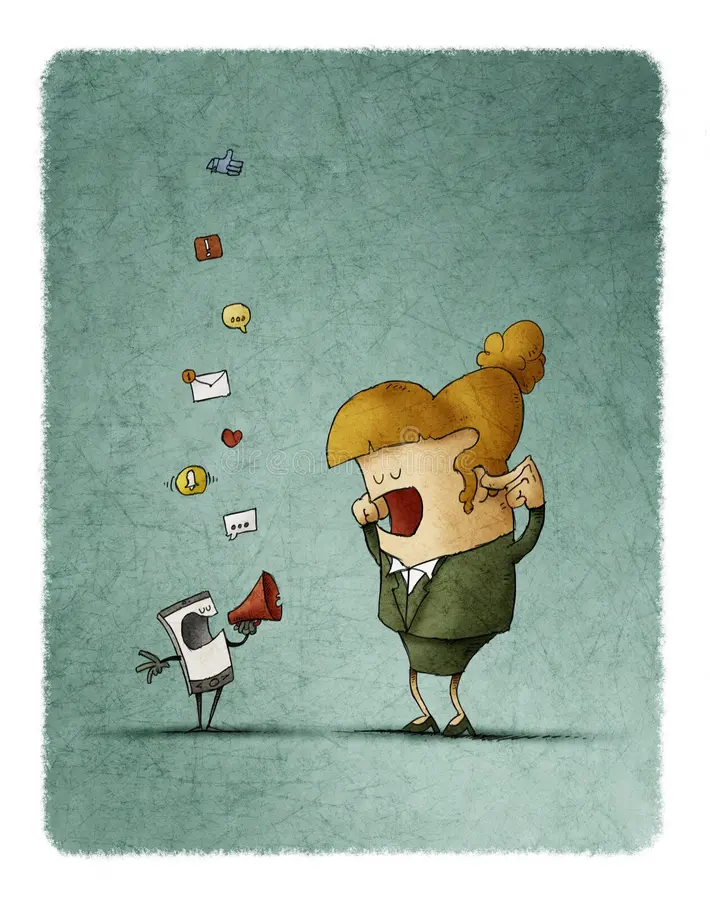
Notifications feel emotionally draining because they trigger brief stress responses, force constant micro-decisions, and interrupt focus through what psychologists call attention residue. Each ping asks your brain to evaluate urgency, relevance, and social obligation in a fraction of a second. Multiply that by dozens of daily interruptions, and even a calm day can leave you feeling unexplainably worn out.
Key Takeaways
- Notifications trigger a genuine, measurable stress response, not just an emotional overreaction.
- Every alert requires a hidden decision, and those tiny decisions accumulate into real cognitive fatigue.
- The unpredictability of notifications activates the same reward circuitry involved in habit-forming behaviors.
- Interruptions leave behind “attention residue,” making it harder to fully return to what you were doing.
- Recognizing this pattern is often the first step toward feeling less controlled by your phone.
Your Brain Was Not Built for This Much Input
Long before smartphones existed, the human brain evolved to notice sudden changes in its environment. A rustle in the grass or a flash of movement meant something worth paying attention to, sometimes urgently so. That same detection system, centered in the amygdala, is what fires when your phone buzzes on the table beside you.
The response is small each time. A brief rise in cortisol, a faint quickening of the heart, a flicker of heightened alertness. On its own, this costs almost nothing. But when that pattern repeats dozens or hundreds of times across a single day, the nervous system never gets a real chance to reset, leaving it stuck in a low-grade, ongoing state of alert.
There is rarely a real threat to resolve, so that activation has nowhere to go. It simply accumulates, often showing up later as tightness in the chest, shallow breathing, or a mind that feels permanently rushed.
This is worth naming clearly: feeling drained by your phone is not a personal failing. It is a biological system doing exactly what it was designed to do, just in an environment it was never designed for.
The Hidden Cost of Constant Micro-Decisions

Every notification carries an invisible question. Who is this from. What do they expect. Is this urgent or trivial. What happens if I do not respond right away. Your brain works through these questions almost instantly, but the effort is real and it is cumulative.
Psychologists describe this as decision fatigue, the gradual depletion of mental energy that comes from making too many choices in too short a time.
Willpower and analytical focus are finite resources, not unlimited ones. When dozens of small decisions arrive before you have even had breakfast, your cognitive reserves are already thinner by the time you need them for meaningful work or a genuine conversation.
This is one reason people often feel exhausted at the end of a day where nothing physically demanding happened. The fatigue was never about effort in the traditional sense. It was about volume, and about how much of your mental bandwidth got quietly spent on things that felt urgent but rarely mattered.
Why You Cannot Just Put the Phone Down
If notifications are so draining, an obvious question follows: why is it so hard to disconnect from them. Part of the answer lies in variable reward schedules, the same psychological mechanism that makes slot machines compelling.
When your screen lights up, your brain has no way of knowing in advance whether the message matters deeply or means nothing at all. That uncertainty creates anticipation, and anticipation triggers a release of dopamine, the neurotransmitter tied to motivation and pursuit rather than pleasure itself. You check the phone to resolve that tension.
Often, what you find is unremarkable, which creates a quiet letdown before the cycle begins again.
Here is a detail worth sitting with: the exhaustion is not caused by disappointment alone. It is caused by the repetition of hope and letdown, dozens of times a day, in cycles too small and too fast to consciously register. Your nervous system experiences this as instability, even when nothing dramatic has happened.
The Overlooked Toll of Constant Interruption
Human attention was never designed for the kind of rapid switching that digital life now demands. What people call multitasking is more accurately described as context-switching, the abrupt movement of focus between unrelated tasks.
When a notification pulls you out of something you were absorbed in, whether that is writing, cooking, or a conversation with someone you love, a fragment of your attention stays behind.
Researchers call this attention residue. Even a two-second glance at a screen can leave your mind partially anchored to that interruption, making it harder to fully return to what mattered a moment earlier.
Over time, this creates a state of continuous partial attention. You are technically present everywhere, but fully present nowhere. It is one reason conversations can feel less satisfying lately, and why brief digital exchanges rarely leave people feeling as connected as an actual, uninterrupted conversation does.
The Unspoken Pressure to Always Be Reachable
Perhaps the least discussed source of notification fatigue is social, not neurological. A generation ago, an unanswered letter or a missed phone call carried no urgency. Today, a smartphone implies constant availability, and a delayed reply can feel, however unfairly, like a small act of rejection.
This unspoken expectation transforms a phone from a tool into an open door that anyone can walk through at any time. Many people respond by quietly filtering their own thoughts, masking exhaustion, or withdrawing from digital spaces altogether, which can deepen isolation rather than relieve it.
This dynamic shows up often in workplace culture, where the expectation of instant responsiveness has quietly become normalized, and in the lives of remote workers who no longer have clear physical boundaries between being on and being off.
What Actually Tends to Help
There is no need to abandon technology to feel better. Most people find relief through smaller, more intentional adjustments rather than dramatic ones.
Auditing which apps genuinely deserve real-time access to your attention is often the most effective single change. Reserving notifications for actual people, while silencing automated updates, social platforms, and non-urgent alerts, restores a sense of choice.
Batching communication into two or three set windows a day, rather than responding as messages trickle in, protects longer stretches of focus and reduces context-switching. Creating small screen-free zones, such as a bedroom or the first hour of the morning, gives the nervous system a predictable place to settle.
None of these changes require willpower in the way people often assume. They work because they reduce the number of decisions your brain has to make, not because they demand more discipline from an already tired mind.
When You Need More Than a Settings Change
Sometimes the exhaustion runs deeper than notification overload, and reorganizing your phone settings only addresses part of the picture. If you are constantly feeling stretched thin, overstimulated, or quietly lonely despite being reachable to everyone, it may help to talk it through with someone who is not inside your daily life.
This is where a space like Callin can be useful. Callin connects people with trained peer listeners for confidential, judgment-free conversations about everyday stress, overwhelm, and burnout.
It is not a replacement for therapy, but for many people it fills a real gap, offering a place to think out loud without worrying about burdening a partner, friend, or coworker who may be just as overstimulated as you are.
Sometimes simply having somewhere to process the noise of the day, without it becoming one more obligation for someone else, is enough to feel a little more like yourself again.
A Reasonable Response, Not a Personal Flaw
The tiredness that follows a crowded lock screen is not a sign of weakness or an inability to keep up with modern life. It is a rational response from a nervous system asked to process far more input than it evolved to handle. Recognizing that distinction changes everything.
Once you understand that this fatigue has a clear cause, it becomes much easier to address it with curiosity instead of self-criticism, and to build a relationship with your devices that leaves room for actual rest.

Leave a Reply