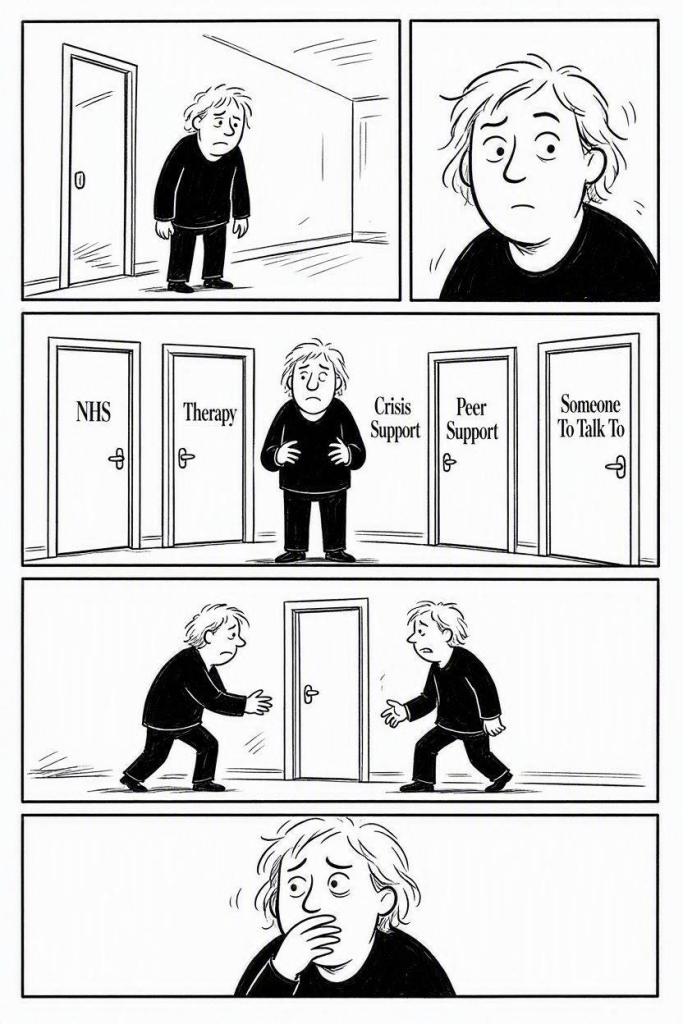
If you are looking for the best alternative to the NHS for your mental health, the honest answer is that there is no single replacement, only a range of options suited to different needs. Long waiting lists have pushed people toward private therapy, charity helplines, and non-clinical peer support, and the right choice depends on whether you need clinical treatment, crisis help, or simply someone to talk to.
Key Takeaways
- NHS mental health waiting times vary enormously. NHS Talking Therapies aims to see most people within 6 to 18 weeks, while community mental health teams and specialist care can take months, and in some documented cases, over a year.
- There is no single “best” alternative to the NHS. The right option depends on whether you are in crisis, need clinical treatment for a diagnosed condition, or need support with everyday stress that has not reached that threshold.
- Crisis support, ongoing therapy, and non-clinical peer support are three different things, and confusing them can send you to the wrong door at the wrong time.
- Charities, warmlines, and NHS self-referral services often sit in the gap between a GP appointment and private care, and many of them are free.
- Non-clinical, confidential support can sit alongside NHS care for everyday stress and overwhelm, but it is not built to treat a mental illness or replace a crisis service.
Why So Many People Are Searching for NHS Mental Health Alternatives
Anyone typing this question into Google is usually not doing it out of idle curiosity. They are doing it because a GP appointment came and went, a referral was made, and then nothing happened for weeks.
NHS England’s own quarterly figures show the median wait between a referral and a second contact with community mental health services was 37 days as of the quarter ending May 2026, with the slowest one in ten patients waiting up to 169 days, according to research published by the House of Commons Library.
Those numbers had actually improved on the previous year, when the same measures stood at 44 days and 221 days, but improvement is not the same as short.
For people with more complex or severe needs, the picture is harder. Analysis of NHS data by the charity Rethink Mental Illness found that in December 2024, over sixteen thousand people had been waiting more than eighteen months for mental health treatment, compared with roughly two thousand people facing an equivalent wait for physical health treatment such as orthopaedics or dermatology.
A later Rethink report suggested people are now up to twelve times more likely to face that extreme wait for mental health care than for physical health care.
Demand has grown alongside this: the British Medical Association estimates that referrals into NHS mental health services reached around 5.2 million in 2024, a rise of roughly 38 percent since 2019, while a 2025 Care Quality Commission review found close to one in ten mental health trust posts sat unfilled.
None of this means the NHS has stopped working. It means the system is stretched, and it explains why so many people start looking elsewhere while they wait, or instead of waiting at all.
What NHS Mental Health Support Actually Offers
Before looking outward, it helps to know what doors already exist inside the NHS, because some of them are underused simply because people do not know they are there.
NHS Talking Therapies (previously called IAPT) treats anxiety, depression, OCD, and related conditions, and you can refer yourself online without seeing a GP first.
NHS England’s access standard states that 75 percent of patients should get a first appointment within six weeks of referral, and 95 percent within eighteen weeks, which is considerably faster than the community mental health pathway described above.
Community mental health teams handle more complex or long-term conditions, usually through a GP referral, and this is the route where the longer waits tend to appear.
NHS 111, option 2 now offers 24-hour crisis mental health support in most areas of England. Calling it connects you to a trained mental health advisor who can offer immediate guidance, safety planning, or a transfer to your local crisis team, and it exists specifically for situations that feel urgent but are not a life-threatening emergency.
999 or A&E remain the right call if you or someone else is in immediate danger.
Knowing which of these already applies to your situation is often the fastest way to get help, before adding anything else into the mix.
The Landscape of Support Outside the NHS
Private Therapy and Counselling
Private therapy removes the wait, at a cost that varies widely by location and modality. It suits people who want structured, clinical treatment for a diagnosed or diagnosable condition and are able to pay privately or through health insurance. It is not a like-for-like swap for NHS Talking Therapies so much as a faster lane into the same kind of treatment.
Charity Helplines and Warmlines
Organizations such as Samaritans, Shout, Mind, and CALM sit entirely outside the NHS and are free to use.
A warmline is a related but distinct idea worth understanding on its own terms: unlike a crisis line, it is designed for support before things reach a breaking point, giving people somewhere to call when they are struggling but not in danger. If that distinction is new to you, it is worth reading about what a warmline actually is and how it differs from both crisis support and therapy.
Affordable, Non-Therapy Support
A large and growing number of people are not looking for treatment at all. They are dealing with ordinary but heavy things, a stressful job, a breakup, a move, a diagnosis they are still processing, and they want to talk it through with someone who is not a friend or family member they might worry about burdening.
If cost or clinical framing has been the barrier, it is worth looking at affordable mental health support that is not therapy, since a formal diagnosis or a long course of treatment is not always what the moment calls for.
Digital Tools and Self-Guided Resources
Apps, structured self-help programs, and psychoeducational content can help people build coping skills between or before other kinds of support. They tend to work best as a complement to human contact rather than a full replacement for it, since most people process difficult feelings better out loud than on a screen alone.
Matching the Option to the Situation, Not Just the Search
This is where most searches for “alternatives to the NHS” go slightly wrong, because they treat mental health support as one category with one best replacement. It is not. A more useful question is not “what should I use instead of the NHS,” but “what kind of help does this specific moment need.”
If you are thinking about ending your life, feel unsafe, or are worried about someone who does, please contact Samaritans free on 116 123, available 24 hours a day, or text SHOUT to 85258. Neither service requires you to be in a diagnosed crisis to reach out. If there is immediate danger to life, call 999 or go to A&E.
NHS 111, option 2 is also available around the clock for urgent, non-life-threatening mental health support. These services exist specifically for this purpose, and no non-clinical alternative should be used as a substitute for them.
If you have symptoms of a diagnosable condition, such as persistent low mood, panic, obsessive thoughts, or a mental illness that is affecting your daily functioning, the right path is clinical treatment, whether that is NHS Talking Therapies, a community mental health team referral through your GP, or private therapy if you can access and afford it.
If neither of those describes where you are, and what you actually need is a space to think out loud about stress, a hard week, a relationship, or a feeling you cannot quite name, that is a real and valid need too, and it does not require a diagnosis to be worth addressing.
When You Need Someone to Talk To, Not a Treatment Plan
Here is something worth sitting with: a lot of people searching for NHS alternatives are not stuck between two treatment options. They are stuck between “this doesn’t feel bad enough to bother anyone with” and “I don’t want to keep offloading onto my partner or my one friend who always picks up.”
That gap, between clinically significant and completely fine, is enormous, and very little in the traditional system is built for it. NHS services are calibrated, reasonably, around clinical severity, which means everyday emotional weight, the kind that builds from overwork, loneliness, or a string of ordinary hard days, often has nowhere obvious to go.
If any of that sounds familiar, it can help to first get clear on how to tell whether you need therapy or just emotional support, since naming the actual need tends to make the next step obvious.
This is also where self-diagnosis culture complicates things in a way worth naming honestly. Searching symptoms and landing on a label can feel clarifying, but it can also make an ordinary stress response feel like it needs a clinical answer before you are allowed to ask for help.
You do not need a diagnosis to justify reaching out, and it is worth reading more on how to ask for support without a mental health diagnosis if that has been holding you back.
This is the space Callin was built for. It is a non-clinical platform where you can speak with a trained peer listener in a confidential setting, for the kind of everyday stress and preventive emotional care that does not need a clinical pathway but still deserves somewhere to go.
It sits alongside NHS care and therapy, not instead of them, and it is not designed for crisis situations or the treatment of a diagnosed mental illness.
Building a Wider Support System
No single service, NHS or otherwise, is meant to carry everything. A sustainable approach usually mixes a few things: the right NHS or clinical pathway if you need treatment, a crisis resource saved somewhere you will actually find it, a practical approach to everyday stress management, and somewhere confidential to talk when you need someone to talk to right now and the people closest to you are not the right audience for it.
Layering these, rather than searching for one perfect substitute, tends to hold up better over time than any single fix.
You Are Not Choosing Sides
None of this is about replacing the NHS. It is about recognizing that a healthcare system under strain and a person’s everyday need for connection are two different problems that call for two different kinds of answers.
Waiting for treatment does not mean waiting to be heard, and there is nothing wrong with reaching for support in the meantime, or alongside it, for as long as you need it.
Frequently Asked Questions
Is it possible to get mental health support without going through my GP?
Yes. NHS Talking Therapies accepts self-referrals online for anxiety, depression, and related conditions, so a GP visit is not always the first step. Charities, helplines, warmlines, and non-clinical peer support are also all accessible without a referral of any kind.
How long will I actually wait for NHS mental health treatment?
It depends heavily on which service you are referred to. NHS Talking Therapies aims for a first appointment within six to eighteen weeks for most patients, while community mental health team waits are longer and more variable, with recent national data showing a median wait of around five weeks and a small proportion of patients waiting considerably longer.
What is the difference between NHS Talking Therapies and a community mental health team?
NHS Talking Therapies focuses on anxiety, depression, and similar conditions, is self-referral, and has published speed targets. Community mental health teams handle more complex, severe, or long-term conditions, generally require a GP referral, and tend to involve longer waits and more intensive ongoing care.
What should I do if I am in a mental health crisis right now?
Call Samaritans free on 116 123, available any time, day or night, or text SHOUT to 85258. NHS 111, option 2 offers 24-hour urgent mental health support in most areas. If there is immediate danger to life, call 999 or go to your nearest A&E.
Is non-clinical emotional support the same thing as therapy?
No. Therapy is a clinical treatment, delivered by a qualified professional, usually aimed at a diagnosed or diagnosable condition. Non-clinical emotional support, such as active listening from a trained peer, is intended for everyday stress, overwhelm, and the ordinary weight of life, and it is not a substitute for treating a mental illness.
Can I use private therapy and NHS care at the same time?
Yes, many people do. There is no rule against being on an NHS waiting list while also seeing a private therapist, and some people use private sessions specifically to bridge the gap while they wait for NHS treatment to begin.
What is a warmline and how is it different from a crisis line?
A crisis line, like Samaritans or Shout, is built for urgent situations, including thoughts of suicide or self-harm. A warmline is a non-crisis support line, meant for reaching out before things reach that point, offering a listening ear for stress, loneliness, or a difficult day.