Emotional consent is the practice of checking whether someone has the capacity to receive what you need to share, and being honest when you do not have the capacity to receive theirs. It sounds simple, yet most of us were never taught it. Understanding this one shift can change how safe, honest, and sustainable your closest relationships feel.
Key Takeaways
- Emotional consent means checking if someone has room for what you need to share, and being honest about your own room in return.
- Emotional energy runs out. It is not a personality trait that some people simply have more of than others.
- Constant, unconsented availability tends to curdle into resentment rather than closeness.
- Saying “I don’t have the capacity right now” is not rejection. It is a form of respect that protects the relationship long term.
- Practicing consent in both directions, giving it and asking for it, tends to build deeper trust than automatic, depleted availability.
The Myth That Good People Are Always Available
Many of us absorbed an unspoken rule early on: a good friend answers at 2 a.m. A good partner drops everything. A good colleague never says “not right now.”
Social media reinforces this constantly, with captions insisting that real ones show up no matter what, no exceptions, no excuses. It sounds noble. It also sets a standard nobody can actually meet.
The truth is quieter and less dramatic. Being a caring person does not require being an inexhaustible one. Compassion does not flow the same regardless of how much has already been drawn from it that day.
When emotional availability gets treated as a moral test rather than a limited resource, people end up failing the ones they love, not from a lack of care, but because they eventually run out of the steadiness that real care requires.
This is where emotional consent earns its place. It does not lower the bar for how much we show up for each other. It changes how we show up, replacing guilt-driven autopilot with honesty about what we actually have to give right now.

What Emotional Consent Actually Means
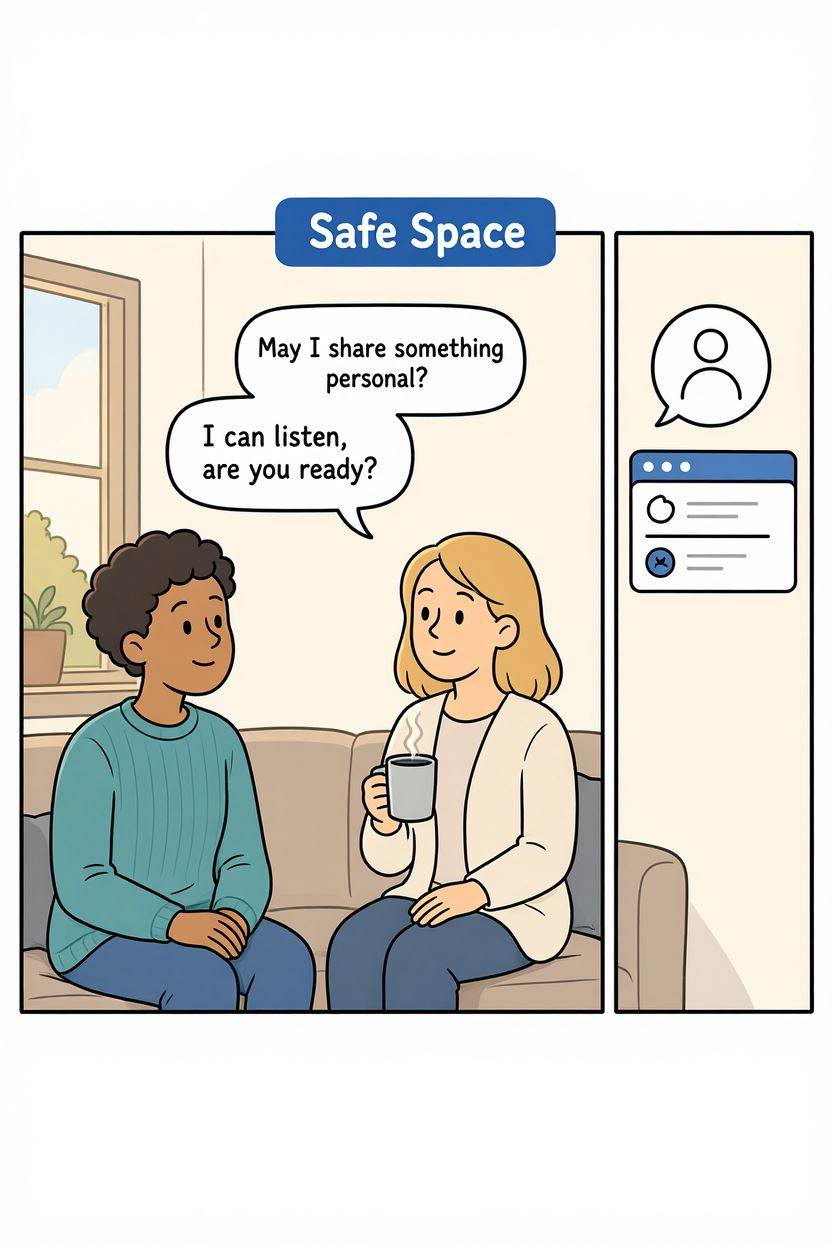
Consent is a familiar idea in physical contexts: nothing happens without a clear, ongoing yes. Emotional consent applies the same logic to feelings. Before unloading something heavy, healthy communication starts with a check-in instead of an assumption.
It can sound as simple as this: “Do you have the emotional space for something that’s been weighing on me?” That single sentence does two things at once. It respects wherever the other person actually is that day, and it signals that what you are about to share deserves real attention rather than distracted, half-present listening.
The other half of emotional consent is answering honestly when someone asks it of you. “I really want to be here for you, but I don’t have the capacity today. Can we talk tomorrow?” is not a rejection. It is information. It tells the other person that when you do show up, you will actually be there, instead of performing presence while quietly resenting the conversation.
Notice what neither sentence does. Neither one closes the door permanently. Both keep the relationship open while staying honest about the moment.
Why Emotional Energy Runs Out
This is not just a figure of speech. Sociologist Arlie Hochschild coined the term emotional labor in 1983 to describe the effort involved in managing feelings to produce a particular emotional state in someone else, originally studying flight attendants trained to stay warm and calm no matter how a passenger behaved.
The concept has since expanded well beyond paid work, and for good reason. Comforting a friend through a crisis, staying steady during a partner’s bad day, and absorbing a coworker’s stress all draw on the same internal resource.
Healthcare researchers have documented something closely related called compassion fatigue, a state of emotional and physical depletion that develops in people who repeatedly absorb the distress of those they are caring for.
First identified among nurses, it has since been studied in family caregivers, therapists, and social workers, and it tends to build gradually through chronic exposure to someone else’s pain with too little chance to recover in between.
Psychologist Christina Maslach’s influential model of burnout names emotional exhaustion as one of its three core dimensions, alongside cynicism and a reduced sense of accomplishment.
None of this research was designed with friendships or romantic relationships in mind, but the underlying mechanism does not check your relationship status before it applies. Emotional bandwidth is a finite resource on a hospital ward, and it is a finite resource in a group chat.
The Hidden Cost of Saying Yes Without Consent
Every time someone says yes to a heavy conversation while running on empty, something quiet happens beneath the surface. The listening still happens.
The right words might even come out. But a small deposit gets added to what could be called a silent resentment ledger, an unspoken debt that accumulates each time support is given from depletion rather than choice.
Unlike a financial debt, this one rarely announces itself with a bill. It shows up instead as irritability toward someone genuinely loved, a flatness in conversations that used to feel easy, or a reaction that feels disproportionate to whatever small thing triggered it. Research on assertiveness helps explain why.
A 2018 review in the journal Clinical Psychology: Science and Practice, by Speed, Goldstein, and Goldfried, described assertiveness training, including the ability to decline requests without guilt, as a well-supported but underused approach to reducing stress and anxiety. Other studies covered by Psychology Today found that structured assertiveness training measurably lowered stress and depression scores in as little as ten weeks.
Saying yes when the honest answer is no does not protect a relationship. It just postpones the moment the relationship has to deal with the truth.
Emotional Consent Is Honesty, Not Rejection
It is worth naming why declining to talk right now feels so uncomfortable, because it usually does.
Psychologist John Gottman’s decades of research on couples found that partners who stayed together over time responded positively, or “turned toward,” each other’s small bids for connection about 86 percent of the time, compared with only 33 percent among couples who later separated.
It is tempting to read that statistic as proof that the answer should always be yes. The more useful reading is different.
Turning toward someone does not mean being available on command. It means being genuinely present when you do respond. A distracted, resentful yes is not actually turning toward anyone.
It is a performance of connection that quietly erodes the trust those small bids are supposed to build. Naming emotional consent protects the ability to turn toward someone for real, later, instead of faking it now.
There is also a simple, practical truth hiding here. Most conversations that feel urgent in the moment are not true emergencies. A short pause, “can we talk tonight instead,” rarely damages a relationship.
More often, it gives the person who needs to talk a little time to organize their thoughts, which tends to make the eventual conversation better, not worse.
How to Practice Emotional Consent in Real Life
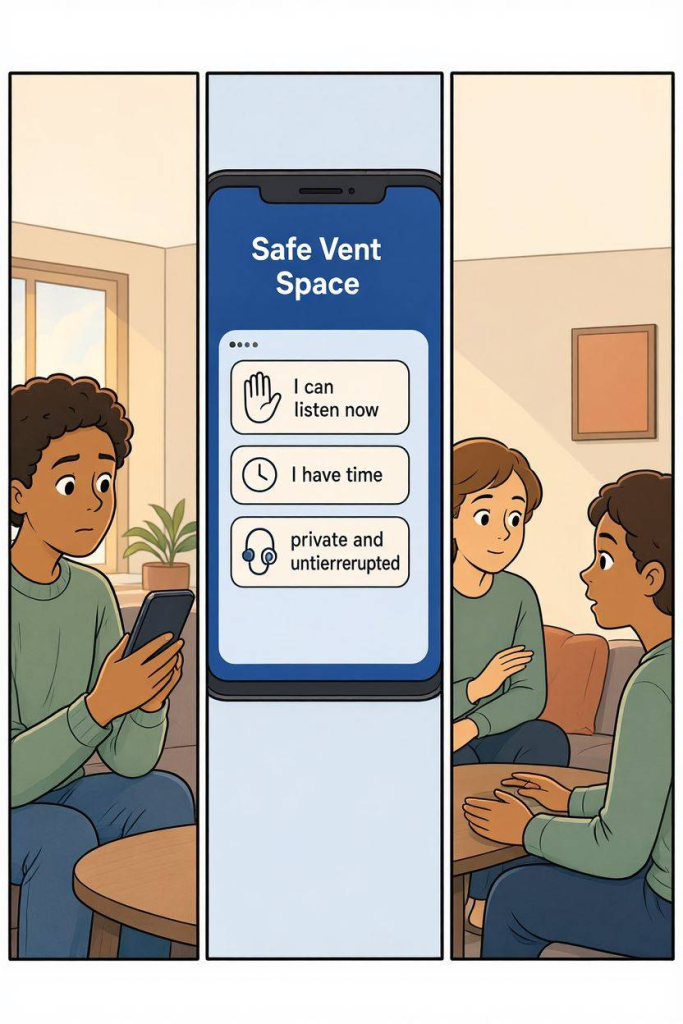
Emotional consent works best as a two-way habit rather than a one-time script. Before bringing up something heavy, a direct check-in helps: “I have something on my mind, is now an okay time, or would later work better?” That small pause respects the other person’s day without demanding they justify their answer.
When capacity is genuinely low, specificity works better than a vague deflection. “I want to hear this properly, and I can’t give it my full attention right now” says more than a distracted “I’m fine, go ahead” ever could. Offering a concrete alternative, tonight, tomorrow morning, this weekend, turns a boundary into a plan rather than an open-ended no.
This applies well beyond romantic relationships. Friendships, family, and even workplaces run on the same emotional currency.
Many people who feel especially drained by group chats and constant digital check-ins are experiencing exactly this: availability without consent, expected around the clock. The same principle that protects one friendship can protect an entire support system, once it becomes a shared norm rather than a special request.
It also helps to tell emotional consent apart from simple avoidance.
Consent means naming a real capacity limit and offering another time.
Avoidance means never being available, with no plan to reconnect.
One protects a relationship. The other slowly starves it. Learning to set boundaries without feeling like the bad guy is often the missing skill between the two.
When You Are the One Who Never Asks
There is a quieter pattern worth naming. Some people are excellent at checking whether others have capacity, and terrible at ever admitting when they don’t have their own.
They become the friend everyone calls at midnight, the one who always says “I’m okay, tell me about you,” the one who eventually stops being able to talk about their own problems because absorbing everyone else’s has quietly become the entire relationship.
This is its own kind of imbalance, and it is not automatically virtuous. Constantly giving consent while never asking anyone to check in on your own capacity is often less about strength and more about discomfort with being on the receiving end of care.
Learning how to stop being the strong one for everyone usually starts with the same small sentence used earlier in this piece, just aimed inward: admitting, out loud, that there isn’t room today either.
When There Is No One Left to Ask
Sometimes the people closest to us are just as depleted as we are, and asking them for consent only adds to their load. Other times, the issue is not availability but comfort.
Some things feel too heavy, too repetitive, or too tangled to bring to a partner, a parent, or a coworker, even when they would probably say yes. Wanting someone to talk to without burdening the people already in your life is one of the most common, and least discussed, reasons people quietly stop reaching out at all.
This is often where a neutral, non-clinical space earns its place, not as a replacement for the people already in your life, but as a pressure valve alongside them.
Callin was built around exactly this gap, offering a confidential space to talk something through with a trained peer listener who has the capacity to be fully present, without the worry of draining someone you love. It does not replace therapy or close friendship. It simply gives your closest relationships room to breathe.
Emotional consent will not make every hard conversation easy. It will make them honest. The people who matter most are rarely looking for someone who is available every single second.
They are looking for someone who shows up fully, tells the truth about their limits, and comes back when they say they will. That kind of relationship holds up. The other kind, built on unlimited access and quiet resentment, usually does not.
Frequently Asked Questions
What is emotional consent?
Emotional consent is the practice of checking whether someone has the mental and emotional capacity to receive something significant before sharing it, and being honest about your own capacity when someone asks the same of you. It borrows the logic of physical consent, an ongoing, honest yes, and applies it to feelings, disclosures, and heavy conversations.
Is it selfish to say I don’t have the emotional capacity to talk right now?
No. Declining a conversation because you are genuinely depleted protects the relationship rather than harming it. A distracted, resentful yes tends to do more damage over time than an honest “not right now, but soon.”
How do I ask someone for emotional consent without sounding cold?
Keep it warm and specific. Something like “I want to hear about this properly, is now a good time, or should we plan for later” signals care while still checking capacity. Offering a concrete alternative time keeps the door open rather than closing it.
What is the difference between emotional consent and just avoiding hard conversations?
Emotional consent involves naming a real limit and offering another time to talk. Avoidance involves never being available and never circling back. One is honest and temporary. The other quietly ends the relationship without ever saying so.
How can I tell if my emotional energy is running low?
Common signs include irritability with people you normally enjoy, a sense of dread before conversations that used to feel easy, and reactions that feel bigger than the moment calls for. These line up with what researchers describe as compassion fatigue and emotional exhaustion, both signs that capacity needs to rebuild before more can be given.
Does emotional consent apply at work, not just in personal relationships?
Yes. Coworkers, managers, and even close work friendships can benefit from the same honesty about capacity. Naming that you can’t fully engage with a heavy conversation during a deadline, while offering a specific later time, protects both the relationship and the quality of the conversation itself.
What if someone gets upset when I ask for emotional space?
That reaction is understandable, and it doesn’t mean the request was wrong. Most of that upset fades once the other person sees that the conversation still happens, just later and with full attention. Consistently following through on the alternative time offered is what builds trust in the boundary itself.

Leave a Reply