You do not need to be out, certain about your identity or in crisis to deserve a confidential place to talk. If you need LGBTQ+ emotional support online, Callin offers private, non-clinical conversations with a trained active listener who will not judge your sexuality, gender, relationship or choices. Your first session is free, and you can begin with whatever feels safest to say.
Perhaps your girlfriend ended the relationship and nobody understands the loss. Perhaps you feel guilty about not coming out, even though disclosure does not feel safe. You might be questioning something you have never said aloud, struggling with family or faith, or simply having an awful week unrelated to being LGBTQ+.
You are welcome to talk about all of it. You do not have to turn your identity into an explanation before you can receive care.
Key takeaways
- Callin is LGBTQ+ inclusive and supports adults across sexual orientations, gender identities and relationship experiences.
- You can book your free first session now. It can last 20 minutes or up to one hour, depending on what you need, with no commitment to continue.
- You can talk about breakups, identity, coming out, family, dating, loneliness, discrimination or ordinary life without being judged or pushed to disclose more than you want.
- Callin provides non-clinical emotional support, not therapy, diagnosis, medical treatment or crisis care.
- Your listener listens before offering suggestions. Advice is given only if you ask for it.
Where can I find LGBTQ+ emotional support online?
LGBTQ+ emotional support is available through trained listening services, LGBTQ+ helplines, peer groups, community organisations, therapists and mental health services. The right option depends on whether you need somewhere to talk, community with shared experience, professional treatment, practical advocacy or urgent help.
Callin is an online, non-clinical emotional support service that connects people with the same trained active listener over time. It gives adults a private place to speak about LGBTQ+ life and everything beyond it, without assuming that being LGBTQ+ is a problem to solve.
You may not know what kind of help you need yet. That is allowed. Sometimes the first useful step is a conversation in which nobody rushes to name, fix or organise your experience for you.
What can I talk about with an LGBTQ+ friendly listener?
You can talk about whatever is weighing on you. That may include:
- questioning your sexuality or gender
- wondering whether, when or how to come out
- feeling guilty because you are not out
- a lesbian, gay, bisexual or queer relationship breakup
- dating, intimacy or trust
- family rejection, tension or uncomfortable questions
- faith, culture and identity pulling in different directions
- being misgendered or having your relationship minimised
- loneliness before or after coming out
- finding friendship, community or chosen family
- bisexual, pansexual, asexual or aromantic invisibility
- deciding what to share and with whom
- stress, burnout, grief or a difficult day unrelated to identity
You do not have to make the conversation educational. You should not spend the session proving that your relationship was real, defending your pronouns or explaining why a comment hurt. An inclusive listener starts from respect.
I’m a lesbian and my girlfriend broke up with me. Who can I talk to?
You can talk to an LGBTQ+ affirming friend, trained listener, queer peer group or therapist if you want structured help. A lesbian breakup is a real loss. You need not minimise it because someone else does not understand the relationship.
You may grieve the person, shared routines, mutual friends, future plans and who you were inside the relationship. If your social circles overlap, the breakup may disturb your community and sense of belonging too.
At Callin, you can talk without being hurried towards “moving on”. Your listener can stay with the anger, longing, confusion or relief and help you hear your own thoughts more clearly. If you want advice, you can ask. If you only need to vent, that is enough.
I feel bad about not coming out. Who can I talk to?
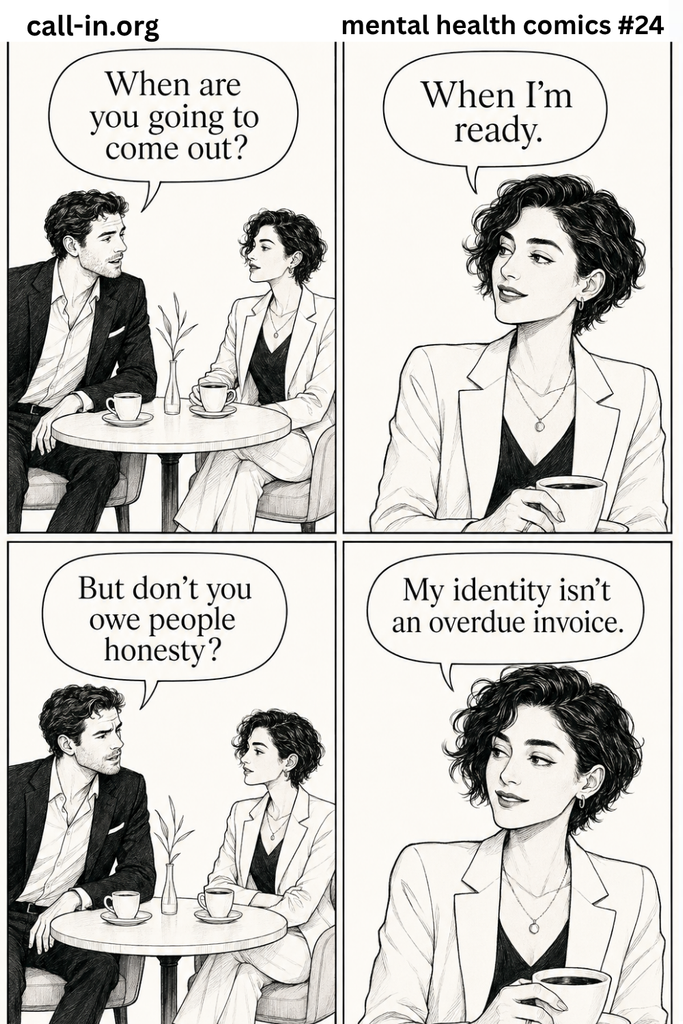
You can talk confidentially with an LGBTQ+ support line, affirming therapist, trained listener or trusted person. Not coming out does not make you dishonest, cowardly or less LGBTQ+. Safety, housing, money, family, culture, faith and readiness all matter.
Coming out is not a debt. You decide who knows, when they know and what language you use. You may feel conflicted. Privacy can protect you and still feel lonely.
Callin gives you room to explore without being pushed towards a decision. The listener will not tell you to come out or remain private. You stay in control. You may also find it helpful to read why coming out can feel emotionally exhausting.
What if I am questioning my sexuality or gender?
Questioning is enough reason to want a thoughtful conversation. You do not need to choose a label before you can talk, and you do not have to choose one at all.
A listener can help you notice what feels true without treating uncertainty as a problem. They should not decide your identity, predict where questioning will lead or pressure you to change. The call does not need to produce a conclusion. It gives you somewhere to be honest about what you know, what you do not and what you fear might change.
Do I need an LGBTQ+ therapist, or someone to listen?
Choose an LGBTQ+ affirming therapist or counsellor when you want clinical assessment, psychological treatment, structured therapeutic work or support for symptoms that are significantly affecting daily life. Choose a non-clinical listening service when you mainly need human presence, emotional relief and a confidential place to think aloud.
Callin is not an LGBTQ+ therapy provider. It does not diagnose, provide psychotherapy, prescribe medication or replace a professional. It can support you while you decide what you need, wait for therapy, use professional care or choose not to pursue therapy.
In England, adults can self-refer to NHS Talking Therapies for anxiety and depression. The NHS also recommends checking that private therapists are registered with an appropriately accredited professional body (NHS talking therapies). LGBT Foundation’s talking therapies programme is another route to affirming clinical care.
For a fuller comparison, read about non-clinical emotional support versus therapy.
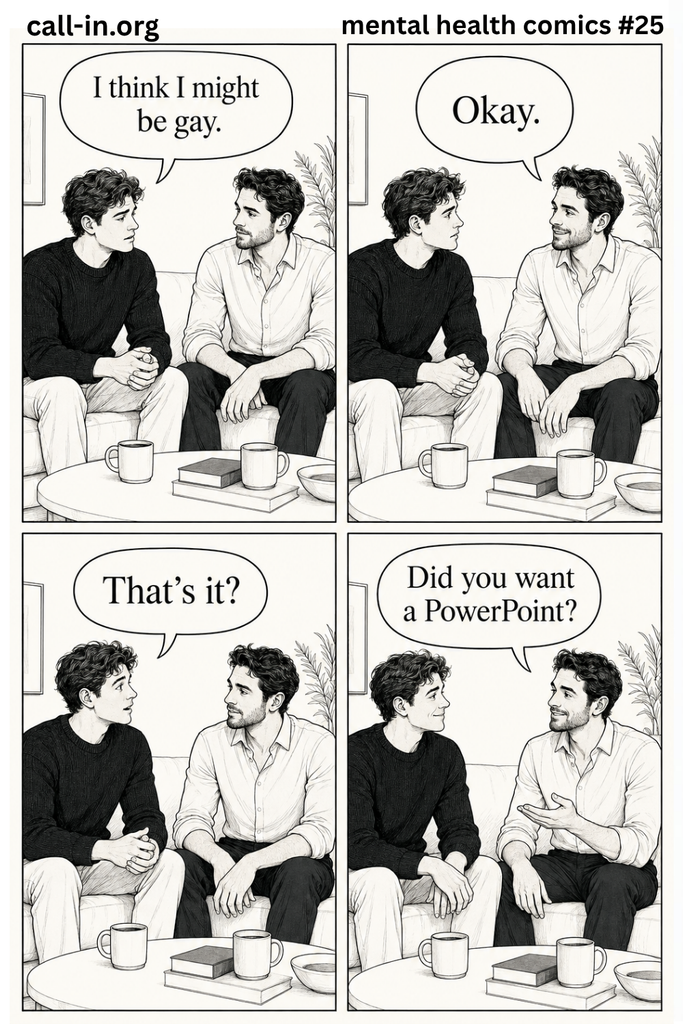
What LGBTQ+ inclusive support means at Callin
LGBTQ+ inclusive support means your identity is respected without becoming the only thing the listener can see about you.
At Callin:
- your sexuality, gender and relationships are not treated as problems to correct
- your name and pronouns are respected
- same-sex and queer relationships are taken as seriously as any other relationship
- you do not have to be out publicly or certain about a label
- the listener does not assume monogamy, marriage, gender roles or what family should look like
- you can talk about queerness, or talk about something completely unrelated
- advice and suggestions are offered only when you request them
Experimental research found that people receiving active-listening responses felt more understood than those given advice or simple acknowledgements (Weger and colleagues, 2014).
Inclusive listening does not require claiming perfect knowledge of every identity. It means listening without contempt, conversion, disbelief or pressure. If you need a non-judgmental person to talk to online, that principle sits at the centre of Callin’s approach.
Will I speak with the same listener?
Where possible, yes. Callin normally connects you with the same dedicated listener over time. Continuity means you do not have to explain your identity, relationship history, family dynamics or current situation from the beginning in every session.
Trust may take time, especially if you have previously been dismissed, outed, stereotyped or treated as an argument rather than a person. A continuing listener can learn what matters to you, remember the context and let the conversation deepen at your pace.
Learn more about how online emotional-support peer listeners can provide consistent human connection.
Is Callin confidential if I am not out?
Callin sessions are private and handled confidentially, subject to limited legal and safety exceptions. You choose what you disclose. You do not have to share your whole story, settle on a label or reveal something before you are ready.
Your listener should never share your story socially or use it as content. However, confidentiality cannot be absolute when there is a serious safeguarding concern or a legal duty to act. These boundaries are explained so that you can make an informed decision about what feels safe to discuss.
What happens in the free first Callin session?
Your first session is completely free and carries no commitment. It can last 20 minutes or up to one hour, depending on what you need in that moment.
You do not need to prepare a polished explanation, prove that your problem is serious or disclose your identity immediately. You can begin with, “My girlfriend left and I do not know who to talk to,” “I think I might be queer,” “I cannot come out safely,” or simply, “I need someone to listen.”
The first conversation lets you experience the service and decide whether it feels right. If Callin is a good fit, client onboarding follows. If it is not, you can be signposted towards more suitable support. This is support that supports you, not pressure to commit.
Where else can LGBTQ+ adults find support?
Different needs deserve different routes. A group may offer belonging, a helpline can provide identity-specific listening, and a GP, counsellor or therapist can provide clinical care. If cost is a concern, explore affordable support that is not therapy and low-cost alternatives to therapy.
UK readers can also contact Switchboard, the national LGBTQIA+ support line, whose calls, messages and emails are answered by volunteers from the LGBTQIA+ community.
If you need urgent help
Callin is not a crisis service and is not continuously monitored. If there is immediate danger, you may harm someone, or you cannot stay safe, contact local emergency services now.
In the UK:
- Call 999 or go to A&E if there is immediate danger.
- Call Samaritans on 116 123 free, day or night.
- Text SHOUT to 85258 for free, confidential, 24-hour text support.
- Call NHS 111 and select the mental health option if you need urgent mental health help but there is no immediate danger.
The NHS urgent mental health guidance explains these routes in more detail.
You deserve a place where you do not have to edit yourself
You may change pronouns when telling a story, call a partner a friend or hide a whole relationship. You may be out and proud but tired of performing certainty. You may still be finding the words.
There is room for you before certainty, after heartbreak, inside complicated family love and in the ordinary mess of being human. You do not need to make yourself easier to understand before asking to be heard.
Your session can last 20 minutes or up to one hour, depending on what you need. There is no commitment, no judgment and no unsolicited advice.
Frequently asked questions
Is Callin LGBTQ+ friendly?
Yes. Callin is an LGBTQ+ inclusive emotional-support service for adults. You can talk about sexuality, gender, relationships, coming out, family, loneliness or anything else without your identity being treated as a problem. Callin provides non-clinical support through trained active listeners. It is not therapy, diagnosis, medical treatment or crisis care.
Who can I talk to after a lesbian or queer breakup?
You can talk to an affirming friend, LGBTQ+ peer group, trained listener or therapist. Callin offers private online conversations for adults who need to process heartbreak without minimising the relationship or rushing towards solutions. Your listener will listen first and offer suggestions only if you ask for them.
I feel guilty about not coming out. Is that wrong?
No. You are not wrong for keeping your identity private. Coming out is a personal decision influenced by safety, housing, finances, family, culture, faith and emotional readiness. You can talk through the guilt without being pressured to disclose. A supportive listener should help you explore your feelings while leaving the decision with you.
Can I talk to Callin if I am questioning my sexuality or gender?
Yes. You do not need a settled identity or label to use Callin. You can speak about uncertainty, attraction, gender, fear, curiosity or what might change if you acknowledge something privately. The listener will not label you or decide what your experience means. You control the pace and what you disclose.
Is Callin an LGBTQ+ therapy service?
No. Callin provides LGBTQ+ inclusive, non-clinical emotional support rather than therapy. Its listeners do not diagnose, treat mental health conditions or provide medical care. Callin may suit you when you need to vent, feel heard or think aloud. For clinical assessment or treatment, seek a registered LGBTQ+ affirming therapist, counsellor, GP or mental health service.
Is LGBTQ+ emotional support online confidential?
Callin conversations are private and confidential, subject to limited legal and safeguarding exceptions. You decide what to share and do not have to disclose your identity or entire situation at once. Before using any support service, check how it protects your information and what circumstances may require it to act for safety or legal reasons.
Will Callin give me advice about coming out or my relationship?
Only if you ask for advice. Callin listeners begin by listening, reflecting and understanding what you need. They will not tell you to come out, end a relationship or make another personal decision. If you request suggestions, they can offer appropriate non-clinical perspectives, while the choice remains yours.
Is the first Callin session free?
Yes. Your first Callin session is completely free, with no commitment to continue. It may last 20 minutes or up to one hour, depending on what you need. The conversation helps you assess whether Callin feels right. If it does, onboarding follows. If not, Callin can signpost you towards more appropriate support.
Suggested internal links used
- Why coming out can feel emotionally exhausting
- Non-clinical emotional support versus therapy
- A non-judgmental person to talk to online
- Online emotional-support peer listeners
- Affordable mental health support that is not therapy
- Low-cost alternatives to therapy