
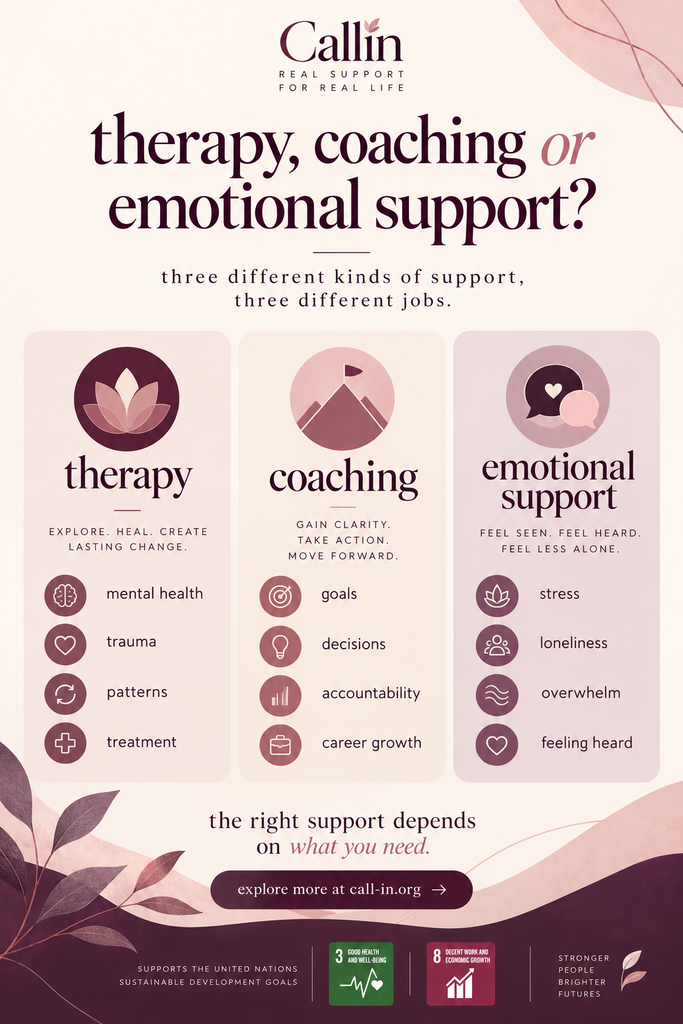
If you are choosing between therapy, coaching, or emotional support, start with what you need the relationship to do for you.
Therapy can help with mental health problems, emotional difficulties, behavioral patterns, trauma, and psychological treatment.
Coaching is generally oriented toward goals, development, decisions, and forward movement.
Non-clinical emotional support gives you space to talk, process, feel heard, and make sense of everyday emotional challenges.
And sometimes? You need more than one. As human beings, our needs don’t always fit into one neat box.
Key Takeaways
- Therapy, coaching, and emotional support overlap in some ways, but their purpose, scope, training, and boundaries are different.
- Therapy is not only for people with a diagnosis. Psychological therapies can help with anxiety, depression, difficult feelings, relationships, life events, and other concerns.
- Coaching is usually goal-oriented and focused on development, choices, performance, accountability, or reaching personal and professional potential.
- Non-clinical emotional support can be useful when you primarily need a confidential person to listen while you process stress, loneliness, relationships, burnout, life changes, or other everyday difficulties.
- You do not have to permanently choose one category. Your needs can change, and different forms of support can sometimes complement one another.
Start With a Better Question Than “How Bad Am I?”
People often choose support by asking themselves:
“Is my problem serious enough for therapy?”
I think there is a better question.
“What do I need help with?”
Those questions lead somewhere very different.
When support is organized according to severity alone, people can start imagining an invisible ladder.
At the bottom: talking to friends.
Then emotional support.
Then coaching.
Then therapy.
Then perhaps specialist mental healthcare somewhere at the top.
Real life does not work like that.
These forms of support are not simply different levels of the same service.
They often perform different jobs.
A career coach may be far more relevant than a therapist when your primary goal is planning a job search.
A therapist may be far more appropriate than a career coach when persistent anxiety is significantly affecting daily life.
An emotional support listener may be exactly what you want when nothing needs to be “solved” tonight and you simply need somewhere honest to put your thoughts.
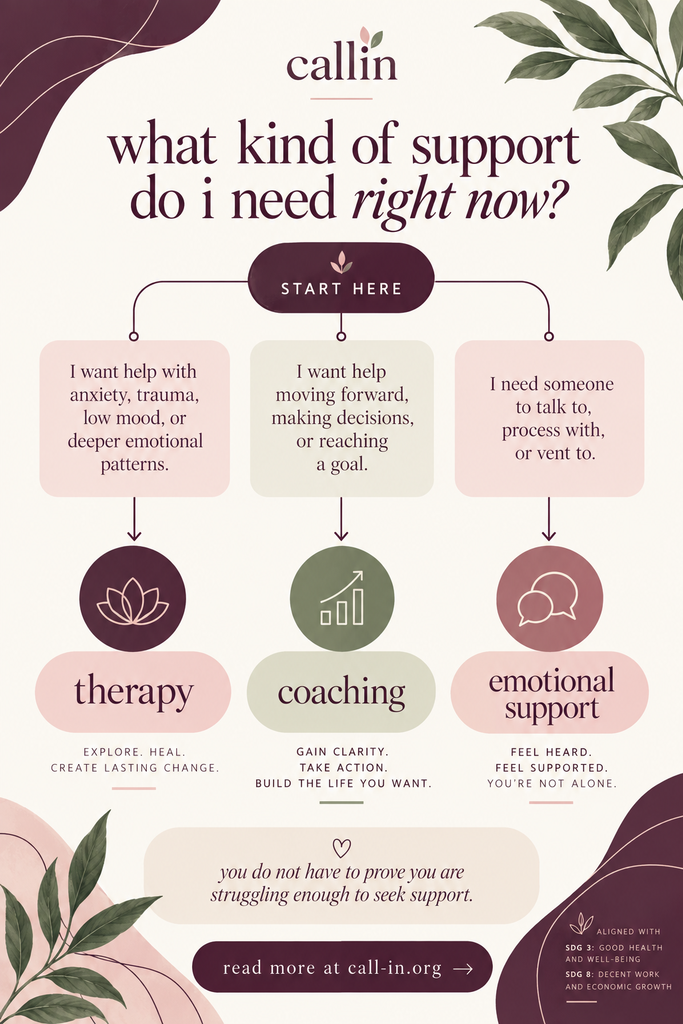
Choose support according to the job you need it to do, not according to whether you believe you have suffered enough to qualify.
What Is Therapy?
Therapy is a broad term covering different forms of psychological treatment and talking therapy.
The NHS describes talking therapies as treatments in which you speak with a trained professional about thoughts, feelings, and behaviors.
They can help with concerns including depression, anxiety, panic, obsessive-compulsive disorder, post-traumatic stress disorder, difficult feelings, relationship difficulties, and coping with long-term health conditions.
Different therapies work differently.
Cognitive behavioral therapy may examine patterns in thoughts and behavior.
Counseling may give you space to discuss feelings, experiences, and current difficulties.
Other therapies may explore relationships, trauma, longstanding patterns, or particular mental health conditions.
One important correction to a common myth:
You do not necessarily need a mental health diagnosis before you can benefit from therapy.
In England, for example, people can self-refer to NHS Talking Therapies for anxiety and depression without already having a diagnosed mental health condition.
So therapy is not only for moments of extreme distress.
It can also support people through grief, life changes, relationships, persistent worry, difficult emotions, or patterns they want to understand more deeply.
When Might Therapy Be the Better Fit?
Therapy may deserve serious consideration when your difficulty is persistent, significantly affects daily life, involves symptoms of a mental health condition, or requires psychological assessment or treatment.
Perhaps anxiety is controlling decisions you want to make.
Maybe low mood has persisted and everyday life is becoming harder.
You are experiencing panic attacks.
Past experiences continue to affect present relationships.
You are struggling with intrusive thoughts.
You suspect trauma may be influencing how you respond to situations.
Or perhaps you cannot quite explain what is happening, but you know the problem is deeper than needing a good conversation after a difficult week.
This does not mean therapy automatically has the answer.
It means therapy operates within a clinical or psychological treatment space that coaching and non-clinical emotional support are not designed to replace.
If you are unsure whether what you need is clinical treatment or another form of support, our guide to how to know if you need emotional support rather than therapy explores that boundary in more detail.
What Is Coaching?
Coaching is different.
The International Coaching Federation defines coaching as partnering with someone through a thought-provoking and creative process that supports their personal and professional potential.
The important words there are partnership, potential, and process.
Good coaching is not someone standing over your life with a clipboard shouting:
“Have you achieved your five-year plan yet?”
Coaching usually starts with where you are and where you want to go.
Perhaps you want to change careers.
Improve your leadership.
Build confidence in professional settings.
Become more accountable.
Make a difficult decision.
Develop better systems.
Prepare for job applications.
Clarify priorities.
Turn a vague ambition into concrete action.
The coach’s role is usually not to treat a mental health condition.
It is to help you think, clarify, plan, challenge assumptions, identify obstacles, and move toward something.
Therapy Is Not “About the Past” and Coaching Is Not “About the Future”
You may have heard this distinction:
Therapy looks backward. Coaching looks forward.
It sounds wonderfully neat.
It is also too simplistic.
Therapy can be extremely present-focused and practical. CBT, for example, often works directly with current thoughts and behaviors.
Coaching can involve discussing previous experiences when they help explain current goals, habits, strengths, or obstacles.
The more useful distinction is not:
Past versus future.
It is:
Treatment and psychological care versus development and goal-oriented partnership.
Even that distinction has nuance because different practitioners use different approaches.
This is why credentials, scope, boundaries, and what somebody actually offers matter more than the label printed underneath their name.
When Might Coaching Be the Better Fit?

Coaching can make sense when the central question sounds like:
“What do I want to do next?”
rather than:
“Why am I struggling to function?”
You may already know that you want a new job but feel stuck on strategy.
Perhaps you are returning to work after a break.
You want to strengthen your CV or LinkedIn profile.
You are considering a promotion.
You feel professionally stagnant.
You have several career options and cannot decide between them.
Or perhaps you are a student who understands the material perfectly well but keeps losing momentum, procrastinating, or struggling to structure your work.
These are areas where structured accountability, reflection, planning, and coaching can be useful.
It is also possible to be emotionally well and still benefit enormously from coaching.
Support does not always begin with distress.
Sometimes it begins with:
“I think I am capable of more, but I need help working out what more actually looks like.”
What Is Emotional Support?
Emotional support is perhaps the least understood of the three.
People sometimes assume that if something is non-clinical, it must therefore be casual or unimportant.
Not at all.
Non-clinical emotional support focuses on giving someone space to talk, feel heard, organize thoughts, express emotion, and process what they are carrying without automatically turning the conversation into treatment, diagnosis, or coaching.
The central need might be:
“I need to get this out.”
“I don’t want advice yet.”
“I need to hear myself think.”
“I don’t know why this is upsetting me so much.”
“I don’t want to burden my friends again.”
“I am lonely.”
“I am going through a breakup.”
“Work is exhausting me.”
“I moved somewhere new and I don’t really have anyone here.”
“I am carrying a lot and I would just like someone to care for an hour.”
There may be no disorder to treat.
No career target to optimize.
No five-step plan required.
Just a human being needing somewhere to be honest.
If that sounds familiar, you may find our guide to non-clinical mental health support versus therapy helpful.
Sometimes the Thing You Need Is Not Advice

This is where people can choose the wrong kind of support without realizing it.
Imagine someone says:
“My relationship is falling apart and I don’t know what to do.”
The instinctive response might be:
“Okay. Let’s make a plan.”
But perhaps they are not ready for a plan.
Perhaps they need to say:
“I still love them.”
“I am furious.”
“I am embarrassed.”
“I don’t want the relationship to end.”
“I also know I cannot keep living like this.”
Those emotions may need room before decision-making becomes useful.
This leads to an important distinction:
Not every unresolved problem is waiting for a solution. Sometimes it is waiting to be understood.
Emotional support can create that space.
Then, when the emotional noise settles, the person may decide whether they need therapy, coaching, practical advice, a difficult conversation, or no further intervention at all.
Emotional Support Can Be the Space Before the Decision
We talk frequently about support after people know what they need.
Far less attention is given to the messy middle where somebody knows only:
“Something isn’t right.”
That stage matters.
You may not know whether you want to leave the job.
You may not know whether the relationship is ending.
You may not know whether your loneliness is situational.
You may not know whether you need therapy.
You may simply know you are tired of carrying everything internally.
Good emotional support does not have to rush you into choosing the next intervention.
Sometimes its value is helping you hear your own thoughts clearly enough to know what the next step should be.
That is why having someone to talk to when you don’t need therapy can be a legitimate form of support in its own right.
So What Is the Difference Between Therapy, Coaching and Emotional Support?
Here is the simplest way I would think about it.
Therapy asks:
What is happening psychologically, what is causing distress, and what therapeutic work may help?
Coaching asks:
Where do you want to go, what is getting in the way, and how do we help you move forward?
Emotional support asks:
What are you carrying, and would it help to have somewhere safe to talk about it?
These questions can overlap.
You can be burned out and need therapy.
You can be burned out and need career coaching.
You can be burned out and need somebody to listen while you decide whether anything actually needs to change.
You can also need all three for completely different reasons.
Human support works better when we stop pretending one tool should solve every problem.
Can You Use Therapy and Coaching at the Same Time?
Potentially, yes.
They may serve different purposes.
Someone might work with a therapist on persistent anxiety while using a career coach to plan a professional transition.
Another person might use therapy to understand longstanding relationship patterns while using coaching for leadership development.
The important issue is clarity.
Each professional should stay within their appropriate scope, particularly where psychological treatment or clinical mental health concerns are involved.
Coaching should not quietly become unqualified therapy simply because difficult emotions appear in a session.
And therapy does not necessarily need to become career consulting because a client mentions work.
Good boundaries protect the client.
Can You Use Emotional Support Alongside Therapy?
Yes.
Therapy is not always designed to meet every emotional need in someone’s week.
You may have a therapy appointment on Thursday and still have a terrible Tuesday.
You might want additional human connection without asking a friend to carry every conversation.
You may simply want somewhere to vent, reflect, or talk through everyday experiences between more structured forms of support.
Non-clinical emotional support should not contradict therapy, attempt to treat mental health conditions, or position itself as a substitute for qualified clinical care.
Its purpose is different.
It can provide another layer of human connection.
What If I Just Need Someone to Talk To?
Then start there.
Seriously.
You do not have to transform the sentence:
“I need someone to talk to.”
into:
“Please allow me three business days while I determine the precise taxonomy of support required.”
Sometimes you discover what you need through talking.
Perhaps the conversation reveals that you have been far more anxious than you realized.
Therapy may become worth exploring.
Perhaps what keeps coming up is frustration about your career.
Coaching may make sense.
Perhaps nothing needs escalation at all.
You were lonely, overwhelmed, angry, heartbroken, or exhausted and needed another human being to listen.
That counts.
If you are specifically searching for someone to talk to when you do not want to burden your friends, having an additional support relationship can also take some pressure off the idea that one partner, sibling, parent, or friend has to hold absolutely everything.
What If I Don’t Have a Mental Health Diagnosis?
You do not need a diagnosis before you are allowed to seek support.
You also do not need one simply to justify having a difficult time.
NHS Talking Therapies itself does not require people to already have a diagnosed condition before self-referring for eligible services.
And outside clinical care, people frequently seek emotional support for experiences that are part of ordinary human life:
Breakups.
Bereavement.
Moving.
Work stress.
Loneliness.
Friendship problems.
University pressure.
Career uncertainty.
Family conflict.
Overwhelm.
You can read more about asking for help without having a mental health diagnosis.
Support should respond to human need, not only diagnostic labels.
When Emotional Support or Coaching Is Not Enough
There are times when non-clinical support should not be the main intervention.
If you are experiencing persistent or severe symptoms of depression or anxiety, panic attacks, trauma-related symptoms, disordered eating, psychosis, significant substance problems, serious difficulty functioning, or another mental health concern requiring assessment or treatment, appropriate professional healthcare deserves consideration.
NHS psychological therapies provide evidence-based treatments for many mental health problems, while some conditions require referral into more specialized services.
Similarly, if there is an immediate risk of harm, a crisis or emergency service is more appropriate than coaching or non-clinical emotional support.
The boundary is not there to dismiss someone.
It exists because support is safest when the person providing it is equipped for what the situation requires.
You Can Change Your Mind About What You Need
This might be the most useful part.
Choosing support today does not commit you to that category forever.
You could begin with emotional support and realize therapy would help.
You could start therapy and later add coaching.
You could work with a career coach for three months, achieve what you wanted, and stop.
You could speak to an emotional support listener during a particularly lonely season and no longer need the service once your life changes.
Support is not an identity.
It is a resource.
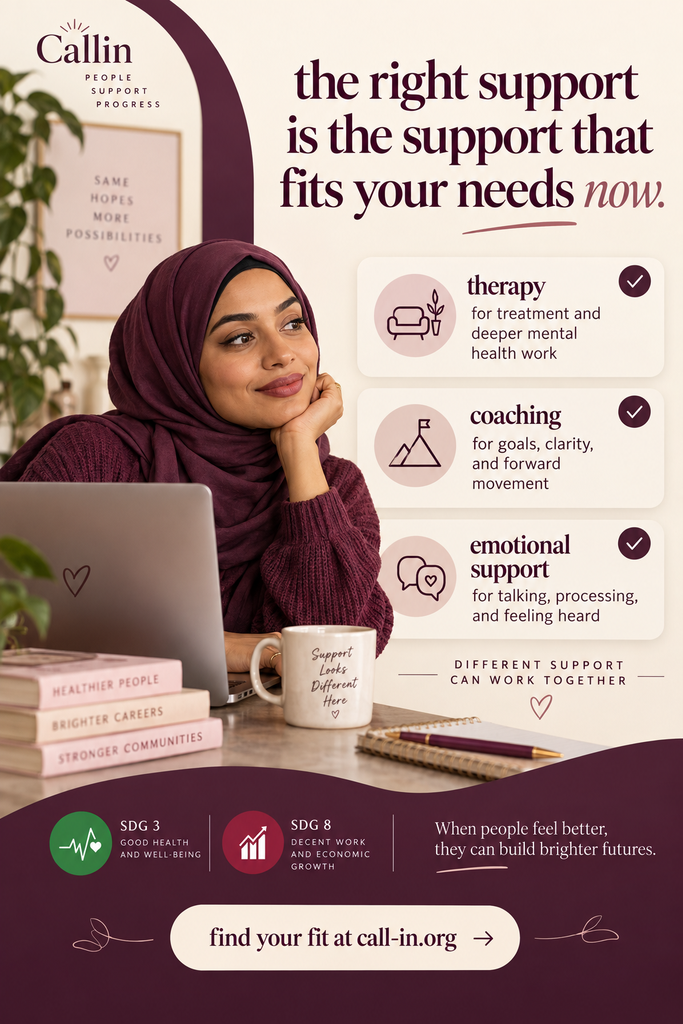
The right support is the support that fits your needs now, with enough flexibility to change when your needs change.
How This Connects to the UN Sustainable Development Goals
Access to appropriate support is also part of a broader global conversation about well-being and human development.
UN Sustainable Development Goal 3, Good Health and Well-Being, includes Target 3.4, which specifically calls for promoting mental health and well-being.
That goal is not served only through crisis intervention.
Prevention, early support, appropriate psychological care, social connection, and cultures where people can seek help without unnecessary stigma all contribute to healthier societies.
Coaching, particularly around careers, skills, and professional development, can also connect with the broader ambitions of SDG 8, Decent Work and Economic Growth, which includes productive employment and decent work.
The important principle is not that every support service should try to become everything.
Quite the opposite.
A healthy support ecosystem works when different services understand what they are for.
Where Callin Fits
Callin provides non-clinical mental health and emotional support for people who primarily need a confidential human space to talk, process, vent, and feel heard, as well as career coaching for professionals and coaching and academic accountability for students when the need is more goal-focused.
Callin does not replace therapy, clinical mental healthcare, or crisis services. If you are curious about the emotional support side but unsure what the conversation would actually be like, you can read what happens in a first Callin session.
Sometimes you need treatment.
Sometimes you need strategy.
Sometimes you need someone to listen.
And sometimes the wisest thing you can do is stop demanding that one person, one service, or one form of support somehow do all three.
Frequently Asked Questions
How do I know if I need therapy or emotional support?
Therapy may be more appropriate when you need psychological treatment, symptoms are persistent or significantly affecting daily life, or you want to work with a trained professional on patterns, trauma, anxiety, depression, or other mental health concerns.
Emotional support may fit when you mainly want a safe, non-clinical place to talk through everyday stress, loneliness, relationships, work difficulties, heartbreak, life transitions, or emotional overload. When you are unsure, a GP or qualified mental health professional can also help you understand what level of support may be appropriate.
What is the main difference between therapy and coaching?
Therapy is a form of psychological care that can address mental health concerns, emotional difficulties, behavioral patterns, relationships, trauma, and other psychological needs. Coaching is generally a collaborative, goal-oriented process centered on development, decisions, performance, potential, or forward movement.
Neither should be reduced to “past versus future.” Both can involve reflection and practical action.
Is emotional support a form of therapy?
Not necessarily.
Non-clinical emotional support can involve listening, empathy, reflection, and helping someone feel less alone, but it does not diagnose or treat mental health conditions. Therapy is delivered within a psychological treatment framework by appropriately trained professionals.
The distinction should be clear so people understand exactly what kind of service they are receiving.
Can coaching help with anxiety?
A coach may help with goals that anxiety affects, such as preparing for an interview, structuring a job search, developing confidence, or building accountability. However, coaching is not a substitute for appropriate mental health treatment when anxiety itself requires clinical assessment or therapy.
NHS Talking Therapies offers psychological treatments specifically designed for anxiety disorders.
Do I need therapy if I just want someone to listen?
Not necessarily.
Sometimes people want to talk about ordinary but difficult experiences without seeking psychological treatment. A trusted friend, support group, counselor, non-clinical emotional support service, or another appropriate listening service may meet that need depending on the situation.
The important question is whether the support matches what you are experiencing.
Can I have a therapist, coach and emotional support listener?
Potentially, yes, particularly if each serves a different purpose.
The important issue is clear roles and boundaries. You should understand what each person is helping you with, what their training and scope are, and where one form of support should hand over to another.
More support is not automatically better. Appropriate support is better.
What if I still cannot tell what kind of support I need?
You do not have to solve that perfectly before speaking to anyone.
Begin by identifying what you most want from the conversation.
Do you want treatment for something that is significantly affecting your mental health?
Do you want help achieving a specific goal?
Or do you primarily want somebody to listen while you make sense of what you are feeling?
That answer usually makes the next doorway much easier to see.

Leave a Reply