
In today’s fast-paced world, it’s easy to feel overwhelmed by the constant hustle and bustle driven by capitalism. Work culture often demands more from us than ever, leaving little room for downtime or self-care.
To cope with this stress, it’s important to carve out moments just for yourself, whether that’s through a quick walk during lunch or indulging in a hobby after work.
Finding ways to disconnect, even briefly, can help you recharge and regain perspective. Remember, it’s okay to prioritize your well-being over the endless grind; after all, you’re more than just a cog in the capitalist machine.
Because we operate in a capitalist society, which places emphasis on making money, most of us construct happiness and success on material possessions. We find ourselves in a constant state of yearning for material things.
Even when we achieve those things, we can’t help but desire more: more money, bigger house, e.t.c, as human nature is insatiable. Desire is beautiful – longing and striving to be better versions of ourselves drives development.
But are your desires causing you to lose peace of mind?
“Capitalism is one of the core reasons a good number of us experience unhealthy mental states incurred from stressing ourselves at work. “
– Callin
Living in a capitalist-driven economy has a way of making you place making money at the top of your priority list. Your peers easily believe you are successful when they see the material possessions you have amassed from the money you earned from your “important” job.

As children, our social context began drumming these messages that made us internalize working hard as a virtue. We heard things like:
- “Hard work leads to success.”
- “No food for lazy people.
- “The idle mind is the devil’s workshop.”
- “Good things don’t come easy.”
Not only that, stories with moral lessons taught us laziness is a vice, an example is one of Aesop’s fables, “The Lazy Donkey”. Inadvertently, our subconscious soaked up the ideas, thereby molding us into adults that would fit into Capitalism’s framework. As adults, we have the desire to keep busy, to hustle.
We glamorize “the grind.” We validate ourselves by how much stress at work we incur, because we have internalized “hard work leads to success.”
To us, the harder the job, the more important it is; ergo, we are important because we do hard, stressful jobs. Some of us even love saying, “I’m busy and swamped” even when we are busy doing nothing.
Five Ways To Deal With Capitalism Induced Stress At Work
I will share a few measures that worked for me in reclaiming and maintaining serenity and harmony in my life. With these tips, I’ve been able to reduce my stress at work and increase productivity, while having enough time to rest. I used to be a “very busy” person with little “me time.”
Until one day, I decided my story had to change, because it did not make sense that I was busier than a worker ant, while it was an issue meeting up with deadlines. I had to self-evaluate.
This entailed me assessing factors and situations in my life in order to figure out all the things I was doing wrong. I had to be honest with myself, too. I firmly believe we need to tell ourselves the bitter truth about any situation, if we must graduate into being better versions of ourselves.
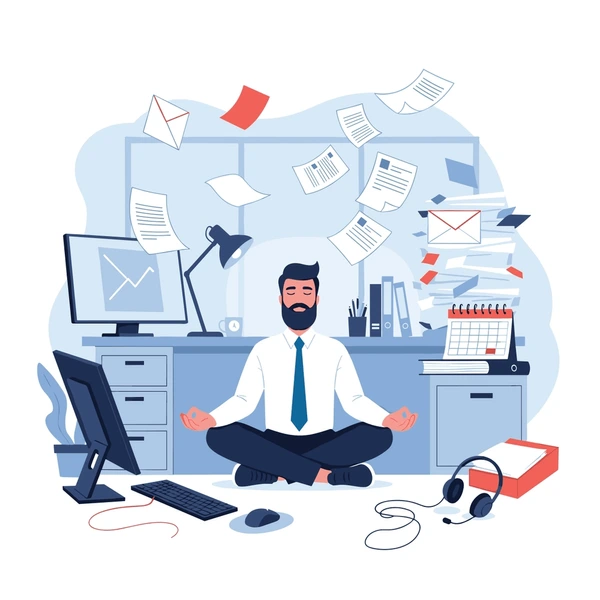
1. Reconstructing My Idea Of Productivity
One day I told myself, Suffering is not a virtue, busyness does not always translate to productivity, and success is a function of smart work, not always hard work. I believed my subconscious would unlearn Capitalism’s toxic messages if I introduced new, wholesome ideas.
What we are in the present is a culmination of the messages we have learnt in the past, mostly during our formative years. When we transform those self-limiting and unhealthy ideas we have stored up in the subconscious, we find ourselves becoming newer, healthier versions of ourselves.
This is what Neuro-Linguistic Programming (NLP) is all about. In changing our thoughts and behaviors, we achieve certain desired outcomes.
“Your beliefs become your thoughts. Your thoughts become your words. Your words become your actions. Your actions become your habits. Your habits become your values. Your values become your destiny.”
– Mahatma Gandhhi
2. Redefining Success And Happiness
Have you heard of the Japanese concept called “ikigai”? Anne-Laure Le Cunff writes on in her article “The Neuroscience of Ikigai.”: Each person’s ikigai is personal to them and specific to their lives, reflective of their inner self, and creating a mental state in which they feel at ease. Ikigai is not linked to your financial status.
When you find your ikigai, it gives a sense of meaning to your life.” Finding your ikigai can reduce anxiety, increase resilience, and add to longevity. I had to look inwards to find my ikigai.
This meant coming up with my personalized definition of success, instead of striving to achieve society’s definition of success that focuses on materialism. Doing that took a lot of weight off my shoulders.
To me, peace of mind is a priceless possession. In a bid to fit into society’s definition of success, we expose ourselves to avoidable stress at work. Feeling we must conform with society’s idea of success and fulfillment can push us into bouts of sadness, depression, panic, and anxiety.
Every life has its own challenges, but when we worry and panic, we turn these situations into stress. I see challenges as a way for me to grow, as there are always lessons attached to them.
3. Following The 80/20 Rule
I decided to effectively apply the 80-/20 rule (also known as the Pareto Principle) to the way I went about work.
According to the 80/20 principle, you have to “identify inputs that are potentially the most productive and make them the priority.” Brian Tracy, public speaker and self-development author, further explains in this video that 20 percent of your activities will account for 80 percent of your results.
He says, “If you have a list of ten items to accomplish, two of those items will turn out to be worth more than the other eight items put together. The sad fact is that most people procrastinate on the top ten or twenty percent of items that are the most valuable and important, the vital few that account for all your success.
And instead they busy themselves with the least important 80 percent, the trivial many that contribute very little or nothing to their success.”
Implementing this rule made me pick out three core tasks for the week and make them priority. This is in line with Tracy’s advice: “Write down 10 goals and determine which one goal would have the greatest impact on your life. Work at those goals all the time.
Before you begin work, always ask yourself, ‘Is this task in the top 20 percent of my activities or is it in the bottom 80 percent?’ Resist the temptation to clear up small things first.”
I learnt to pace myself to get the best possible results in little or no time. Most times, people are busy all day because they are working on low-value tasks, while procrastinating on the tasks that would make a positive impact on their work. Tracy also says, “When your goals are clear, you will come up with exactly the right answer at exactly the right time.
4. Disconnecting And Effectively Managing My Time
In 2017, Office Team, a staffing firm, discovered the average office employee spends 56 minutes a day using their phones during work hours for non-work activity, adding up to less than five hours a week of lost productivity per employee.
Report findings in a research by Éllish Duke and Christian Montag in 2017 stated: “Further analysis also indicated significant negative relationships between smartphone use and negative effects on participants’ personal lives. . . . These data suggest that smartphone use was perceived by participants to have a negative effect on both their work-related and non-work related productivity.”
At times, a person is “busy” because they do not manage their time effectively. This was true in my case. Time is relative. We all have 24-hour days, yet it would seem this time was not enough, judging by how I had to run against time to beat deadlines. I had to ask myself, “What are the unnecessary things taking up my time?” The answer was in my hands: my phone.
All I had to do was reduce social media time. I was intentional about giving time to my priorities. In addition, I became mindful of engaging in certain social situations. I was intentional about the conversations I would have.
In the morning, I’d tell myself (more like an affirmation), “Today, I choose peace of mind. I’ll only have conversations and interactions that are wholesome.” Programming our minds this way, first thing in the morning over a period of time, can go a long way in shaping the way we navigate through life.
– Callin
If we can internalize toxic ideas through words we heard since childhood, it makes sense that we can transform those negatives into positives when we consciously repeat new, healthy ideas.
Disconnecting from unnecessary interactions made me more productive. To disconnect, I made it my priority to nap during the day, read, and stay away from social media.
5. Using My Mind, Not My Mind Using Me
I began to see life as a peaceful, beautiful journey, not a racecourse. I realized rest was part of the creative process.
Creative ideas come when we disconnect from the regular beta brain waves and tune into alpha brain waves. I started practicing mindfulness by focusing my attention towards anything I was working on at the moment.
In the past, I could be reading a book while scrolling through Instagram and replying to random messages from WhatsApp and Twitter. Instead of reading a book within two days, I would pace myself and spent a week. I let go of multifocusing and multitasking.
Contrary to what we have been led to believe, spreading our attention across tasks, also called multitasking, takes a toll on our mental health. It reduces our ability to focus, while increasing stress levels. In addition to this, it leads to memory impairment, reduced efficiency, and hampers creativity.
Letting go of multitasking helped to increase my attention span. Now, I easily focus on a task. Doing this makes me access the flow state, where I get into the “zone” and become one with the task at hand.
This way, I was using my mind to my advantage, as against how my mind would wander to several places on its own volition without me managing it.
Putting It Together…
Using these five solutions above, I was able to manage work-induced stress. In looking into my life’s context to make adjustments pertaining to how I handled stress at work, I found myself making lifestyle changes.
It all began with me making a conscious decision to let go of all ideas that made me seek validation from allowing myself to get into stressful situations. Something about breaking free of societal expectations on how I should find fulfillment and define success feels good, because it has given me a sense of peace.
Everyone is walking their personalized journey. It’s expected that different things fulfill us.
It is not easy to wake one morning and decide to let go of the unhelpful subconscious conditioning that has inspired the way you have ideated success, happiness, and fulfillment.
You are bound to feel strange at first, because you’re upstaging years of conditioning. I felt the same way. With practice, taking it one day at a time, I transformed ideas such as “hard work leads to success” into “I can work with so much ease and achieve success”.
As Haruki Murakami wrote, “Pain is inevitable; suffering is optional.” Embracing avoidable stress is not a virtue. We can make the choice to adopt a more peaceful and harmonious life, without unnecessary stress. This attitude would inadvertently translate into how we go about all aspects of our lives – career, relationships, etc.

Leave a Reply