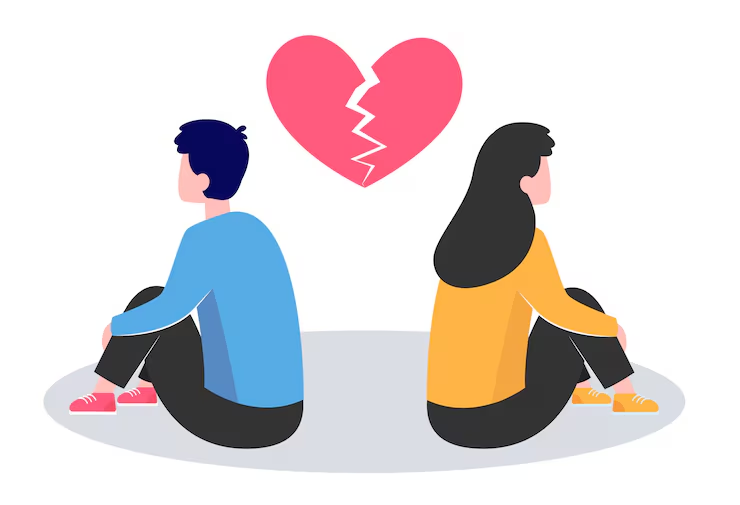
If you are going through a breakup and feeling completely lost, you are not imagining it. It’s not all in your head. Even when it feels like a part of you has been torn away, you are not being dramatic.
Think of it like this: “you are standing in the wreckage of a self that used to make sense.” Sounds poetic, but that is a way to describe the feeling.
One day you knew exactly who you were. You knew your role in a shared story, what you’d be doing this weekend, who you’d call first with good news, whose voice you’d hear before falling asleep. Then it ended. Suddenly none of that exists anymore.
The floor feels gone. Your thoughts feel scattered. Even simple decisions, like what to eat for dinner, feel strangely heavy.
This is more than sadness. It is part of why modern life can already feel emotionally overwhelming, and a breakup adds a sharp spike on top of that baseline. This article explains why, with real psychology and neuroscience, then walks through practical steps to help you rebuild.
The Identity Vacuum: Why Going Through a Breakup and Feeling Completely Lost Is Not Weakness, It’s Biology
Psychologist Arthur Aron developed something called Self-Expansion Theory. It explains a simple but profound truth about love: when we fall into a relationship, our brain does not just add a person to our life. It merges that person into our sense of self.
Aron’s research found that close partners get cognitively folded into our own identity. We start using “we” instead of “I.” We absorb their interests, their habits, their friends, their language. Their traits start to feel like our traits, their future like our future. This is not weakness. It is how human bonding works. Our brains treat deep attachment as a literal expansion of who we are.
So when the relationship ends, it is not just a loss of companionship. It is a sudden, forced contraction of self. A part of your identity that you built your days around has abruptly been removed.
This is what we call the Identity Vacuum: the hollow space left behind when a relationship that helped define you disappears. You are not just losing a partner. You are losing a draft of yourself. If you have been searching for why do I feel so lost after a breakup, this is the deepest answer: your brain has to renegotiate who you are.

The Neurobiology of Feeling Lost After a Breakup
This disorientation is not only emotional. It is neurological.
Going Through a Breakup and Feeling Completely Lost? Your Brain’s Predictive Map Has Lost Its Anchor
Your brain is a prediction machine, constantly building models of what should happen next based on patterns from your daily life.
For months or years, a large portion of your predictive map was built around your partner: their text in the morning, their car in the driveway, their voice when something good or bad happened. These were not just routines. They were neural shortcuts your brain relied on to feel safe and oriented.
When the relationship ends, all of those predictions suddenly return errors. Your brain reaches for the pattern and finds nothing there. This mismatch between expectation and reality creates a very real, physical sense of disorientation.
This is the neurobiology of breakups in its simplest form. Your nervous system is recalibrating an entire internal model of your life, all at once. That recalibration is also a major physical stressor, which is why basic stress management tools matter just as much as emotional ones right now.
The Default Mode Network and the Disappearance of Familiar Loops
A part of your brain called the Default Mode Network, or DMN, plays a central role here. It activates when you are not focused on a task, and handles self-reflection, autobiographical memory, and imagining the future.
In a long relationship, your partner becomes deeply woven into your DMN activity. You imagine your future and they are in it. You reflect on your past and they are threaded through it.
When that person is suddenly gone, the DMN keeps reaching for them anyway. It pulls up memories on a loop and tries to simulate a future that no longer exists. This creates the looping, ruminative thoughts so many people describe after a breakup. It is exhausting because your brain is essentially trying to run old software on a system that has changed.
Cognitive Disorientation After Heartbreak Feels Like Spatial Confusion
Many people describe breakup grief in spatial terms: “I feel like I’m floating,” “nothing feels solid,” “I don’t know which way is up.” That language is not a coincidence. The brain regions involved in spatial navigation overlap significantly with the regions involved in social and emotional navigation. Your internal sense of “where am I in my life” uses some of the same machinery as your literal sense of direction.
When your primary relational anchor disappears, it genuinely registers as a form of psychological spatial disorientation. Your inner compass has lost its fixed point. This is why cognitive disorientation after heartbreak can feel almost physical, like dizziness of the mind.
Deconstructing the Closure Myth
Most people are taught to wait for closure: a final conversation, an explanation, some neat emotional bow that ties the story together. The uncomfortable truth is that closure rarely comes the way we imagine it.
Waiting for your ex to give you closure means handing them the keys to your healing. It keeps you tethered to their words, their timeline, their willingness to explain themselves. That is a trap disguised as hope.
Real closure is not something someone gives you. It is something you build. You do not need your ex to validate the relationship’s meaning, or to confirm that you mattered. You already know what you experienced.
So let go of waiting. Look at the space they left behind differently. That void is not empty. It is unwritten freedom, and it feels frightening because it is unstructured, with no script telling you what to do next. But unstructured space is also where new identity gets built. A blank page is terrifying right up until the moment you start writing on it. This is also a useful moment to notice the difference between living versus simply existing. A breakup can either numb you into autopilot or push you toward a life you actually choose.

Emotional Recovery Steps: A Solution-Oriented Roadmap
Understanding the science is important. But you also need a clear plan. Here is a structured set of emotional recovery steps to help you find yourself again after a relationship ends.
Step 1: Re-anchoring With Micro-Routines
Your brain craves predictability. When the big structures of your life collapse, the fastest way to calm a disoriented nervous system is small, repeatable actions: micro-routines, intentionally tiny so they cannot fail.
Try things like:
- Making your bed the same way every morning
- Drinking water first thing, before your phone
- Taking a five minute walk at the same time each day
- Writing three lines in a journal before bed
None of these will fix the breakup. The point is to give your brain’s predictive coding system small, reliable patterns it can count on again. Each completed micro-routine sends a quiet signal: this part of my life is stable. Over time, these tiny anchors rebuild a sense of internal solid ground.
Step 2: Narrative Redrafting, Reclaiming Your Neural Real Estate
Your brain has spent a long time telling a story where your ex is a main character. That story does not disappear on its own. You have to actively edit it. This is called narrative redrafting.
Start by noticing the automatic story your mind tells, like “I am nothing without them.” Then consciously rewrite it, not with toxic positivity, but with honesty and possibility:
- Old line: “I don’t know who I am without them.”
- New line: “I am rediscovering who I am, on my own terms.”
Say the new line out loud. Write it down. Repeat it when the old story tries to play. Every replay of the old narrative reinforces the same neural pathway. Every time you consciously choose a new one, you build a different pathway. You are reclaiming the neural real estate the relationship used to occupy.
Be careful not to let the breakup become your entire identity either. There is a real risk of identifying with your trauma rather than moving through it. Many also find it grounding to revisit how they would define success on their own terms, separate from any relationship.
Step 3: Somatic and Environmental Shifts
Your environment is full of cues that your brain associates with your ex: the coffee shop you used to visit together, the playlist you both loved, the side of the couch where they always sat. These cues quietly trigger memory and longing, often without you realizing it.
Try these environmental shifts:
- Rearrange your furniture, even slightly
- Change your usual route to work or the gym
- Wash your sheets and pillows to remove lingering scent cues
- Put shared photos away, not necessarily forever, just for now
Pair this with somatic practices: anything that brings you back into your body, like slow breathing, stretching, a hot shower, or a short walk outdoors. These interrupt the spiral of rumination and ground you in the present, rather than the looping past.
It can also help to rebuild your social world deliberately during this stage. If your circle had become small or centered on your ex, this is a natural time to make friends as an adult again, on your own terms.
The Power of a Sounding Board When You’re Going Through a Breakup and Feeling Completely Lost
There is one ingredient that makes all of these steps work faster: saying your thoughts out loud to another person.
Externalizing your inner experience, meaning speaking it rather than just turning it over silently in your head, helps your brain process it differently. Talking activates language centers and forces vague, swirling feelings into clearer, organized thoughts. It is part of why people so often say “I didn’t even know what I felt until I said it out loud.”
Breakup grief can be relentless. You might want to process the same thoughts at 7am and again at midnight, and friends and family, however loving, have limits. Leaning on them constantly can quietly strain those relationships, and it can leave you carrying reasons you feel guilty for needing emotional support in the first place.
This is where having a dedicated, judgment free space matters.
Callin was built for exactly this kind of moment. It offers a non-clinical, peer-led space where you can vent to someone and receive real emotional support, whenever you need to, without worrying about wearing out the people closest to you. It is not therapy, which is exactly what many people want when they need someone to talk to, not therapy. Each conversation is grounded in genuine active listening, so you actually feel heard.
If you have ever worried about being too much, or burning out the people around you, this kind of support can be a genuine relief. Many people use it as a safe space to vent when 2am thoughts feel too loud to sit with alone, or when they are simply overwhelmed without needing a clinical diagnosis attached to it.
Speaking your story out loud, to someone equipped to really hear it, is one of the fastest ways to turn confusion into clarity.
Frequently Asked Questions About Feeling Lost After a Breakup
Why do I feel so physically sick and disoriented after a breakup?
Heartbreak triggers a genuine stress response in the body. Cortisol rises, sleep gets disrupted, appetite shifts. Your nervous system treats the loss of a primary attachment figure similarly to a threat, which is why nausea, dizziness, and exhaustion are so common. This is a physiological response to a major disruption in your brain’s predictive and attachment systems, not a sign anything is wrong with you. Gentle hydration, regular meals, and consistent sleep can help your body settle while your mind catches up.
Is it normal to feel like I do not know who I am anymore?
Completely normal. As covered earlier, your identity becomes genuinely intertwined with a long term partner through self-expansion. Losing your identity in a relationship’s aftermath is not a character flaw. It is the predictable result of a merged identity being pulled apart. Give yourself permission to feel unfamiliar to yourself for a while. This feeling is temporary, not permanent.
How long does the “lost” phase typically last?
There is no universal timeline, and anyone who promises an exact number of weeks is oversimplifying. Many people notice the most intense disorientation easing within a few months, while a fuller sense of identity continues rebuilding over six months to a year. What matters more than the calendar is whether you feel small signs of progress week to week, not a straight line toward perfection.
What is the difference between normal breakup grief and identity loss?
Normal breakup grief involves sadness, missing the person, and adjusting your daily routine. Identity loss goes deeper: not knowing your own preferences, feeling unsure of your values, struggling to picture a future at all. If you find yourself asking “who even am I without them” rather than just “I miss them,” you are likely experiencing identity loss layered on top of grief. Both are valid, and the roadmap above addresses that deeper layer.
How can I stop checking my ex’s social media when I feel lonely?
Start with structure rather than willpower alone. Mute or unfollow if you can, even temporarily. Replace the specific moment of loneliness, often evenings or early mornings, with a planned micro-routine instead, like a short call with a friend. Each time you check, you reopen a wound your brain is trying to heal. It also helps to understand why you feel lonely even around other people, since the urge to check their profile is often less about them and more about that underlying loneliness.
How do I find myself again after a relationship ends?
Finding yourself again is less about discovering something hidden and more about deliberately rebuilding. Revisit interests you set aside during the relationship. Notice preferences that are entirely your own, with no compromise involved. Spend time alone without immediately filling the silence. Each action adds a new data point to your evolving sense of self, and over time those data points form a clearer picture of who you are now. Looking into the broader emotional support options available to you during this stretch can also help.
Why does losing your identity in a relationship happen even in healthy, loving relationships?
This is an important and often misunderstood point. Identity merging is not a sign that a relationship was unhealthy or codependent. It is a natural feature of close attachment. Even securely, lovingly bonded partners blend routines, language, and plans together. The depth of disorientation after a breakup often correlates with how close the relationship was, not how dysfunctional it was. Feeling profoundly lost can actually be evidence that the connection mattered. If your relationship involved harder dynamics, it is also worth exploring whether you spent time reparenting yourself through earlier wounds, since old patterns can intensify how a breakup feels.
Conclusion: Building a Map That’s Entirely Your Own
If you are going through a breakup and feeling completely lost right now, please hear this clearly. What you are experiencing has a real explanation. Your brain built an entire internal map around another person, and that map has been disrupted. Disorientation is the expected result, not a sign of weakness.
Rebuilding takes time. There is no shortcut around that. But there is something quietly hopeful here too. The map you build now will not be shaped by compromise or merged identity. It will be entirely your own.
Small routines will steady you. A rewritten narrative will give you language for who you are becoming. New environments will quiet old triggers. And having somewhere to say all of it out loud, without fear of being too much, will help you process it faster than carrying it alone ever could.
You have not lost yourself. You are redrawing the map. And this time, every coordinate on it will be yours.

Leave a Reply