Loneliness and the feeling of being alone in a crowded room are not always the same experience. Conflating them leads to poor self-understanding and ineffective responses.
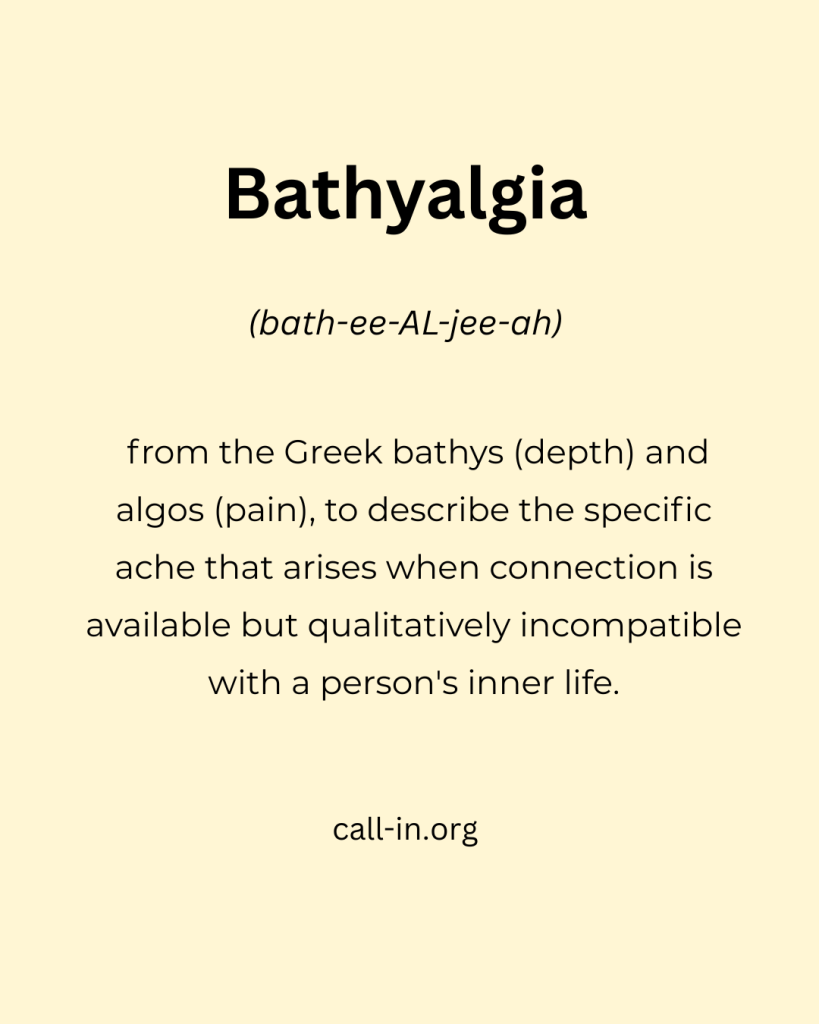
This article proposes a new descriptive term, Bathyalgia (bath-ee-AL-jee-ah), from the Greek bathys (depth) and algos (pain), to describe the specific ache that arises when connection is available but qualitatively incompatible with a person’s inner life.
Bathyalgia is not a psychiatric diagnosis, a medical condition, or a scientifically validated clinical construct. It is offered as a conceptual vocabulary for an experience that existing language inadequately captures.
Key Takeaways
- Research consistently distinguishes the quantity of social contact from its quality. Bathyalgia lives in that gap.
- The proposed solution is not finding better people. It is a form of radical acceptance: learning to inhabit the space between people with honesty rather than despair.
- Language shapes emotional reality. What we cannot name, we often misinterpret. Misinterpretation leads to suffering that is not inevitable.

I. The Problem With the Word Lonely
Language is not neutral. The words available to us do not merely describe emotional experience; they actively shape it. When a language lacks a precise term for a particular inner state, people reach for the closest available approximation, even when that approximation distorts the reality it is trying to capture.
Loneliness is one of the most reaching words in the English emotional vocabulary. We use it to describe the acute isolation of bereavement. We use it for the quiet ache of a Sunday afternoon with nothing planned.
We use it for the experience of a new city, a new job, a new phase of life in which the old familiar faces have not yet been replaced by new ones.
And we use it, perhaps most persistently and most inaccurately, for something else entirely: the peculiar feeling of sitting in a full room, surrounded by people who are speaking, laughing, and apparently connecting, while experiencing a kind of interior silence that none of the noise around you can reach.
These are not the same experience. Treating them as synonymous is not merely imprecise. It is consequential. It leads people toward the wrong remedies, the wrong self-assessments, and the wrong conclusions about their own psychology.
This article is an attempt to name that second experience more honestly. It proposes a new conceptual term: Bathyalgia. The argument is not that a new word will solve anything in itself.
The argument is that naming an experience accurately is the necessary first step toward understanding it, and that understanding it is the necessary first step toward relating to it without unnecessary suffering.

II. What Research Actually Says About Connection
Before introducing a new concept, it is worth clarifying what the established science tells us about human connection and its relationship to wellbeing.
The research on loneliness is now substantial. Neuroscientist John Cacioppo spent decades demonstrating that perceived social isolation is among the most reliable predictors of poor physical and psychological health outcomes.
His work, particularly the landmark studies conducted with colleagues at the University of Chicago, showed that the pain of loneliness is not merely metaphorical. It activates neural threat-detection systems, elevates cortisol, disrupts sleep architecture, and accelerates cognitive decline.
Social neuroscientist Matthew Lieberman’s research at UCLA expanded this picture. His findings suggested that the human brain devotes significant default-mode processing to thinking about other people.
Social connection, Lieberman argued, is not a luxury that the brain pursues after other needs are met. It is a primary need, as fundamental to human functioning as shelter or nutrition.
The World Health Organisation formally recognised loneliness as a global public health concern in 2023, and the literature that followed confirmed what many had long suspected: that the epidemic of loneliness in developed nations is real, costly, and growing.
But here is what the research also consistently shows, and what tends to receive less attention in the popular conversation: quantity of social contact and quality of social contact are not the same variable.
A 2015 study published in Personality and Social Psychology Bulletin found that superficial social interactions could fail to reduce loneliness and sometimes intensify it. Research by psychologist Arthur Aron at Stony Brook University established that feelings of genuine connection depended substantially on what he called self-disclosure: the experience of being known at some meaningful level of depth.
In other words, science has already identified something important. It is not the presence of other people that determines whether we feel connected. It is the quality and register of the exchange.
People can be profoundly lonely in a crowd. They can feel deeply connected in solitude, through a book, a piece of music, an absorbing memory of a person who genuinely understood them.
The experience we are attempting to name sits precisely here, in the territory between the presence of connection and the absence of resonance.
III. A Distinction the Language Does Not Make
Martin Buber, the Austrian-Jewish philosopher whose work on dialogue and encounter remains among the most thoughtful treatments of human relationship ever written, distinguished between what he called I-Thou and I-It relations. In an I-Thou encounter, two people meet each other as full subjects.
Something is genuinely exchanged. The encounter changes both people, however subtly. In an I-It relation, one person is relating to another as an object of experience or utility rather than as a full interior being.
Buber did not intend this distinction as a moral hierarchy. Most daily interaction necessarily operates at the I-It level, and that is not pathological. The issue arises when a person craves the depth of I-Thou encounter and finds themselves surrounded exclusively by I-It exchange. They are not unloved. They are not abandoned. They are simply unmet.
The Danish philosopher Soren Kierkegaard wrote extensively about the crowd as a force that obscures rather than enables the individual. His concern was somewhat different from the one this article addresses, but the underlying observation is related: physical proximity to other people does not constitute genuine encounter.
A person can be entirely submerged in social life and remain, at some essential level, unwitnessed.
Erich Fromm, the social psychologist and humanistic philosopher, was perhaps the most direct. In The Art of Loving, he observed that modern people have confused the abundance of social stimulation with genuine intimacy, and that this confusion produces a specific, diffuse suffering.
People feel that something is missing. They cannot name it. Because they cannot name it, they assume the solution is simply more of what they already have: more socialising, more company, more noise.
Fromm would have recognised immediately what we are attempting to describe.
IV. Introducing Bathyalgia
Bathyalgia (noun, pronounced bath-ee-AL-jee-ah) is a proposed descriptive term derived from two Greek roots: bathys, meaning depth, and algos, meaning pain or ache.
It is offered here as a philosophical and psychological framework, not as a clinical diagnosis. It is not a medical condition. It is not a scientifically validated construct
It does not appear in the DSM-5 or any established psychological taxonomy. It is not intended to replace existing terminology or to pathologise ordinary human experience.
Bathyalgia describes the following:
The quiet emotional ache that arises when human connection is fully available but qualitatively incompatible with a person’s inner life. It is not the pain of absence. It is the pain of presence at the wrong frequency.
The person experiencing Bathyalgia is not isolated. They may be socially active, professionally engaged, and surrounded by people who genuinely care about them. The connection is real. The goodwill is real. What is missing is something harder to name: resonance. The sense that the conversation they are having in the room corresponds, in some meaningful way, to the conversation they are having inside themselves.
Nostalgia, the word from which Bathyalgia partly takes its structural cue, describes the ache of home, the pain of temporal distance from a place or time that once held meaning.
Bathyalgia describes something analogous but distinct: the ache of depth, the pain of being a person for whom certain kinds of exchange are nourishing and finding, in a particular room or moment or relationship, that those kinds of exchange are absent.
The person experiencing Bathyalgia does not need to be rescued from solitude. More company is not the answer. What they are experiencing is not loneliness. It is a mismatch of register.
V. The Frequency Problem
It may help to think of human beings as operating at different interior frequencies. This is not a mystical claim. It is a recognition that people differ substantially in the kinds of conversation that produce genuine engagement versus the kinds that leave them feeling, despite all surface indications of sociability, internally untouched.
Psychologist Carl Rogers, whose work on person-centred therapy remains foundational, argued that genuine therapeutic encounter required something he called active listening: full presence, careful attention, and the suspension of the listener’s own agenda long enough to actually inhabit the speaker’s frame of reference.
Rogers was describing what happens in a therapeutic context. But his insight points toward something universal. Most people rarely experience being fully listened to. They experience being waited on while the other person formulates their response.
Viktor Frankl, the Viennese psychiatrist and Holocaust survivor, argued that the deepest human need is not pleasure or power but meaning. Frankl’s framework, logotherapy, rests on the idea that humans can endure almost any what if they have a sufficient why.
Applied to social experience, this observation implies that what makes conversation nourishing is not its pleasantness or its efficiency but whether it engages something that matters. Bathyalgia arises when social experience is pleasant, even warm, but persistently fails to engage anything that matters to the person experiencing it.
Byung-Chul Han, the South Korean-German philosopher, has written about what he calls the transparency society: a culture that demands that everything be frictionless, easily legible, and immediately satisfying.
Han argues that this culture has produced an impoverishment of the inner life, partly because genuine depth requires slowness, resistance, and the willingness to sit with what cannot be immediately resolved. The person prone to Bathyalgia is, in a specific sense, a person who has not been fully absorbed by the transparency society.
They retain an interior complexity that demands a corresponding complexity from their environment. When the environment cannot meet that demand, the ache is real.
Philosopher Iris Murdoch wrote that loving attention, the kind of careful, unsentimental regard for another person as they actually are rather than as we wish them to be, is one of the rarest and most demanding of human acts.
Most social exchange does not ask this of us. Bathyalgia is partly the ache of a person who is capable of that kind of attention and who finds, in a given moment, that no one around them is offering it in return.
VI. What Bathyalgia Is Not
Precision requires exclusion as much as definition. Bathyalgia is not several things that it might superficially resemble.
It is not loneliness in the clinical sense. Loneliness, as Cacioppo defined it, is the perceived gap between desired and actual social connection. It is typically accompanied by a wish for more or different company. Bathyalgia does not necessarily produce this wish.
A person in the grip of Bathyalgia may have no desire for additional social contact. They may actively enjoy solitude. What they experience is not the absence of people but the absence of a particular quality of encounter.
It is not introversion, though the two are sometimes related. Introversion is a stable personality trait describing a preference for less stimulating social environments and a tendency to find large amounts of social contact energetically costly. Bathyalgia can be experienced by introverts and extroverts alike. It is not about quantity of social engagement. It is about quality.
It is not social anxiety. Social anxiety involves fear and anticipatory dread around social situations. Bathyalgia involves no fear. The person experiencing it is often socially confident and genuinely interested in other people. The difficulty is not engaging with others. The difficulty is finding others who engage at a corresponding level of depth.
It is not elitism or snobbery, though this distinction requires care. Bathyalgia does not imply that the person experiencing it is superior to the people around them. It implies only that the current social environment is not providing what they need.
A musician at a gathering of people with no interest in music is not superior to those people. They are simply experiencing a mismatch. The mismatch causes discomfort. That discomfort is Bathyalgia.
It is not depression, though the two can coexist. Depression involves pervasive low mood, anhedonia, altered sleep and appetite, and impaired functioning. Bathyalgia is a specific, situational ache. It lifts when resonant conversation or connection is found. It is not a disorder. It is a signal.
VII. The Paradox of Closeness
There is a particular cruelty in the fact that Bathyalgia is often most acute not among strangers but among the people we love most.
With a casual acquaintance, the bar is low and the distance is accepted. We do not expect a passing colleague to understand our interior life. The gap between us is wide, but it does not hurt, because we never reached across it.
The moment genuine intimacy develops, the situation changes. We open up. We disclose. We invite someone into the private world of our thoughts, fears, and convictions.
And it is precisely then that we begin to feel, with increasing clarity, the edge of the other person’s mind. We discover that even in the warmest, most loving relationship, we are still sitting inside our own head. They are sitting inside theirs.
This is what the existential psychiatrist Irvin Yalom identified as one of the deepest sources of existential anxiety: the recognition that no one can fully accompany us into the interior. Not because they refuse to. Not because they are incapable of love. But because the structure of individual consciousness makes total merger impossible.
Jean-Paul Sartre’s observation that hell is other people is frequently misread as misanthropic. What Sartre actually meant is something more precise and more disturbing: that the attempt to force another person to completely satisfy our need for recognition is necessarily frustrated, because the other person is always, irreducibly, other.
They cannot fully see us, because seeing requires a perspective, and perspective requires distance.
Bathyalgia, in this light, is not a failure of relationship. It is the experience of relationship at sufficient depth that the gap becomes visible. It is the intimacy tax. The closer we get to another person, the more clearly we perceive the distance that remains.
This is worth sitting with. The people who experience Bathyalgia most acutely are often the people who have pressed closest to others, who have brought the most honesty and the most genuine interest to their relationships, and who have discovered, not because of anyone’s failure but because of the structure of human consciousness, that a residue of interior distance always remains.
VIII. Why Solitude Is Not the Answer Either
It would be tempting to conclude that the solution to Bathyalgia is withdrawal. If social engagement produces the ache of unmet resonance, perhaps the answer is to stop seeking it.
This conclusion does not hold.
Research on the psychology of solitude distinguishes carefully between chosen solitude and imposed isolation. Chosen solitude, the deliberate and intentional decision to spend time alone, is associated with creativity, reflection, and psychological restoration in people who value inner complexity. It is not the same as loneliness, and it is not the same as the suppression of the need for resonance.
The person experiencing Bathyalgia does not need less social engagement. They need more honest social engagement, or at minimum, a clearer understanding of what they are looking for and why its absence hurts.
Alain de Botton, the philosopher and author, has written about the way we approach relationships with expectations that are both too high and too vague: too high because we expect another person to permanently resolve our existential aloneness, and too vague because we have never clearly articulated what we actually need from them. The result is a persistent, low-grade disappointment that neither party can quite diagnose.
Bathyalgia proposes a vocabulary for that diagnosis. It says: the ache you feel in the room full of people is not evidence that your life is failing. It is not evidence that your relationships are broken. It is the specific sensation of a particular kind of resonance being absent. That sensation has a name. Named, it becomes less frightening. Less frightening, it becomes workable.
IX. The Listening That Is Almost Never Offered
One of the quieter tragedies of Bathyalgia is how it is typically responded to.
When a person admits to feeling alone despite having plenty of company, the responses they receive are almost universally oriented toward the elimination of the feeling. Friends remind them of all the people who care about them.
Partners suggest activities to distract. Well-meaning advisors recommend wider social circles, new hobbies, more deliberate community-building.
These responses, however kindly intended, make a specific error. They treat the feeling as a factual mistake to be corrected rather than as a signal to be understood. They confirm, inadvertently, the very thing the person experiencing Bathyalgia already suspects: that articulating their inner state will produce not resonance but management.
Carl Rogers identified something he called unconditional positive regard as central to genuine therapeutic encounter. What Rogers meant was not simply warmth or approval.
He meant the willingness to be fully present to another person’s experience without the need to alter, correct, or resolve it. That quality of presence is, in most ordinary social contexts, extremely rare.
What the person in the grip of Bathyalgia typically needs is not advice. It is not reassurance. It is not to be told that the gap they are perceiving does not exist. It is to be witnessed, honestly and without rush, in the experience of perceiving it.
This is a different form of support from what most social contexts offer. It is the difference between someone who listens while forming their reply and someone who listens in order to understand. Most people, most of the time, are doing the former. That is not a moral failing. It is a structural feature of how most social interaction is conducted.
When talking to friends does not feel like enough, the problem is rarely the friendship. It is the register. Friends are not trained to hold the particular quality of presence that Bathyalgia requires.
X. Acceptance as a Form of Intelligence
The final movement of this essay concerns a proposal that runs counter to the dominant therapeutic culture of the present moment.
The contemporary self-help landscape tends to treat every form of emotional suffering as a problem to be solved.
If you feel lonely, find community. If you feel unheard, communicate better.
If you feel disconnected, expand your social skills. The implicit premise is that the correct response to discomfort is always the elimination of discomfort.
This premise is not always wrong. But applied to Bathyalgia, it produces a specific trap. It sends people in search of a social environment that will permanently resolve the ache of incompatible resonance.
And because no such environment exists at all times and in all contexts, the search produces not relief but an escalating sense of failure.
Philosopher Iris Murdoch wrote that one of the central tasks of a mature inner life is the gradual replacement of fantasy with reality. Not the resignation to reality, but the honest embrace of it: seeing clearly, without illusion, what is actually there.
Applied to Bathyalgia, Murdoch’s insight suggests that the path through the ache is not the elimination of the gap between what we hope for from other people and what they can actually offer. It is the honest acceptance of that gap as a structural feature of human intimacy rather than a personal failure.
This is not resignation. Acceptance, properly understood, is not giving up. It is the recognition that certain forms of suffering arise not from what is wrong with our lives but from our resistance to what is true about them.
When we stop demanding that the people around us close a gap they cannot close, we free them to be what they actually are: separate, whole, genuinely other human beings doing their best to reach across the distance between minds.
Zygmunt Bauman, the Polish sociologist whose work on liquid modernity remains quietly essential, argued that contemporary culture has produced a fear of genuine commitment precisely because commitment requires tolerating imperfection and distance. We want connection without the discomfort of incompleteness. We want intimacy without the exposure of the gap.
But the gap is not a design flaw. It is the design. The distance between two interior worlds is not an obstacle to relationship. It is the condition of relationship.
You can only genuinely encounter another person across a distance. Collapse the distance entirely and you have not achieved connection. You have achieved merger. And merger is not love. It is the dissolution of the self.
The acceptance that dissolves unnecessary Bathyalgic suffering is the acceptance of this: that no person will ever fully inhabit your frequency. That no conversation will permanently resolve your existential aloneness.
That the moments of genuine resonance you experience are not permanent states to be seized and held but genuine encounters to be appreciated as they occur, without demanding that they continue indefinitely.
When you stop fighting the gap, you stop suffering it as evidence of failure. And what was suffering becomes something closer to a clear-eyed awareness of how extraordinary genuine resonance actually is, precisely because it is not guaranteed.
XI. A Note on Spaces That Take Depth Seriously
This article has argued for language as a tool of self-understanding. But language alone is not enough. The experience of Bathyalgia is also an argument for the value of spaces, relationships, and forms of support that are intentionally designed to allow depth to develop.
Most social contexts do not allow this. They are structured around efficiency, entertainment, or the maintenance of social roles. They are not designed for the kind of slow, honest, unhurried exchange in which genuine resonance can emerge.
Callin was built on a different premise: that meaningful conversation is not a luxury, and that many people are carrying experiences too complex or too layered for ordinary social exchange. Its peer listeners are not therapists.
They do not offer diagnoses or clinical interventions. They offer something rarer in most people’s daily lives: genuine presence, without the pressure to resolve, fix, or conclude.
That is not a cure for Bathyalgia. Nothing is a cure, because Bathyalgia is not a disease. But it is an illustration of what it looks like to take the need for depth seriously, in practice, rather than in principle.
XII. What We Gain From Naming This
The history of psychological vocabulary is, in one sense, the history of suffering becoming legible. Before the development of language adequate to describe anxiety, depression, trauma, or grief, people experienced those states but could not name them. Without names, they could not be shared. Without being shared, they could not be met with any form of understanding or support.
Bathyalgia is offered in that spirit. Not as a diagnosis. Not as a clinical category. As a conceptual frame for an experience that many people recognize immediately upon encountering it and have never had adequate language to describe.
Perhaps you have sat in the middle of a dinner party, surrounded by laughter, and felt a specific interior quiet that no amount of conversation was touching.
Perhaps you have ended an evening with people who care about you and driven home with the distinct sense that nothing that matters had been said.
Perhaps you have felt guilty for wanting something from your relationships that you could not quite name, and assumed that the wanting itself was the problem.
It is not the problem. It is information.
What we cannot name, we tend to misread. We call it loneliness when it is not quite loneliness. We call it depression when it is not quite depression. We call it unsociability when it is not that either.
We conclude that we are broken when we are, in fact, simply specific: people with particular interior lives and particular needs for resonance who are moving through a world that does not always provide what we need.
Naming it does not make the ache disappear. But it changes the relationship to the ache. Instead of evidence of failure, it becomes information. Instead of a sentence, it becomes a signal. And signals, unlike sentences, can be responded to with curiosity rather than despair.
Conclusion: The Space Between
Language shapes emotional reality. This is not a theoretical claim. It is an observable phenomenon with measurable consequences. People who have adequate vocabulary for their emotional states are better able to regulate those states, seek appropriate support for them, and communicate them to others. People who lack that vocabulary are not less intelligent or less sensitive. They are simply less equipped.
Bathyalgia is a proposed addition to that vocabulary. It is offered modestly, as a framework rather than a fact, as an invitation to reconsider rather than a final word. It will be refined, debated, and possibly replaced by better language. That is how conceptual vocabulary develops.
In the meantime, it serves a purpose. It says to the person sitting in the full room, feeling the particular interior silence that no amount of ambient noise can reach: you are not misremembering your own experience. You are not being melodramatic. You are not failing at a social life that other people navigate without effort.
You are experiencing something real that most people experience without having a name for it.
And we spend remarkable energy trying to eliminate the distance between people, when perhaps the wiser task is learning how to inhabit that distance with honesty and grace. To look across it at the other person, acknowledge that they cannot fully cross it and neither can you, and find, in that mutual acknowledgement, something that is not quite fusion but is, in its own quiet way, enough.
Related Reading
- Why you feel lonely even though you have friends
- Why you crave connection but withdraw from people
- When talking to friends does not feel like enough
- Why adult emotional needs no longer fit traditional categories
- What to do when you need to vent, but not therapy
- Why you feel lonely around people
- Active listening at Callin

Leave a Reply