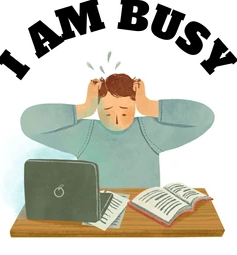
My aunt Vera could not sit in a quiet room without finding her hands a task. Busyness culture, the quiet agreement that our worth is measured by motion, teaches us to earn rest rather than simply have it, and it costs us the very connection it promises to protect. You are not lazy for wanting to stop. You may only be tired of performing.
Key Takeaways
- Busyness often works less like a schedule and more like a shield, keeping us too occupied to sit with quieter questions about who we are underneath the doing.
- Sociologists have long noticed that an overflowing calendar performs the same social function that leisure once did for the wealthy: it signals that you matter.
- The more fully we schedule our days, the less room remains for the unstructured, communal spaces where real belonging tends to form.
- Rest is not something you unlock by finishing enough. Treating it as a reward slowly wears down both the mind and the relationships around it.
- Naming busyness as a pattern we were taught, rather than a personal flaw, is usually the first real step toward loosening its grip.
The Woman Who Could Not Sit Still

Sunday dinner at my grandmother’s table ran on a rhythm only she fully understood, but there was one rule everybody knew without being told. Once the dishes were cleared, my aunt Vera would find something. A drawer that suddenly needed reorganizing.
A pot that did not require a second scrubbing. A nephew’s shirt missing a button it did not actually need replaced. My grandmother would watch her from the kitchen doorway and say the same thing every time, gently but plainly: Vera, sit down and be somebody’s company.
Vera rarely could. It was not that she disliked us. It was that stillness asked something of her that motion never did. When her hands were busy, nobody could ask how she was really doing, including her.
Years later, studying sociology made me realize that my aunt was in nearly every theory of modern work I read. She was not an outlier. She was an early warning.
What Busyness Culture Is Really Protecting Us From

We tend to talk about busyness as a scheduling problem, something a better calendar or a firmer no could fix. That framing is comforting because it makes the solution sound simple.
But busyness culture rarely survives on logistics alone. It survives because it is doing quiet emotional work, standing guard at the door of feelings we have not yet made peace with.
Erving Goffman spent much of his career describing how we perform versions of ourselves for whichever audience happens to be watching, saving our unguarded selves for whenever the curtain finally falls. Busyness has become one of our most trusted performances.
A full calendar announces, without a word of boasting, that you are needed, capable, and in demand. What it conveniently hides is everything happening backstage: the exhaustion, the loneliness, the nagging sense that if you ever stopped moving, no one would notice, or worse, no one would ask why.
I think often of how many of us answer “I’m fine” when someone asks how we are, using busyness the same way we use that phrase, as a door closed politely enough that no one thinks to knock again.
The cost of that particular kind of surface answer is one many of Callin’s readers already know well. It keeps us safe from being misunderstood. It also keeps us from being known.
The Inheritance of Always Doing
None of us invented this pattern on our own. Max Weber wrote, over a century ago, about how certain religious and economic shifts recast work from a practical necessity into something closer to a moral report card, proof of character rather than simply a way to eat. T
hat inheritance settled deep into the culture and never fully left. Many of us were praised as children for our grades and our schedules before we were ever praised for our presence, and the lesson took.
For some of us, the inheritance runs even more specifically. Scholars who study Black women’s mental health have written about what they call the strong Black woman schema, an unspoken expectation to be endlessly capable, endlessly composed, and endlessly available to everyone but yourself.
Vera never read those studies. She lived inside the pattern anyway, the way most of us do, learning early that being needed felt safer than being unnecessary, and that a full plate of responsibilities was easier to defend than an empty afternoon.
This is worth naming plainly, because so many of us quietly believe our worth was something we had to earn through output, and were never told outright that the belief was optional.
That particular ache, the sense that your value rises and falls with your productivity, deserves to be examined rather than simply managed with a better morning routine.
Where Belonging Used to Live
Robert Putnam spent years documenting the quiet disappearance of what sociologists call third places: the barbershop, the porch, the church basement, the corner diner where people gathered for no productive reason at all. These were not luxuries.
They were the informal architecture of community, the places where you were known simply for showing up, not for what you had accomplished that week.
Busyness culture and third places do not easily coexist. A life scheduled down to the last half hour has little room left for the aimless, unbilled hours where friendship actually deepens.
We have not stopped needing each other. We have simply run out of time we are willing to call unproductive, and so the spaces built for lingering have quietly closed, one by one, while we told ourselves we were too busy to notice.
I have watched this happen even at moments that were supposed to feel like arrival. The particular loneliness that shows up right after a promotion is a strange one, precisely because it looks, from the outside, like everything working out.
And still, coping with a culture that treats constant output as a virtue is something a great many people are quietly trying to figure out, often alone, often at the exact moment their calendars look fullest.
What Wu Wei and the Wild Woman Already Know
There is an older wisdom running underneath all of this, one my grandmother would have recognized even without the vocabulary for it.
The Taoist idea of wu wei, often translated as effortless action, does not ask us to stop moving through the world. It asks us to notice when we are fighting a current that would carry us anyway, spending ourselves on force where patience would have done the same work more gently.
Clarissa Pinkola Estés wrote about the wild woman archetype, the instinctive self that knows things the busy, managed self has forgotten how to hear.
That instinctive self does not measure a good life by the length of a to-do list. She measures it by whether she was truly present for the people and moments in front of her.
Every tradition that has survived long enough to write down its wisdom seems to arrive at some version of the same warning: a life spent entirely in motion eventually forgets what it was moving toward.
Making Room Without Turning It Into Another Project
Here is where I want to be careful, because the instinct at this point is usually to hand you a new system, a fresh set of habits to optimize, one more way to manage your way out of exhaustion using the same managing that caused it. I would rather tell you what tends to actually help, and let you decide what fits your life.
Protecting a little unscheduled time each week, even just an afternoon, tends to matter less for what you do with it and more for what it proves to your nervous system: that your calendar answers to you and not the other way around.
A brief pause between commitments, a few minutes of quiet before the next call or the next conversation, tends to lower the low-grade static that builds when we move from one demand straight into the next without ever fully arriving anywhere. And doing one thing at a time, difficult as that has become, tends to leave people less depleted than the constant switching we have started to mistake for efficiency.
None of this works especially well in isolation, which is worth saying plainly. Peer connection has been shown to guard against burnout in ways that solo productivity habits simply cannot reach, because burnout is rarely just a time management problem. It is often a connection problem wearing a scheduling costume.
Measuring a Day by Its Depth, Not Its List
Most of us end our days the same way, running down everything we finished and quietly grading ourselves against everything we did not. It is a tidy system, and it is also a trap, because it measures a day entirely by its output and never once asks about its texture.
A different question is worth trying instead. Not how much did I get done, but how present was I for the parts of today that mattered.
Did I let a conversation breathe instead of rushing it toward its conclusion.
Did I notice anything at all today that had nothing to do with my responsibilities. These questions will not show up on any performance review, and that is precisely the point.
Coming Back to the Table
My grandmother has been gone some years now, and the kitchen with her, but I think of Vera every time I catch myself reaching for a task simply to avoid an empty ten minutes. I understand her better now than I did as a child. Her constant motion was never really about the drawer or the button. It was about never having to sit still long enough to be asked, and to have to answer, how are you, really.
Some people find it easier to have that conversation with someone outside the family kitchen entirely, a confidential, non-clinical space to think out loud without worrying about becoming a burden to the people they love. That is part of what Callin was built for. Learning to live rather than simply keep existing rarely happens through one more productive week. It happens in the sitting down.
Be somebody’s company today, including your own.
Frequently Asked Questions About Busyness Culture
Why do I feel guilty when I’m not being productive?
That guilt is usually learned rather than natural. Most of us were praised early and often for our output, our grades, our schedules, and rarely for simply being present, so the nervous system quietly came to associate rest with a kind of failure. Recognizing that the guilt was taught is often the first step toward untangling it.
Is busyness a sign of anxiety?
Not always, but the two frequently travel together. For many people, constant activity functions as a way to avoid sitting with uncomfortable feelings, and the moment the schedule empties out, the anxiety that was being outrun tends to catch up. If stillness consistently feels unbearable, that discomfort is worth paying attention to rather than immediately scheduling over it.
How do I stop tying my self-worth to my productivity?
This tends to happen gradually rather than all at once, usually by practicing small moments of rest without requiring them to be earned first. Noticing the automatic thought that you have not done enough today, and simply questioning whether that thought is true, does more over time than any single dramatic change.
Does rest actually make people more effective, or is that just a wellness trend?
Research on attention and cognitive fatigue consistently shows that sustained focus without recovery leads to more mistakes and slower work, not less. Rest is not the opposite of productivity. It is one of the conditions that makes sustainable effort possible in the first place.
Why does slowing down sometimes feel lonelier than staying busy?
Busyness can act as a distraction from feelings of disconnection, so when the activity stops, those feelings often surface for the first time in a while. That is not a sign something is wrong with you. It is usually a sign that the loneliness was there all along, simply drowned out.
Can peer support help with burnout caused by busyness culture?
Yes, and often in ways solo strategies cannot. Talking through the exhaustion with someone who is genuinely listening, rather than immediately offering advice or comparing schedules, tends to relieve the isolation that busyness quietly creates, which is a different kind of relief than simply blocking off more free time.
What is the difference between healthy productivity and busyness culture?
Healthy productivity is chosen and tends to leave you with energy left over for the people and things you care about. Busyness culture is compulsory and tends to leave you depleted, disconnected, and slightly anxious the moment your calendar opens up. The difference often shows up less in what you are doing and more in how you feel once you stop.

Leave a Reply