Men seeking emotional support often face more than simple reluctance. Many have learned that competence means coping alone, vulnerability carries social risk, and feelings should be translated into action before they can be spoken. This does not mean men feel less. It means many men have been given fewer safe, practiced routes into an honest conversation.
Key Takeaways
- Men are not naturally less emotional. Cultural expectations often shape which emotions they can safely express and how they communicate distress.
- Self-reliance can be useful, but rigid self-reliance may turn ordinary help-seeking into a threat to a man’s identity.
- Distress in men may appear as irritability, withdrawal, overwork, numbness, substance use, or risk-taking, although none of these automatically indicates a mental health condition.
- Men tend to find support easier when it is confidential, specific, respectful of autonomy, and focused on understanding rather than judgment.
- Emotional support does not have to begin with therapy. A trusted person, peer listener, support group, GP, or mental health professional may each fit different levels of need.
Why Do Men Find It Hard to Seek Emotional Support?
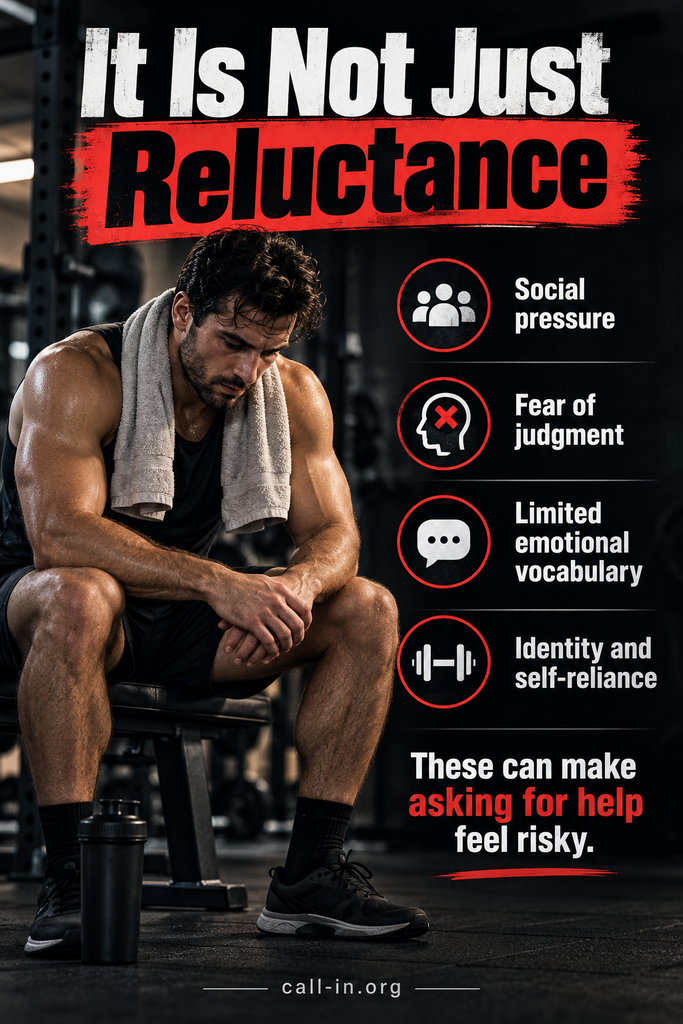
The short answer is social learning, identity, stigma, emotional language, trust, and access. Age, culture, race, sexuality, disability, religion, income, family history, and previous experiences all influence whether asking for help feels sensible, pointless, or dangerous.
The gap is visible in service use. In the United States, 2024 national health data showed that 10.9 percent of men had received counseling or therapy during the previous year, compared with 16.9 percent of women. This does not mean women have more feelings. It means men and women do not reach care through identical pathways.
The consequences of unmet need matter. In England and Wales, the 2024 suicide rate was 17.6 deaths per 100,000 males and 5.7 per 100,000 females. Suicide has many causes, so help-seeking alone cannot explain this difference. Still, lower use of support should never be mistaken for lower need.
Research has examined those pathways for decades. A foundational review by psychologists Michael Addis and James Mahalik argued that men’s help-seeking is highly contextual. A man may ask for assistance in one setting but avoid it in another, depending on whether the problem threatens his sense of control and what he expects the social cost to be.
Many Men Learn That Strength Means Emotional Self-Sufficiency
From childhood, some boys receive a narrow emotional education. Anger, humor, competitiveness, and confidence may be accepted. Fear, tenderness, shame, sadness, and the wish to be comforted may be mocked, minimized, or quietly redirected.
The lesson is rarely delivered as a formal speech. It arrives through reactions: “Shake it off.” “Man up.” “Do not let them see you cry.” A boy can learn that the feeling itself is not the problem. Being witnessed having it is.
Many men are not afraid of emotion in private. They are wary of making emotion visible. Support can feel risky when openness has previously led to ridicule, rejection, unwanted advice, or a disclosure being used as ammunition later.
Asking for Help Can Feel Like an Identity Threat
For someone who defines himself through usefulness, control, protection, or competence, receiving support may feel uncomfortably close to failing at those roles. The question is no longer only, “Would talking help?” It becomes, “What does needing to talk say about me?”
A systematic review of masculinity and depression found that stronger conformity to traditional masculine norms could affect how men experienced symptoms, whether they sought help, and how they managed distress.
The problem is not masculinity itself. Courage, responsibility, loyalty, and perseverance can all support well-being. Difficulty emerges when strength is defined so rigidly that no form of receiving care is allowed inside it.
There is a strange cultural contradiction here. We admire men who take responsibility for problems, yet may shame them for using one of the most responsible tools available: support.
Nobody thinks less of a roof because it needs beams. Human beings are apparently expected to manage superior engineering through denial.
Stigma Is Not Merely “What Other People Think”
Mental health stigma is often discussed as if a man could defeat it by becoming more confident.
In reality, stigma can have consequences. Men may worry about being treated differently at work, losing status in their family, being perceived as unstable, or becoming the subject of jokes among friends.
The World Health Organization’s review of men, culture, and mental health found that masculine norms, social expectations, and the design of services can all influence help-seeking. These pressures vary between groups. A gay man, a Black man, a migrant, a military veteran, a new father, and an older widower may meet different versions of the command to remain silent.
This is why “men should just open up” is not a complete solution. Disclosure requires somewhere safe to land. If a culture celebrates vulnerability in theory but punishes it in practice, men notice the discrepancy.
Men May Not Recognize Distress as Emotional Distress
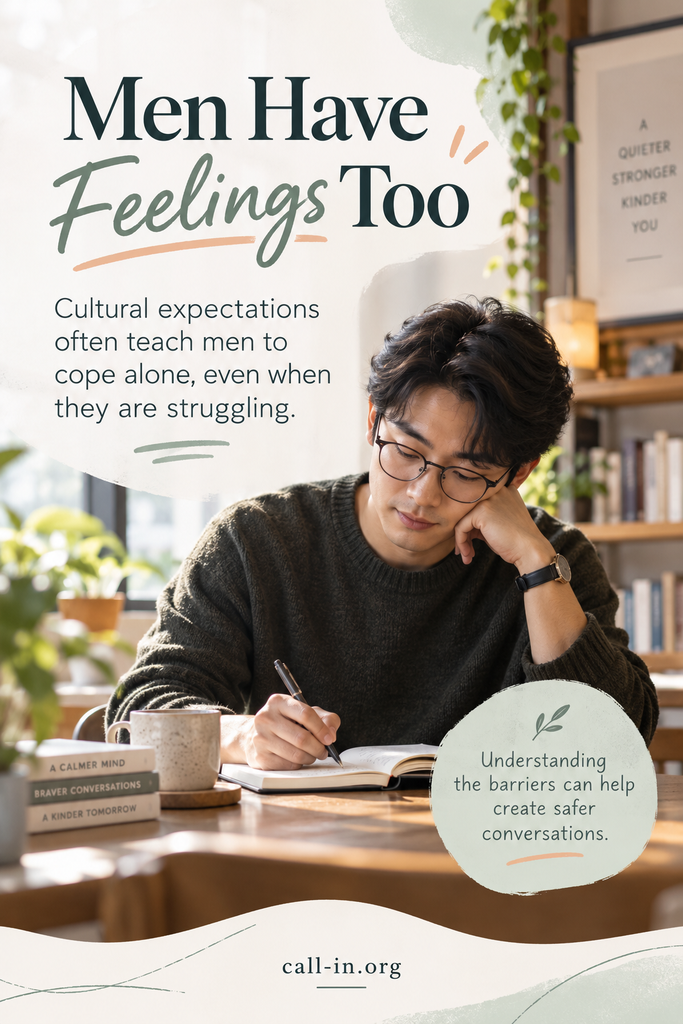
Before someone can seek support, he has to recognize that support is relevant. Yet distress does not always arrive wearing a neat label that says sadness or anxiety. It may feel like constant irritation, exhaustion, poor concentration, physical tension, insomnia, reckless behavior, drinking more, working later, or wanting everyone to leave him alone.
Research on externalizing symptoms describes anger, aggression, avoidance, substance use, and risk-taking as possible expressions associated with depression in some men. This requires nuance. Anger is not always depression, and emotional pain does not excuse frightening or abusive behavior. Distress may still be misread as a personality problem or “just stress” until it becomes severe.
The first barrier to emotional support is sometimes not disclosure. It is recognition.
Some Men Have Feelings but Not the Vocabulary
Knowing that something is wrong is different from being able to describe it. Psychologists use the term alexithymia for difficulty identifying and putting feelings into words. Researchers have also studied “normative male alexithymia”, the idea that gender socialization can contribute to restricted emotional language in some men.
This can produce conversations in which a man says, “I’m tired,” “I’m stressed,” or “It is what it is,” because those are the words available. Underneath may be grief, humiliation, fear, loneliness, rejection, helplessness, or several emotions having an unsupervised committee meeting.
Emotional vocabulary is not decorative. It helps a person distinguish what kind of support might fit. If every uncomfortable state is called stress, the response may always be distraction, even when the actual need is reassurance, mourning, rest, connection, or professional care.
Male Friendships May Be Close Without Being Disclosure-Ready
Many men have loyal, meaningful friendships built around shared activity, humor, work, sport, gaming, faith, or long history. Those bonds are real. Still, a friendship can be close without having an established language for emotional disclosure.
Qualitative research on masculinity and social connectedness has found diverse patterns. Some men mobilize support effectively, while others connect socially but avoid revealing distress. A man may have people who would help him and still have no practiced route into the conversation.
Moving from football, work, and family updates to “I have not felt like myself for months” can feel like changing lanes at high speed. The problem is not always a lack of love. Sometimes the relationship has never rehearsed that move.
Why “Just Go to Therapy” Can Miss the Point
Therapy can be valuable, and it may be essential when symptoms are persistent, severe, traumatic, or affecting daily functioning. But therapy is not the only legitimate form of support, nor is every difficult feeling evidence of a mental disorder.
Some men want to talk before a problem becomes a crisis. They may need help processing a breakup, loneliness, workplace pressure, fatherhood, retirement, grief, identity, or a decision they cannot discuss comfortably with people close to them. For these situations, the choice should not be limited to “cope alone” or “enter clinical treatment.”
That missing middle may include a trusted friend, a men’s group, a faith or community leader, a trained peer listener, or another confidential option. Knowing the difference between non-clinical emotional support and therapy can help a man choose support based on what he needs, rather than waiting until his distress becomes unbearable.
What Makes Emotional Support Easier for Men?
Research suggests that engagement improves when support respects autonomy, uses relatable language, offers clear information, and feels relevant to men’s lives. A systematic review of male-focused interventions found that role models, information about symptoms and services, and accessible routes into help could improve attitudes or behavior, although the evidence base still needs development.
Several conditions tend to make the first conversation easier:
- A specific opening. “You seem quieter than usual. How have you been sleeping?” may be easier to answer than “Tell me about your feelings.”
- Permission to begin imperfectly. A man does not need an elegant explanation. “I do not know what is wrong, but I am not doing well” is enough to start.
- Confidentiality and trust. People disclose more honestly when they understand who will hear the information and what will happen next.
- Choice and control. Options such as online emotional support, a GP appointment, a support group, or a private conversation allow the person to choose a tolerable first step.
- Listening before fixing. Immediate advice can accidentally confirm that difficult feelings are problems to eliminate rather than experiences that can be understood.
- Continuity. Speaking with the same person over time reduces the burden of explaining the entire emotional backstory from episode one.
Support becomes more approachable when it is framed as a resource, not a verdict. Asking for help can be understood as information gathering, load sharing, or protecting the people and responsibilities a man values. This is not clever packaging for weakness. It is a more accurate description of healthy support.
How Can You Help a Man Open Up Without Pressuring Him?
If you are worried about a partner, friend, colleague, brother, or father, curiosity usually works better than interrogation. Mention what you have noticed without diagnosing him. Give him room to answer now, later, or while doing something else.
It also helps to make the offer concrete. “Do you want me to listen, help you think through options, or simply sit with you?” removes the fear of receiving the wrong kind of response. If he shares something vulnerable, resist teasing, minimizing, broadcasting it, or using it to win a future disagreement. Safety is built from what happens after disclosure.
Respecting autonomy does not mean ignoring danger. Sudden withdrawal, hopelessness, talk of being a burden, escalating substance use, or references to death deserve direct, calm attention and appropriate professional or emergency support.
When Does a Man Need More Than Everyday Emotional Support?
Clinical support may be appropriate when distress is persistent, worsening, connected to trauma, or interfering with sleep, work, relationships, hygiene, eating, concentration, or safety. A GP or licensed mental health professional can assess symptoms and discuss treatment options. A person does not need to wait for complete collapse or arrive with a self-diagnosis.
Non-clinical support can sit alongside professional care, but it should not replace diagnosis, therapy, medication management, or crisis intervention when those are needed. The goal is not to force every emotional need into the same category. It is to match the level of support to the level of need.
Seeking Support Is Not the Opposite of Strength
Men do not struggle to seek emotional support because they are incapable of intimacy or unconcerned about their well-being. Often, they are responding logically to lessons, environments, and previous experiences that made silence feel safer. Those patterns can change when support offers dignity, privacy, useful language, and a manageable first step.
For men who want an objective place to talk without burdening family, friends, coworkers, or partners, Callin offers confidential, non-clinical online emotional support with trained peer active listeners. The first 20-minute session is free, giving someone space to experience the conversation before deciding whether ongoing support feels right.
Needing another human being is not evidence of defective independence. It is evidence of being human. The aim is not to make every man narrate his soul on command. It is to ensure that when he is ready to speak, there is somewhere safe enough to hear him.
If you or someone else may be in immediate danger in the UK, call 999 or go to A&E. For urgent mental health support that is not an emergency, call NHS 111 and select the mental health option. Samaritans can be reached free at 116 123, and Shout offers free 24-hour text support by texting SHOUT to 85258. Outside the UK, contact your local emergency service or crisis line.
Frequently Asked Questions
Are Men Naturally Less Emotional Than Women?
No. Research does not support the idea that men simply possess fewer emotions. Biology, personality, culture, and social learning all influence emotional experience and expression. Men may display, label, or manage feelings differently, but difference in expression should not be mistaken for absence.
Why Do Men Avoid Therapy?
Some men avoid therapy because of stigma, cost, access problems, confidentiality concerns, poor previous experiences, or the belief that they should cope alone. Others do not recognize their distress as something therapy could help. The barrier needs to be understood before the right option can be offered.
How Can a Man Ask for Emotional Support if He Does Not Know What to Say?
He can begin with the impact rather than the emotion. “I am not sleeping,” “I cannot switch my mind off,” “I have been angry with everyone,” or “I do not feel like myself” gives the listener somewhere to begin. Emotional clarity can develop during a safe conversation. It is not an entrance exam.
Is Anger a Sign of Depression in Men?
Anger and irritability can occur alongside depression in some men, but anger alone does not prove that someone is depressed. Depression may also involve low mood, loss of interest, sleep changes, fatigue, hopelessness, poor concentration, or thoughts of death. A qualified professional can assess persistent or concerning symptoms.
What Emotional Support Is Available for Men Who Do Not Want Therapy?
Options include trusted friends, peer groups, trained active listeners, community organizations, faith leaders, workplace well-being services, and confidential online support. These can help with everyday distress and connection. Severe, persistent, or safety-related symptoms require professional assessment.
How Can I Encourage a Man to Seek Help Without Making Him Defensive?
Describe what you have noticed, express care, and offer choices. A calm statement such as “You have seemed exhausted and unlike yourself lately. Would it help to talk to me, your GP, or someone confidential?” preserves dignity and autonomy. If there is an immediate safety concern, be direct and seek urgent help.

Leave a Reply