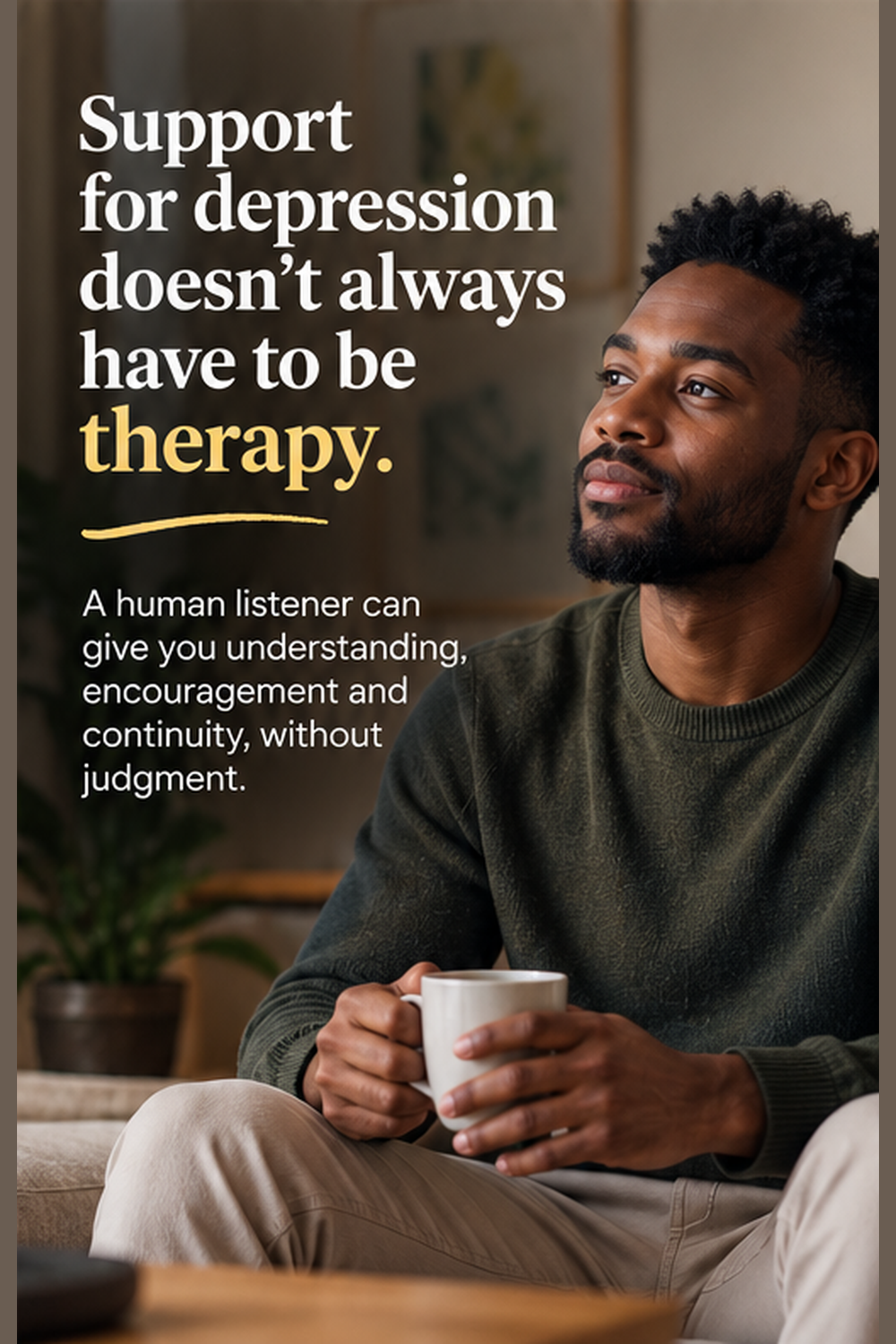
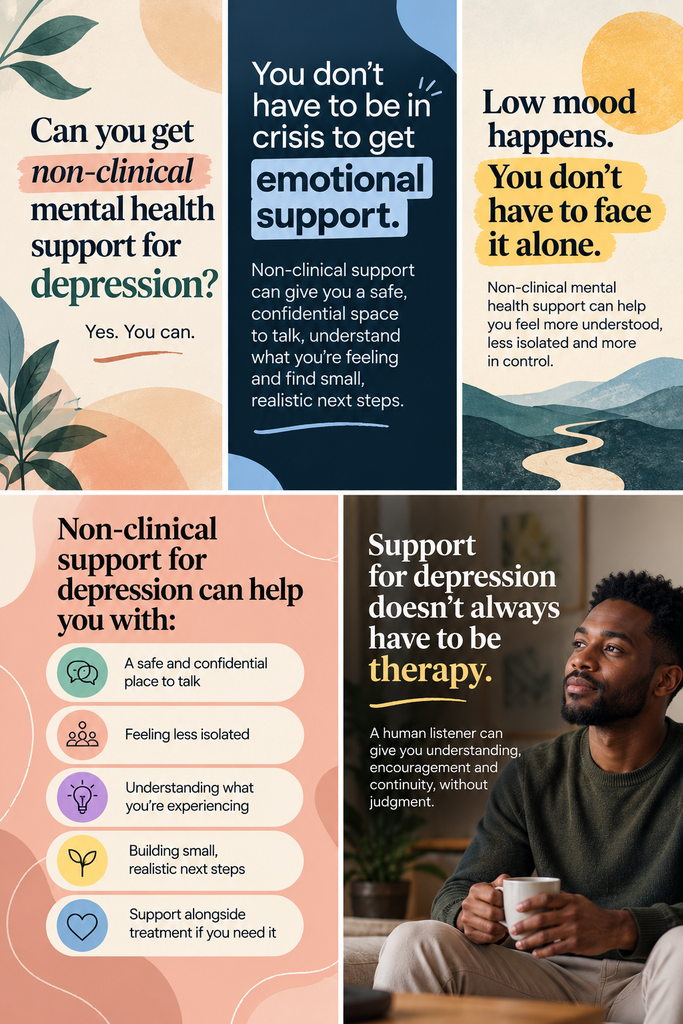
Yes, you can get non-clinical mental health support for depression. It can provide a confidential place to talk, reduce emotional isolation, help you understand what you are experiencing, and support everyday coping. It is best used as part of a wider support system, not as a replacement for clinical assessment, therapy, medication, or urgent care when those are needed.
Key Takeaways
- Non-clinical support can offer listening, connection, encouragement, and continuity, but it does not diagnose or treat depression.
- Depression is more than a difficult week. Persistent symptoms that affect daily life deserve assessment by a GP or qualified mental health professional.
- Social support matters. Research links poorer perceived support and greater loneliness with worse depression outcomes, although support alone is not a cure.
- You can use non-clinical support before treatment, while waiting for care, alongside therapy or medication, and after treatment as part of ongoing emotional support.
- If you are thinking about suicide, cannot keep yourself safe, or your condition is deteriorating quickly, seek urgent or emergency help rather than relying on a non-clinical service.
What Is Non-Clinical Mental Health Support for Depression?
Non-clinical mental health support is human support that does not involve diagnosis, psychotherapy, prescribing medication, or managing a mental health crisis.
It may come from a trained peer listener, support group, community service, trusted person, helpline, or structured listening platform. Its purpose is to help you feel heard, less alone, and better able to process what is happening.
For someone with depression, that may mean describing the heaviness without being rushed toward advice. It might involve talking through loneliness, relationship strain, shame, grief, or practical difficulties.
A listener may help organize your thoughts and identify possible next steps, but should not claim to cure depression or tell you to abandon clinical care.
“Non-clinical” does not mean unimportant. It describes the scope of the support, not the value of the conversation. Food is not medicine, friendship is not therapy, and sleep is not psychiatry, yet each can still matter enormously to a person’s health.
Can Non-Clinical Support Actually Help With Depression?
It can help with parts of the experience, particularly isolation, emotional overload, and the difficulty of carrying everything privately. The World Health Organization’s guidance on depression includes staying connected and talking to someone you trust among the actions that can support recovery, alongside seeking care from a healthcare provider.
Research suggests that social support is relevant to how depression unfolds. A systematic review of longitudinal studies found that people with depression who perceived poorer social support tended to have worse symptoms, recovery, and social functioning. The relationship can run both ways: depression can weaken connection, while poor support may make depression harder to navigate.
Some structured peer-support interventions have reduced depressive symptoms in research, including a meta-analysis of randomized trials. However, peer-support programs vary widely, and their findings cannot be transferred wholesale to every listening service. The responsible conclusion is that non-clinical support may contribute to recovery and connection. It is not evidence that a supportive conversation replaces evidence-based treatment.
Depression often shrinks a person’s world. Non-clinical support may not rebuild the entire world, but it can help reopen one door.
How Do I Know Whether It Is Depression or a Low Mood?
Everyone experiences sadness, disappointment, exhaustion, or periods of low mood. Depression is different because symptoms tend to persist and interfere with everyday life. According to the NHS guidance on depression symptoms, it is sensible to see a GP when symptoms occur for most of the day, every day, for more than two weeks.
Possible symptoms include persistent sadness or emptiness, hopelessness, guilt, low self-esteem, loss of interest or pleasure, low energy, irritability, difficulty making decisions, changes in sleep or appetite, withdrawing from others, and thoughts of self-harm or suicide. People experience depression differently, and you do not need to have every symptom.
A trained peer listener can hear what you are experiencing, but cannot determine whether you have a depressive disorder or how severe it is. Diagnosis requires a qualified professional who can consider your symptoms, functioning, medical history, physical health, and other explanations. The internet may offer seventeen diagnoses before breakfast. Your care deserves more context than that.
What Can Non-Clinical Depression Support Help With?
Having Somewhere to Say the Unedited Version
Depression can make people censor themselves. You may worry that friends are tired of hearing about it or that your partner will feel responsible. A confidential conversation can provide room for the version that is not tidied up for public consumption.
Being heard does not automatically remove depression. It can, however, reduce the additional strain of performing “fine” while struggling internally. Sometimes the first relief is not feeling better. It is no longer having to hide how bad you feel.
Reducing Emotional Isolation
Depression frequently encourages withdrawal, then uses the resulting isolation as evidence that nobody cares. A scheduled conversation can interrupt that loop by creating reliable human contact. This is especially relevant for people who live alone, work remotely, have recently moved, or do not feel able to discuss their mental health within existing relationships.
Connection should not be oversold as a cure. It is not merely a pleasant extra either. Consistent contact can help keep a person connected to life outside the illness.
Making the Experience Easier to Understand
Depression can turn thoughts into a crowded room where everyone is speaking at once and none of them has useful minutes from the last meeting. Talking aloud may help separate facts from fears, identify recurring pressures, and give language to experiences that previously felt like one solid mass.
This is where active listening can be valuable. A trained listener may reflect what they heard, notice themes, ask clarifying questions, and allow pauses without treating silence as a technical fault. They are not delivering therapy. They are helping you hear your experience more clearly.
Supporting Small, Realistic Next Steps
Depression can make ordinary tasks feel administratively hostile. Booking a GP appointment, replying to a message, eating something, or opening the curtains may require more energy than outsiders realize. Non-clinical support can help you think through what feels manageable without pretending that a cheerful checklist will defeat a health condition.
The next step might be contacting a GP, asking someone to attend an appointment, exploring NHS Talking Therapies, or making a plan for the evening. The goal is not supervision. It is reducing the fog around the decision.
Providing Support Alongside Treatment
Therapy and medical appointments occupy only a small part of a person’s week. Depression continues between them. Non-clinical support offers another place to discuss everyday experiences, relationships, setbacks, and the frustration of recovery taking longer than expected.
It should complement the clinical plan rather than compete with it. A non-clinical listener should not advise you to change medication, reinterpret a therapist’s guidance, or position themselves as the person who understands you better than your care team. Good support respects its own boundaries.
https://tidycal.com/m4gyjln/callin-support-free-session
What Can Non-Clinical Support Not Do?
Non-clinical support cannot diagnose depression, assess its clinical severity, prescribe or review medication, provide psychotherapy, or manage a mental health emergency. It also cannot guarantee that symptoms will improve. Any service promising to cure depression through listening alone is making a promise the evidence does not support.
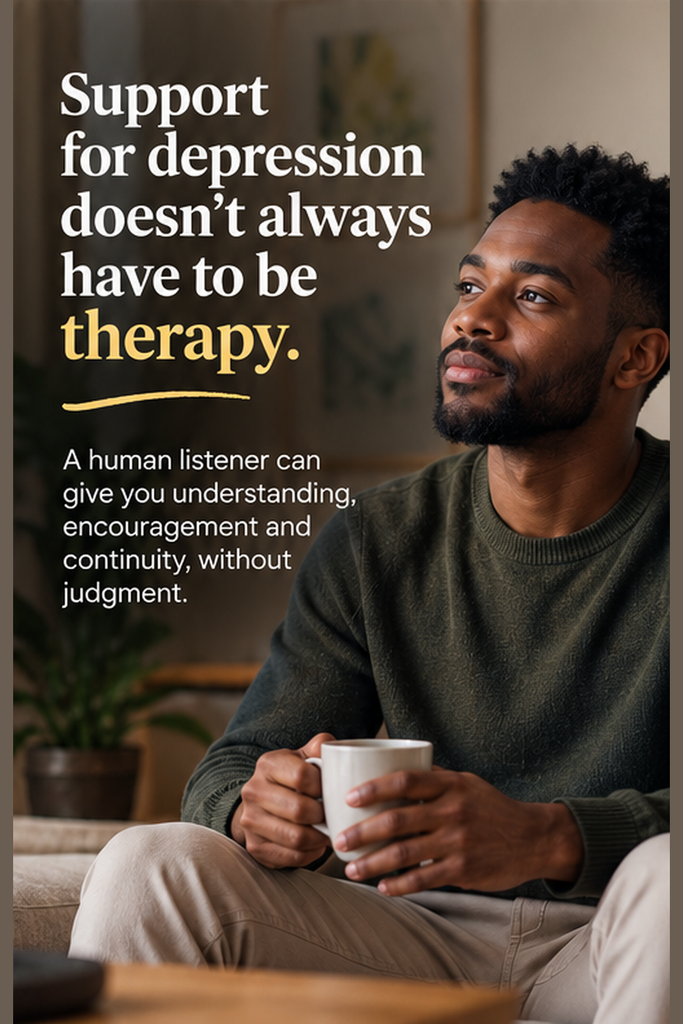
This does not make the service pointless. It makes the relationship clearer. A good non-clinical provider knows when listening is appropriate, when a person may benefit from clinical care, and when immediate escalation is necessary.
Clinical care asks what condition may be present and which evidence-based treatment fits. Non-clinical support asks what living through this is like today, what feels hardest, and what human support would help you carry it.
Do I Need Non-Clinical Support, Therapy, or a Doctor?
You do not always have to select one permanent category. Different forms of support can work together, and your needs may change over time.
A GP or qualified mental health professional is an important starting point if you think you may have depression, particularly when symptoms have lasted more than two weeks, keep returning, or affect work, sleep, eating, hygiene, relationships, concentration, or safety. The NICE guideline on depression in adults recommends matching care to clinical need, personal preferences, previous treatment, and the severity and duration of symptoms.
Therapy may address depressive thinking, behavior, relationships, trauma, grief, or recurring patterns through a structured clinical approach. Medication may be recommended after assessment. NHS guidance explains that treatment can include guided self-help, exercise programs, talking therapies, medication, or combinations of these.
Non-clinical support may fit when you need a confidential person to talk to, want support while waiting for treatment, or feel isolated between appointments. Understanding the difference between non-clinical mental health support and therapy can make the decision less mysterious. The better question is often, “What combination of support fits what I am facing?”
Can I Get Support if I Have Not Been Diagnosed?
Yes. You do not need a diagnosis to deserve a conversation or to seek support. You may know only that you feel persistently low, disconnected, exhausted, or unlike yourself. Non-clinical emotional support can give you room to talk while you decide whether to approach a GP or another professional.
However, a listening service should not confirm that you have depression based on a conversation. Some physical conditions, medications, substance use, grief, bipolar disorder, trauma, and other mental health conditions can involve symptoms that overlap with depression. Assessment matters because the right support depends partly on what is actually happening.
You are also allowed to seek clinical advice before you are certain. A GP appointment is not a courtroom in which you must prove your sadness beyond reasonable doubt. “I have not felt like myself for several weeks” is a valid place to begin.
What Should I Look for in a Non-Clinical Support Service?
A trustworthy service should explain what it does, what it does not do, how listeners are trained, how confidentiality works, and what happens if someone may be at risk. It should be honest about pricing and avoid promises of treatment, cure, or guaranteed emotional transformation.
Continuity may also matter. Depression can make repeating your history exhausting. Speaking with the same listener creates familiarity and avoids beginning every conversation with a full documentary recap.
The relationship should feel respectful rather than controlling. You should be able to ask questions, understand the boundaries, and stop if the service does not feel right. Support is not automatically good merely because someone has offered it. Quality, safety, and fit still matter.
What if Depression Makes Reaching Out Feel Impossible?
Depression often interferes with the very actions that might bring support. It reduces motivation, creates hopeless predictions, and may tell you that you are a burden. The difficulty reaching out can be part of the condition, not evidence that you do not want help badly enough.
The opening does not need to be eloquent. You might say, “I think I may be depressed,” “I have been struggling for weeks,” “I do not know what I need, but I need to talk,” or “Can you stay with me while I contact someone?” A small sentence can carry a serious amount of truth.
If arranging support feels too difficult, someone you trust might help make an appointment, write down what has been happening, or join the call. Accepting practical help does not invalidate your independence. Sometimes independence includes refusing to let the illness make every decision.
Non-Clinical Support Can Be Part of the Answer
Depression deserves to be taken seriously, but seriousness does not require turning every supportive conversation into a clinical encounter. People also need warmth, continuity, dignity, and somewhere to speak without worrying about exhausting the people they love. Treatment can address the disorder while non-clinical support helps address some of the loneliness and everyday emotional weight around it.
For people who want an objective, confidential place to talk alongside appropriate clinical care, Callin offers non-clinical online emotional support with trained peer active listeners. The first 20-minute session is free, so you can experience the conversation before deciding whether ongoing support feels useful.
You do not have to become “unwell enough” to deserve human support. You also do not have to pretend that human support can do everything. The kindest approach is an honest one: use connection for what connection can provide, and seek clinical care for what requires clinical expertise.
If you may harm yourself, have seriously injured yourself, taken an overdose, or cannot keep yourself safe, call 999 or go to A&E now. For urgent mental health help in the UK that is not an immediate emergency, call NHS 111 and select the mental health option. You can also call Samaritans free at 116 123 or text SHOUT to 85258 for Shout’s free 24-hour support. Outside the UK, contact your local emergency service or crisis line.
Frequently Asked Questions
Can Non-Clinical Support Treat Depression?
No. Non-clinical support can help with connection, emotional processing, and everyday coping, but it is not a treatment for a depressive disorder. Evidence-based treatment may include guided self-help, psychological therapy, medication, or a combination chosen with a qualified professional.
Can I Use Non-Clinical Support While Taking Antidepressants?
Yes. Emotional support can sit alongside prescribed medication and clinical appointments. A non-clinical listener should not advise you to start, stop, or change an antidepressant. Questions about effectiveness, side effects, missed doses, or withdrawal should go to your prescriber, pharmacist, or another qualified healthcare professional.
Can I Talk to Someone About Depression Without Having a Diagnosis?
Yes. You do not need a diagnosis to talk about persistent low mood, numbness, isolation, or emotional exhaustion. If symptoms last, worsen, or affect daily functioning, a GP or mental health professional can assess what may be happening and discuss suitable care.
Is Peer Support the Same as Therapy?
No. Peer support usually draws on listening, shared humanity, lived experience, encouragement, or mutual understanding. Therapy is a clinical intervention delivered within a professional framework by an appropriately trained practitioner. Both can be valuable, but they have different purposes, responsibilities, and boundaries.
What if I Do Not Know What to Say in a Support Session?
You can begin with the effect depression is having: “I cannot get myself to do anything,” “I feel detached from everyone,” or “Everything takes too much effort.” You do not need to explain your entire life in the correct order. A good listener can begin where you are.
When Is Depression an Emergency?
Depression requires urgent help when you may harm yourself or someone else, cannot keep yourself safe, have taken an overdose, are experiencing severe self-neglect, or have symptoms such as hallucinations or delusions. Contact emergency or urgent mental health services immediately. A non-clinical listening appointment is not the appropriate level of care in those circumstances.

Leave a Reply