Looking for affordable options when mental health support is expensive? Mostly because good care depends on skilled human time, years of training, supervision, and systems that still have more demand than capacity.
If you have ever seen the price of weekly therapy, done the monthly arithmetic, and quietly closed the tab, you are not failing at self-care. There are affordable mental health support options, and choosing one begins with understanding what kind of help you actually need.
Key Takeaways
- Mental health care is labor-intensive. A session fee also helps cover training, supervision, administration, insurance, and the time required to practice safely.
- In 2026, more than half of therapists advertising in the BACP directory list fees between £40 and £60 per session. Four sessions can therefore cost £160 to £240.
- A higher fee does not automatically mean better therapy. Qualifications, registration, relevant experience, fit, and the right type of support matter more than price alone.
- Free and lower-cost routes include NHS services, reduced-fee therapists, supervised training clinics, workplace or university counseling, groups, charities, and peer support.
- Not every difficult feeling requires therapy, but persistent, severe, or high-risk symptoms deserve appropriate clinical assessment and care.
Why Is Mental Health Support So Expensive?
Mental health support is often delivered one person at a time. It cannot be manufactured once and sold endlessly, and a therapist cannot safely hold 40 emotionally demanding sessions in a day, however enthusiastic their calendar may be.
That human limitation makes good support valuable and costly. The uncomfortable truth is that care can be expensive for the client while the professional is still not especially well paid.
You are paying for more than the visible hour
A 50-minute appointment is the part you see. Behind it may sit years of study, clinical placements, professional registration, supervision, continuing education, insurance, records, safeguarding, and unpaid administration. Private practitioners may also pay for confidential premises, secure technology, taxes, and late cancellations.
This does not make every fee affordable or every practitioner good. It simply explains why comparing a therapy hour with an ordinary conversation can be misleading. The price of a therapy hour includes work you never see.
One-to-one care is difficult to scale
Some services become cheaper as more people use them. Human attention works differently. Digital tools, groups, and online appointments can reduce some costs, but individual care still requires one trained person to be present with one client. Ethical work also requires attention and sound judgment, especially when trauma, risk, or complex symptoms are involved.
Public services have limited capacity
Free care is not costless. Its cost is carried collectively, and when funding or workforce capacity falls behind demand, people often pay in another currency: waiting, eligibility rules, restricted choice, or fewer sessions.
This is a global systems problem, not evidence that mental health needs are somehow excessive. The World Health Organization’s Mental Health Atlas 2024 found that median government spending on mental health remained at only 2% of health budgets, unchanged since 2017. It also reported a global median of just 13 mental health workers per 100,000 people.
Demand is greater than the old system was built to hold
More people now recognize anxiety, depression, burnout, trauma, and loneliness as valid reasons to seek help. That awareness is progress, but appointment capacity has not grown neatly alongside it.
In BACP’s nationally representative 2026 Public Perceptions Survey, 35% of people who considered therapy but did not pursue it cited cost, while 22% cited long waiting lists. Sometimes the barrier is not willingness. It is a system asking a strained person to become a researcher, budget analyst, and project manager before anyone will listen.
How Much Does Private Therapy Cost in the UK?
Fees vary by location, experience, specialization, and therapy type. According to the British Association for Counselling and Psychotherapy, more than half of therapists advertising in its directory list £40 to £60 per session. Weekly, that is £2,080 to £3,120 a year before missed-session fees.
Some practitioners charge less, while specialists or therapists in higher-cost areas may charge more. Many offer a free introduction or reduced rates. Asking about money is a normal practical question, not a confession of poor character.
Does More Expensive Therapy Mean Better Therapy?
Not automatically. A higher price may reflect advanced training, specialist expertise, location, or simply the economics of a particular practice. It cannot guarantee trust, emotional safety, progress, or a therapeutic approach that suits you.
The relationship matters, as do competence and relevant experience. BACP warns that anyone can call themselves a counselor and open a private practice in the UK, so professional registration matters. The NHS recommends choosing a private therapist registered with an organization accredited by the Professional Standards Authority.
Low-cost does not mean low-quality. A service may be subsidized, online, charitable, group-based, or delivered by a trainee under qualified supervision. The useful question is not, “Is this the most expensive option I can endure?” It is, “Is this safe, suitable, credible, and sustainable?”
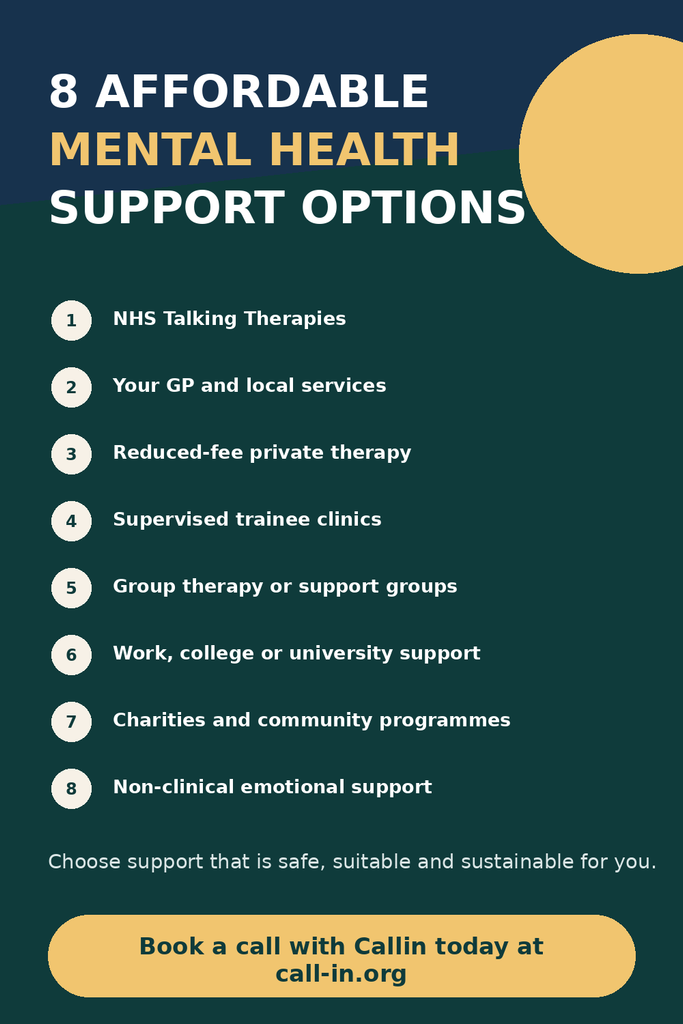
8 Affordable Mental Health Support Options
Affordable support is a range of services with different purposes. Think of it as a support ladder, where the right rung depends on whether you need treatment, assessment, practical guidance, shared experience, or a steady human conversation.
1. NHS Talking Therapies
In England, adults can often self-refer to NHS Talking Therapies for anxiety and depression without a diagnosis or GP appointment. You generally need to be registered with a GP and at least 18, although some services accept people aged 16 or 17. The care is free, and the provider should explain its waiting time.
Support may include guided self-help, cognitive behavioral therapy, counseling, or group work. In Scotland, Wales, and Northern Ireland, a GP or local NHS website is usually the best starting point. If you are unsure whether self-referral fits, speak with a GP.
2. Your GP and local community services
A GP can discuss symptoms, rule out physical contributors, explain treatment choices, prescribe medication when appropriate, and make referrals. They may also know about local charities, social prescribing, bereavement services, or condition-specific programs that are difficult to find online.
It can help to describe the effect on daily life, not only the emotion. Sleep, appetite, concentration, work, relationships, self-care, and safety give the clinician a clearer picture. “I am functioning, but it is taking everything I have” is useful information too.
3. Reduced-fee private therapy
Many private therapists reserve some appointments for people on lower incomes. Useful search terms include “sliding-scale counseling,” “reduced-fee therapist,” and “low-cost counseling for adults,” followed by your town or “online.” BACP says many practitioners in its directory offer reduced rates, so it is reasonable to ask directly.
Ask whether the lower fee is permanent, whether frequency can change, and what happens if your income changes. Fortnightly sessions may suit some people, but frequency should be a clinical conversation, not a silent compromise.
4. Supervised trainee counseling clinics
Universities, training institutes, and nonprofit counseling centers sometimes offer lower-cost sessions with advanced trainees. The work should have qualified supervision, and the trainee’s status should be clear. This can provide thoughtful care at a lower price.
Some training clinics cannot support current psychosis, severe trauma, high suicide risk, or other complex needs. Ask about supervision, registration, confidentiality, exclusions, and referral arrangements. A clear boundary is a safety feature, not a rejection.
5. Group therapy and facilitated support groups
Groups can reduce cost because one professional supports several people at once. A therapy group may teach skills or explore relationship patterns, while a peer support group usually centers shared experience and mutual understanding. Those are different offers, and both can be valuable.
Some people imagine revealing their life story to twelve strangers beneath hostile fluorescent lighting. A well-run group should explain its boundaries, confidentiality, format, and participation before you begin. Mind offers a guide to deciding whether peer support is right for you.
6. Support through work, college, or university
Your employer may provide a confidential Employee Assistance Program, occupational health support, or a limited course of counseling. Colleges and universities may offer free counseling, well-being teams, disability support, advice services, or student peer networks. BACP lists both workplace and education services as possible free routes.
Before using an employer service, ask what remains confidential, how many sessions are included, and what the provider reports. Students can check their institution or Student Minds’ overview of university support. These services can be brief, but brief does not mean pointless.
7. Charities, community programs, and peer support
Local and national charities may offer helplines, counseling, befriending, groups, or support focused on bereavement, caring, identity, debt, addiction, or a particular health condition. Some are free; others request a donation or use an income-based fee. Availability varies by area, which is frustrating, but local specificity can also make the support more relevant.
Peer support can reduce the feeling that your brain alone schedules emergency board meetings at 3 a.m. It offers recognition, practical knowledge, and connection. It is not assessment or treatment, so look for clear moderation, safeguarding, and referral boundaries.
8. Non-clinical emotional support
Sometimes you do not need a diagnosis or treatment plan. You need somewhere to say the whole thing, organize your thoughts, and feel heard without burdening a friend. Non-clinical emotional support can fit stress, loneliness, overthinking, burnout, relationship strain, and waiting for care.
This kind of support should be honest about its limits. An active listener does not diagnose depression, provide psychotherapy, manage medication, or replace a clinician. Its value is different: accessible human attention before every difficult week becomes an emergency.
How to Choose Support Without Wasting Limited Money
Start with the job you need support to do. Are you seeking diagnosis or treatment, help changing a pattern, shared experience, or a confidential place to process a hard day? Clarity prevents you from paying a clinical price for a listening need, or asking a listening service to carry clinical risk.
Before paying, ask about qualifications, professional registration, relevant experience, approach, session length, total fee, cancellation charges, reduced rates, likely duration, and confidentiality. Notice how the person answers. A credible practitioner should be able to explain their scope without becoming vague, defensive, or mysteriously allergic to nouns.
Affordability is not only the booking price. Travel, childcare, time away from work, waiting, retelling your story, and poor fit are costs too. The cheapest session can become expensive if it is unsafe or unsuitable; the best-value support is sustainable and matches the need.
When an Affordable Non-Clinical Option Is Not Enough
Non-clinical support can sit alongside treatment, but it should not be used to delay care that needs clinical expertise. Speak with a GP or qualified mental health professional when symptoms are persistent, worsening, seriously affecting daily functioning, or involve suspected bipolar disorder, psychosis, an eating disorder, substance dependence, or complex trauma. The NHS specifically advises a GP route for several of these concerns so you can be directed to suitable specialist treatment.
If you need urgent mental health help in the UK, contact NHS 111 and select the mental health option, or ask for an urgent GP appointment. If you or someone else is in immediate danger, call 999 or go to A&E. You can also call Samaritans free on 116 123 or text SHOUT to 85258 for confidential crisis support.
You Deserve Support That Does Not Punish Your Budget
Needing help before life becomes unbearable is not indulgent. It is often the most responsible time to seek it. The goal is not to prove that you are struggling enough to deserve the most intensive service, but to find the right level of care with dignity.
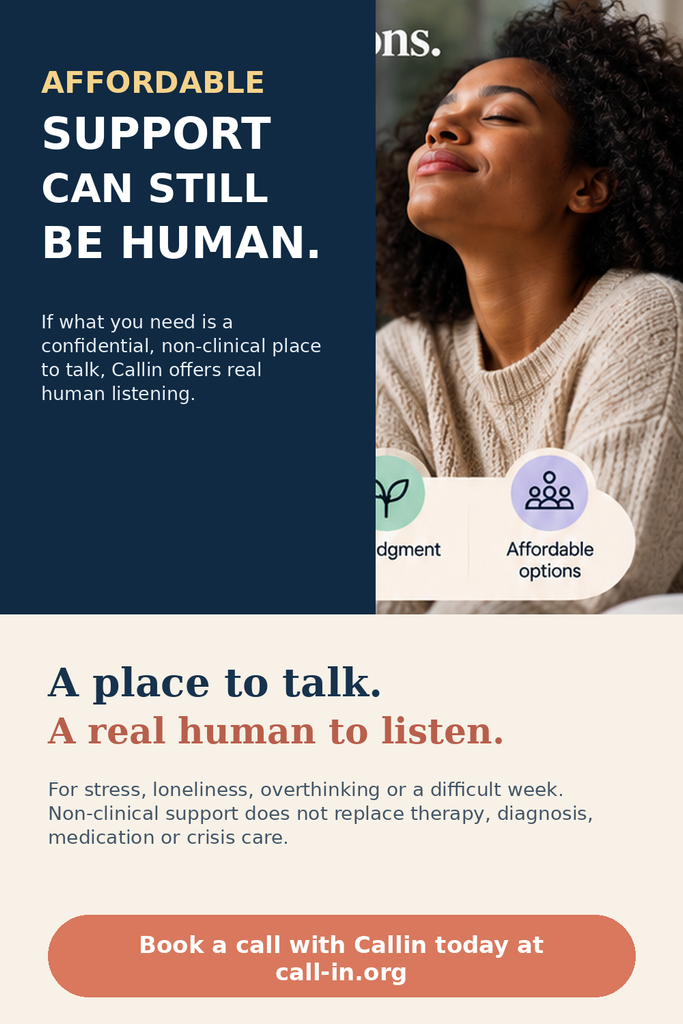
For people who need an objective, confidential, non-clinical space to process stress, loneliness, overthinking, or the wait for other care, Callin offers conversations with trained peer active listeners, including a free 20-minute first session. Callin does not replace therapy, diagnosis, treatment, or crisis support.
Mental health access still has a missing middle: people who are not in immediate crisis, cannot afford weekly private therapy, and should not have to cope alone. Building a sensible mix of clinical care, community support, and human conversation is not settling. It is a more realistic way to care for an actual life, bills and all.
Frequently Asked Questions
Why is private therapy so expensive?
Private therapy fees cover more than face-to-face time. Practitioners may pay for extensive training, regular supervision, professional development, insurance, registration, secure records, premises, administration, and taxes. One-to-one emotional work also places a reasonable limit on how many sessions a therapist can safely deliver each day.
How much does private therapy cost in the UK?
BACP reports that more than half of therapists advertising in its directory charge between £40 and £60 per session. Fees may be higher in expensive locations or for specialist work, and some practitioners offer reduced-fee places. Always confirm the session length, cancellation policy, and whether the quoted fee may increase.
Can I get free therapy on the NHS?
Yes. In England, many adults can self-refer to NHS Talking Therapies for anxiety and depression without first seeing a GP. Routes differ elsewhere in the UK, and availability, treatment type, and waiting times depend on local services and your needs.
What can I do if I cannot afford weekly therapy?
Ask therapists about reduced fees, supervised trainee clinics, group therapy, or whether a clinically appropriate fortnightly schedule is possible. Also check NHS services, your employer, university, local charities, and condition-specific organizations. If what you mainly need is space to talk rather than treatment, peer or non-clinical emotional support may be a better fit.
Is low-cost counseling safe?
It can be, but price alone does not establish safety. Check the counselor’s qualifications, professional registration, supervision, confidentiality, complaints process, and experience with your concern. A responsible low-cost service should also explain what it cannot support and where it would refer you if your needs become more complex.
What is the difference between therapy and non-clinical emotional support?
Therapy is a professional intervention intended to treat psychological or behavioral difficulties using a defined therapeutic approach. Non-clinical emotional support offers listening, reflection, and human connection without diagnosing or treating a mental health condition. The two can complement each other, but they are not interchangeable.
Is free mental health support only for people in crisis?
No. NHS talking therapies, some charity services, community groups, university counseling, workplace programs, and peer communities may support people before a crisis develops. Eligibility varies, but you do not need to wait until you are unable to function before asking what is available.

Leave a Reply