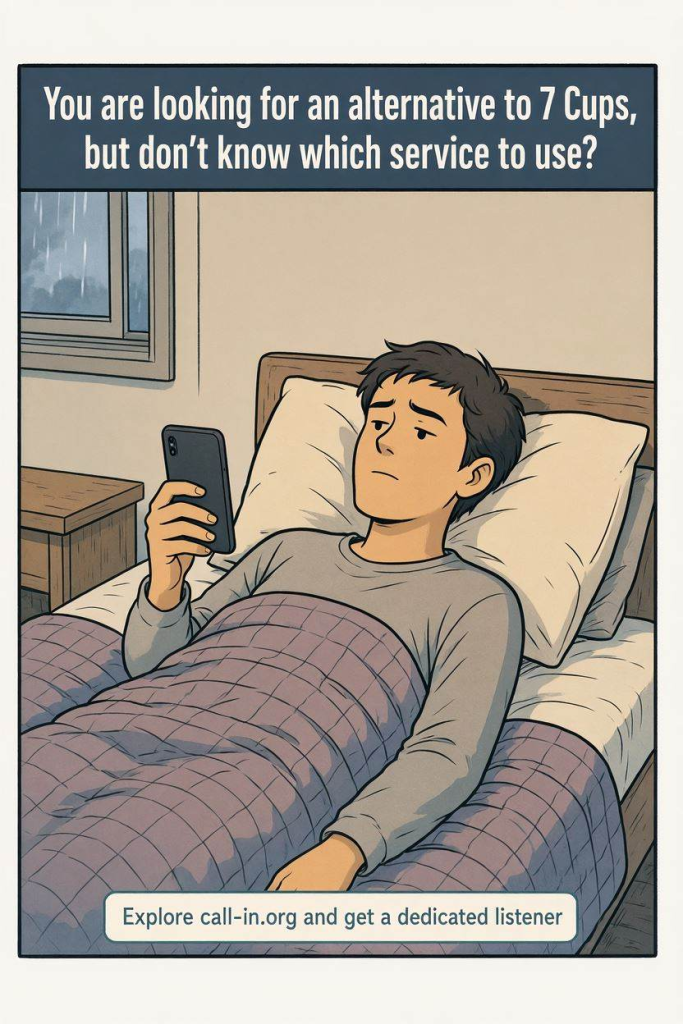
Someone searching for a 7 Cups alternative is usually looking for one of a few things: a different format, more consistency with the same person, or simply a space that feels a little less anonymous and a little more personal. None of these reasons mean 7 Cups didn’t help. It just means your situation might call for something a bit different right now.
That’s worth sitting with for a moment. Needing something different isn’t a failure of the first option you tried. It’s just information about what you actually need.
Table of Contents
- Why People Look for a 7 Cups Alternative
- How 7 Cups Works
- Where Callin Takes a Different Approach
- Which Option May Fit Different People
- Who Non-Clinical Emotional Support May Be Good For
- Who May Need a Different Type of Support
- Real-Life Scenarios
- Frequently Asked Questions
Why People Look for a 7 Cups Alternative
The reasons people search for something different tend to be quiet and specific, rather than dramatic.
Some people want to talk to the same person again, rather than being connected to whoever happens to be available at that moment.
There’s something about explaining your situation to someone new each time that gets tiring fast, especially when you’re already low on energy. Why does texting feel emotionally draining touches on this exact kind of fatigue, the effort of constantly re-establishing context in a written conversation.
Others find that text-based chat, while useful in the moment, doesn’t quite replace the feeling of a real, flowing conversation. Why texting can’t replace real conversations looks at what gets lost when connection is reduced to typed messages, timing, tone, the small pauses that carry meaning.
Some people are looking for a step beyond anonymous peer support, something closer to an ongoing relationship with a person who remembers their story, rather than a rotating pool of volunteers.
And some simply don’t want to burden the friends and family they’d normally turn to, and are searching for a different outlet altogether. Someone to talk to when I don’t want to burden my friends speaks directly to that particular kind of hesitation, the guilt of needing support and not wanting to be “too much.”
How 7 Cups Works
7 Cups is a platform built around free, anonymous emotional support. It connects users with trained volunteer listeners for one-on-one chat, alongside community forums, group support spaces, and self-help resources.
The listener model is peer-based rather than clinical: listeners are trained to provide supportive, active listening, but they are not licensed mental health professionals. 7 Cups also offers a separate paid option for users who want to connect with licensed therapists.
7 Cups is not affiliated with or endorsed by Callin. Any trademarks belong to their respective owners.
For a lot of people, this model works well. It’s accessible, free to start, and gives people somewhere to go the moment they need to talk, day or night. For others, the anonymous and rotating nature of the listener pool means it’s harder to build the kind of continuity that makes opening up feel easier over time.
Where Callin Takes a Different Approach
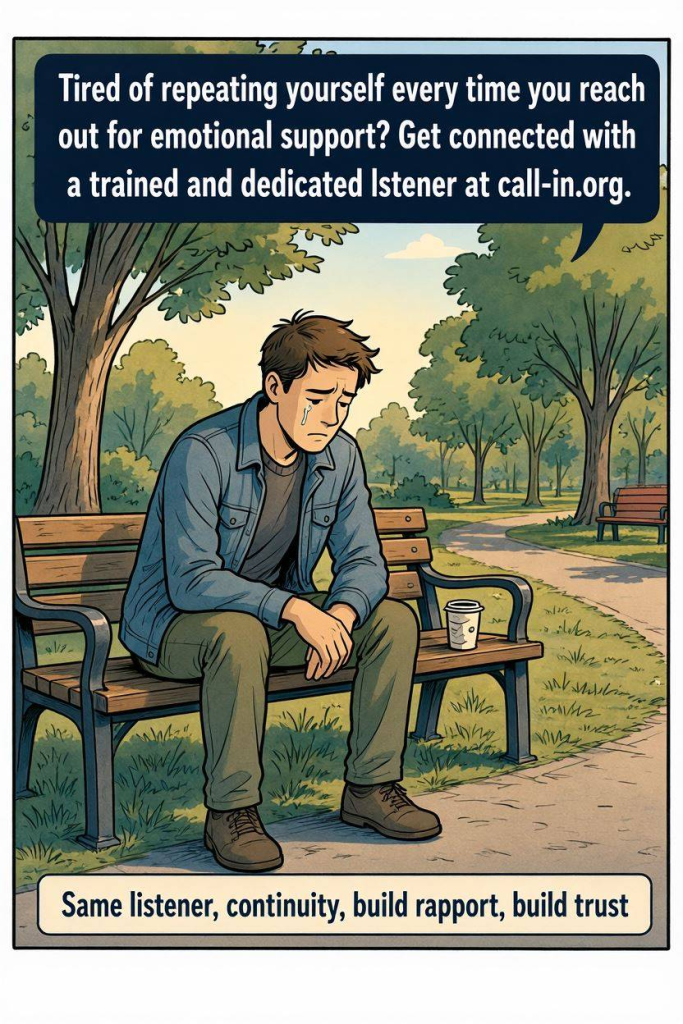
Callin is built around continuity. Rather than connecting you to whoever’s available, the aim is to build an ongoing relationship where you’re not starting from scratch every time you reach out.
That difference matters more than it might seem at first. Repeating your story to someone new, over and over, is its own kind of exhausting, even when every person you speak to is kind and well-intentioned. Something in you has to stay guarded when you can’t fully trust that the person on the other end already understands the shape of your life. Callin’s approach is to reduce that friction, so the conversation can go deeper because the groundwork doesn’t need to be rebuilt each time.
There’s also something worth naming about human connection specifically. Can AI replace human connection is a useful read if you’ve noticed that automated or scripted responses, however well designed, don’t land the same way a real, attentive person does. Callin’s model is built entirely around human conversation, not automation, because presence and memory are part of what makes support feel like support.
Callin provides non-clinical emotional support and is not therapy, counselling, diagnosis, or crisis intervention. If you are experiencing a mental health crisis, contact appropriate crisis support services such as Samaritans (UK: 116 123), 988 Suicide & Crisis Lifeline (US), or Lifeline (Australia: 13 11 14).
Which Option May Fit Different People
There’s no universal answer here, only what fits your situation.
Someone who values free, immediate access and doesn’t mind speaking to a different listener each time may find that 7 Cups’ community model suits them well, particularly for lighter, in-the-moment support or peer forums.
If your priority is consistency, talking to the same person who already knows your situation, a model built around continuity may suit you better. This tends to matter most for people dealing with something ongoing, rather than a single difficult moment.
Someone who wants a safe space to vent without needing to explain their whole backstory every time may prefer an approach that carries memory of previous conversations forward. Who can I talk to when I feel lonely is a good starting point if you’re still working out what kind of support actually fits what you’re feeling.
A different approach may suit you if you’ve found that talking to friends doesn’t quite scratch the itch anymore. When talking to friends don’t feel enough explores that gap between casual support and something more sustained.
Who Non-Clinical Emotional Support May Be Good For
Non-clinical, continuity-based support tends to suit people who are managing ongoing life stress rather than facing an acute crisis.
That includes someone feeling lonely even while surrounded by people, a more common experience than it sounds. When connections feel shallow, why you are feeling lonely in your relationships explores this exact disconnect.
It also fits someone who tends to hold everything together for other people and rarely gets asked how they’re doing themselves. Strong one for everyone, but who is supporting you speaks to that particular kind of quiet exhaustion.
It suits someone who wants to talk without framing their feelings as a mental health condition first. Ask for help without mental health diagnosis covers this directly, the desire to be heard without needing a clinical label attached to what you’re going through.
And it fits someone who craves connection but notices themselves pulling away from people anyway. Why you crave connection but withdraw from people is worth reading if that pattern sounds familiar.
Who May Need a Different Type of Support
It’s important to be honest about the limits of non-clinical support, and about 7 Cups’ own limits as a peer-based platform.
If you are experiencing a mental health crisis, thoughts of self-harm, or an emergency, please contact crisis services immediately: Samaritans (UK: 116 123), 988 Suicide & Crisis Lifeline (US), or Lifeline (Australia: 13 11 14).
If you’re working through a diagnosed condition, trauma, or something that needs clinical assessment, a licensed therapist is likely the more appropriate option, whether through 7 Cups’ paid therapy tier or another provider. Peer support and non-clinical conversation can sit alongside that kind of care, but neither is designed to replace it.
Real-Life Scenarios
It sometimes helps to picture what this actually looks like in ordinary life.
Someone lies awake at 1am with their mind racing, wanting to talk to someone but not wanting to wake a friend or partner. They open an app hoping for a real conversation, not just a waiting room.
Someone has just been promoted at work and, instead of feeling celebrated, feels strangely isolated, unsure who they can be honest with now that their role has changed. Why do promotions feel lonely captures that unexpected kind of loneliness.
Someone is a few weeks into a new city after a move, still building a support system from scratch, and finds themselves wishing there was one consistent person to talk to instead of starting over each time. How do I build my support system after moving reflects that exact transition.
Someone is going through a breakup and has told the story so many times to different people that it’s started to feel hollow in their own mouth. Going through a breakup speaks to that particular kind of tiredness.
These are illustrations meant to reflect common situations, not testimonials, and they aren’t presented as real Callin users.
Frequently Asked Questions
Is there a free alternative to 7 Cups? Callin offers a free 20-minute session as a way to try non-clinical emotional support before deciding whether to continue. It’s a different model to 7 Cups’ free listener chat, built more around continuity than immediate, rotating access.
What’s the difference between 7 Cups and Callin? 7 Cups connects users to trained volunteer listeners, often different people each time, alongside forums and community support. Callin focuses on building continuity, so conversations build on previous ones with the same person, rather than starting fresh each session.
Is 7 Cups actually free? 7 Cups offers free peer support through trained volunteer listeners and community forums, with a separate paid tier for licensed therapy. Free access does not include licensed clinical care unless you opt into the paid option.
Can non-clinical support help with loneliness? Yes, non-clinical emotional support can be genuinely helpful for loneliness, particularly when it offers consistency and real human conversation rather than a one-off interaction. It isn’t a treatment for clinical conditions, but it can meaningfully ease the isolation of not having anyone to talk to.
How do I know if I need therapy instead of someone to talk to? If you’re dealing with persistent symptoms, trauma, or thoughts of self-harm, professional support is the safer option. If you mainly need space to process everyday stress or feelings, non-clinical support may be enough. How do I know if I need emotional support, not therapy walks through this distinction in more depth.
A Space to Start the Conversation
If you’ve been looking for somewhere consistent to talk, somewhere that feels less like starting over each time and more like being known, Callin offers a space to start that conversation. It begins with a free 20-minute session, no pressure, no commitment, just a chance to talk to someone who’s actually listening.