When life has been difficult for a while, “finding your next chapter” can sound inspiring right up until you are expected to actually write it. You may know that something needs to change, but finding the motivation to believe in yourself, make decisions and start again can feel like another impossible task on top of everything you are already carrying.
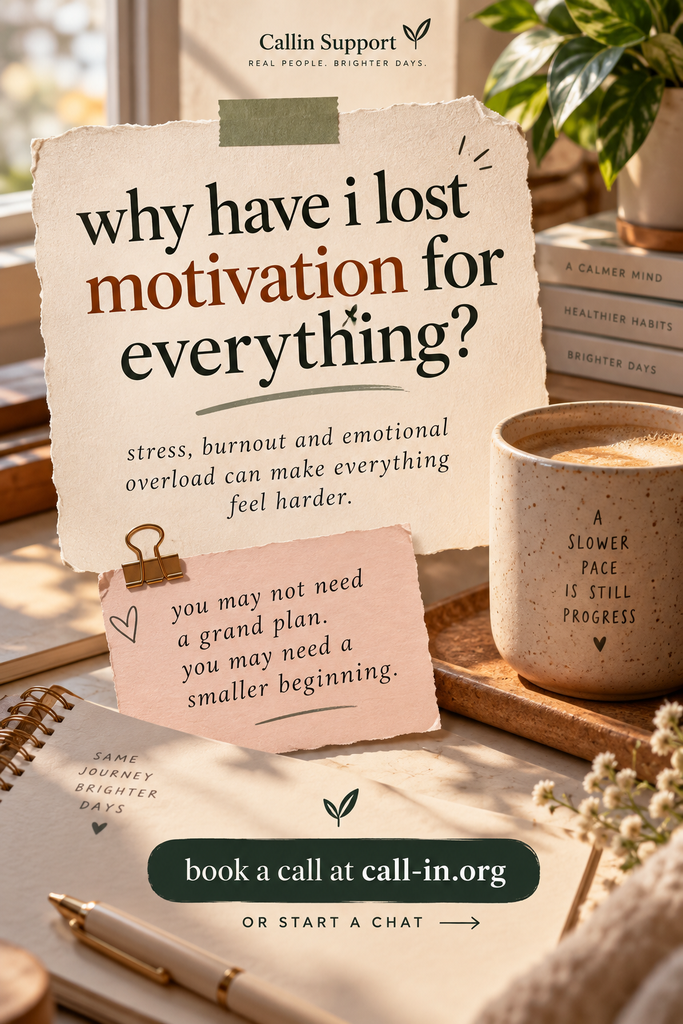
You do not necessarily need a grand plan yet.
You may need a smaller beginning.
Because sometimes the way you pick yourself back up is not by suddenly becoming confident, optimistic and motivated again. Sometimes you begin while still feeling tired, uncertain and thoroughly unimpressed with how life has been going.
Key takeaways
- Feeling unmotivated during a difficult period does not automatically mean you have become lazy or incapable.
- Stress and emotional overload can make planning, concentration and decision-making harder, which can make the future feel more overwhelming.
- Motivation does not always have to arrive before action. Small actions can sometimes create the conditions for momentum to return.
- You do not need to know your entire “next chapter.” A useful next step may be much smaller than a life plan.
- Difficult experiences do not have to have happened “for a reason” for you to eventually create meaning from what happened.
Why does everything feel harder when life has been bad for a while?
When several difficult things happen close together, even ordinary decisions can begin to feel strangely heavy.
Replying to an email takes longer.
Choosing what to eat becomes irritating.
You keep postponing something you genuinely want to do.
Then you look at yourself and think, What is wrong with me? I used to be able to handle things.
Stress can affect some of the cognitive abilities involved in planning and goal-directed behavior.
A meta-analysis examining acute stress found impairments in working memory and cognitive flexibility, while a broader review concluded that the relationship between stress and executive functioning is complex and affected by many individual and situational factors. PubMed
This does not mean every difficult week damages your brain.
It means that when your mind is carrying a lot, expecting yourself to make elegant long-term decisions as though nothing has happened may be unrealistic.
Sometimes overwhelm is not evidence that you cannot move forward.
It is evidence that you are trying to think about too much at once.
“I just need to get my life together” is usually too big a task
When people feel stuck, they often respond by increasing the size of the assignment.
I need a better job.
I need to lose weight.
I need to move.
I need to find someone.
I need to sort my finances.
I need to become confident again.
I need to figure out what I am doing with my life.
Now your problem is no longer one difficult period.
It is your entire existence.
No wonder your motivation disappears.
Psychological research on goal setting suggests that goals can influence behavior, but the effect is generally modest and depends heavily on how goals are structured and pursued.
A meta-analysis of 141 papers found a small positive effect of goal setting across different behaviors rather than evidence that simply setting an ambitious goal transforms performance. PubMed
You may therefore get further by reducing the size of the question.
Not, “What am I doing with the rest of my life?”
Try, “What would make the next seven days slightly easier?”
You do not need to find your next chapter today
“Next chapter” is a lovely phrase.
It can also become another form of pressure.
You start thinking you need to identify a new career, reinvent your personality, move somewhere exciting, develop a compelling life philosophy and emerge from adversity with magnificent hair.
Perhaps not.
Sometimes a chapter starts before you know what it is about.
You take the temporary job.
You join the class.
You call someone.
You go somewhere alone for the first time.
You begin exercising again.
You finally sleep properly for three nights.
You stop contacting the person who keeps destabilizing you.
Only later do you realize that something new had already started.
You do not always recognize a new chapter while you are still on its first page.
What if I have lost all motivation?
It may help to stop treating motivation as a magical substance you must locate before doing anything.
People often imagine the sequence as:
Motivation.
Then action.
Then progress.
But human behavior does not always happen in that order.
One evidence-based psychological treatment illustrates this clearly. Behavioral activation is a structured treatment used particularly for depression that encourages engagement with activities rather than waiting for mood to improve first. A large 2026 systematic review and meta-analysis of 105 trials found behavioral activation effective for adult depression compared with control conditions, although the studies showed substantial variation and the evidence concerns treatment for depression rather than everyday motivational slumps. PubMed
The broader idea is useful without pretending you are giving yourself therapy:
Sometimes action comes before motivation.
You do not have to feel ready to take a shower.
You do not have to feel inspired to walk around the block.
You do not have to believe completely in your future before applying for one job.
Sometimes you do the small thing first.
The feeling catches up later.
Make the first action almost embarrassingly small
When everything feels overwhelming, ambitious advice can become another thing you fail to complete.
“Transform your morning routine.”
“Create your five-year vision.”
“Become the highest version of yourself.”
Wonderful.
But if brushing your teeth currently feels like administration, perhaps we can lower the stakes.
A useful action might be:
- Put one load of washing on.
- Reply to one message.
- Walk outside for 10 minutes.
- Update one paragraph of your CV.
- Book one appointment.
- Clear one surface.
- Research one course.
- Apply for one role.
- Eat something with actual nutritional value.
- Tell one person that you have been struggling.
None of these actions has to change your life.
They simply prove that movement is still available.
Confidence often comes from evidence, not pep talks

“Believe in yourself” is good advice until you do not.
Then what?
You can stand in front of the mirror announcing that you are powerful, unstoppable and destined for greatness while some part of your brain quietly replies, Citation needed.
Psychology gives us a more useful idea: self-efficacy.
Self-efficacy refers broadly to your belief that you can carry out actions needed to manage a task or situation. Research associated with social cognitive theory has consistently linked self-efficacy with motivation, goal pursuit and performance, although the relationship varies by context. PubMed
You do not necessarily rebuild belief in yourself by arguing with yourself.
You build evidence.
I said I would send that email, and I did.
I thought I could not manage today, but I did.
I applied even though I was nervous.
I went alone.
I tried again.
Small completed actions become receipts.
Stop demanding that your current self perform like your best-ever self
Maybe you used to be highly productive.
Maybe you were ambitious, sociable, disciplined or constantly planning your next move.
Then life happened.
Now you keep comparing your current capacity with a version of yourself who had different circumstances, different energy and perhaps fewer things going wrong.
That comparison can quietly become cruel.
You are not necessarily trying to become less capable.
You may simply be recovering capacity.
The goal does not have to be, “How do I immediately become who I was?”
It can be, “What can the person I am today reasonably carry?”
Self-compassion is not letting yourself off the hook
Some people worry that if they stop criticizing themselves, they will never get anything done.
The logic sounds like this:
If I am kind to myself, I will become lazy.
If I accept where I am, I will stay here.
If I stop calling myself useless, I will lose the pressure that makes me improve.
Research does not support that assumption as neatly as people might expect. In four experiments, participants encouraged to respond to personal shortcomings with self-compassion showed greater motivation toward self-improvement than people in several comparison conditions. PubMed
A broader review published in the Annual Review of Psychology similarly describes self-compassion as responding supportively to yourself during pain, failure or difficulty, and reviews evidence linking it with psychological wellbeing rather than motivational collapse. PubMed
You can therefore say:
“This has been a horrible month.”
“I am struggling.”
“I have not handled everything perfectly.”
“And I am still going to do one useful thing today.”
Compassion and accountability can occupy the same sentence.
What if I do not know what I want anymore?
Then do not demand certainty.
After a difficult period, people sometimes lose confidence not only in themselves but in their preferences.
Do I still want this career?
Do I want to stay here?
Do I want another relationship?
What am I actually working toward?
You may not solve those questions by sitting still and thinking harder.
Sometimes clarity comes from contact with life.
Try something.
Talk to someone doing the work you are considering.
Take the short course rather than enrolling immediately in the degree.
Spend a weekend somewhere before deciding to move there.
Volunteer.
Go on one date rather than deciding whether you are ready for another relationship.
Experiment creates information.
Hope does not mean being certain everything will work out
Hope is often presented as optimism wearing inspirational typography.
Psychological theories of hope are more practical than that.
Snyder’s influential hope framework emphasized both agency, the sense that you can move toward a goal, and pathways, the ability to identify possible routes toward it. A recent review notes that the exact structure and measurement of hope remains debated across populations and cultures, so it should not be treated as one universal psychological formula. PubMed
A 2025 meta-analysis of 129 studies found that higher hope was associated with lower anxiety, including in longitudinal research, although association does not prove that increasing hope alone will reduce anxiety. PubMed
The useful point is that hope does not require you to know exactly what happens next.
Sometimes hope is simply:
There may be another route.
I have not found it yet.
What about “everything happens for a reason”?
Maybe you believe that.
Maybe you desperately want to.
Maybe the sentence annoys you because what happened was genuinely awful and you cannot imagine what possible reason could justify it.
Psychology cannot establish that every painful event occurs for some predetermined reason.
What research can examine is meaning-making, the process through which people try to understand difficult experiences and fit them into their broader beliefs, identities and life stories.
A major review in Psychological Bulletin found that meaning-making after stressful experiences is complex. Some forms of meaning and adjustment appear useful, but simply searching harder for meaning does not reliably guarantee better psychological outcomes. PubMed
Later research has continued to caution against assuming that adversity automatically produces growth. Some studies of post-traumatic growth have substantial methodological limitations, and researchers increasingly distinguish between believing that growth occurred and demonstrating measurable positive change. PubMed
So perhaps you do not need to say:
“Everything happened for a reason.”
You can say:
“I do not know why this happened, but I can decide what I do with what happened next.”
That leaves room for pain without requiring it to justify itself.
You are allowed to create meaning instead of discovering it
Perhaps the terrible job finally showed you what kind of environment you never want again.
Perhaps the breakup forced you to build friendships you had neglected.
Perhaps a period of loneliness revealed how much connection actually matters to you.
Perhaps nothing meaningful has appeared yet.
That is allowed too.
Not every painful season needs an immediate moral.
Sometimes the meaning arrives years later.
Sometimes the meaning is simply that something hurt and you survived it.
When you feel overwhelmed, reduce the time horizon
The future becomes particularly frightening when you try to experience all of it simultaneously.
How will I afford next year?
What if I never meet anyone?
What if I choose the wrong career?
Where will I live in five years?
You are emotionally living 15 hypothetical lives before breakfast.
Come closer.
What needs attention today?
What needs attention this week?
What can wait?
This does not mean refusing to plan.
It means matching the planning horizon to your current capacity.
Pick one area that would make everything else easier
When life feels chaotic, you may have 14 problems.
Do not necessarily start with the biggest one.
Start with the one that creates leverage.
If poor sleep makes every day harder, perhaps sleep becomes the immediate priority.
If money anxiety is consuming your attention, looking at your finances may create more relief than beginning a new hobby.
If isolation is amplifying everything, reconnecting with another person may matter more than finding a new productivity system.
Ask:
“If one part of my life became 10 percent easier, which one would give me the most breathing room?”
Start there.
Progress becomes easier to see when you track it
Your mind is surprisingly bad at remembering ordinary progress.
You remember the day you collapsed.
You forget the six days you got up anyway.
One meta-analysis of 138 studies found that interventions encouraging people to monitor progress increased both monitoring behavior and goal attainment. The effects varied across circumstances, but the general finding supports making progress visible rather than relying entirely on memory. PubMed
You do not need an elaborate habit tracker.
Write three lines at night:
What did I handle today?
What did I move forward?
What needs less pressure tomorrow?
Some days the answer may be, “I survived a very bad day without making it worse.”
That counts as information too.
Do something that makes you feel like a person again
Not everything needs to contribute to your comeback.
You are allowed to do something because it is enjoyable.
Cook something unnecessarily elaborate.
Watch something ridiculous.
Put music on loudly.
Sit in the sun.
Wear the outfit.
Go somewhere beautiful.
Call the person who makes you laugh.
Difficult periods can reduce life to management.
Bills.
Applications.
Appointments.
Problems.
Plans.
Recovery also involves remembering that your existence is not merely a project that requires fixing.
You do not have to rebuild alone
There is an odd expectation that personal reinvention should be solitary.
We praise people for “picking themselves up” as though strength is measured by how little support they required while doing it.
But talking to someone can help you organize thoughts that have become tangled inside your own head.
You might speak with a friend, relative, mentor, coach, community member or mental health professional depending on what you need.
And if you mainly need somewhere to say, “Everything has been a bit rubbish lately and I do not know what I am doing next,” that is a valid reason to talk too.
Callin’s non-clinical mental health support offers confidential conversations with a real human listener for people dealing with experiences such as stress, loneliness, overthinking, relationship difficulties, life transitions and feeling overwhelmed.
You do not need to have a diagnosis.
You do not need to arrive with a perfectly articulated problem.
Sometimes you need enough space to hear your own thoughts again.
If typing feels easier than talking aloud, you can also explore online emotional support chat with a real person.
When low motivation may need more attention
There is a difference between having a rough period and experiencing persistent changes that significantly affect daily life.
If low mood, loss of interest, hopelessness, severe anxiety, major sleep or appetite changes, difficulty functioning or other concerning symptoms continue or intensify, it may be worth speaking with an appropriate healthcare or mental health professional.
You can also read What to Do When You Can’t Cope With Life or Where to Get Help for Anxiety if you are unsure what kind of support might fit.
Callin provides non-clinical emotional support.
It does not diagnose or treat mental health conditions and does not replace therapy, medical care, psychiatric care, emergency services or crisis support.
If you are in immediate danger or feel you may harm yourself or someone else, contact emergency or crisis services appropriate to where you live.
Your next chapter does not require a dramatic beginning
Maybe there will be a huge moment.
A new job.
A plane ticket.
A breakup.
A business.
A move.
A person.
But perhaps the next chapter begins much less dramatically.
You sleep properly.
You finally make the call.
You admit that something is not working.
You stop waiting to feel motivated.
You take one small action.
Then another.
One day, you look around and realize you are no longer trying to get back to your old life.
You have started building a different one.
FAQs
Why have I suddenly lost motivation for everything?
Low motivation can happen for many reasons, including stress, exhaustion, disappointment, grief, burnout, low mood, anxiety, lack of sleep, competing responsibilities or feeling overwhelmed by goals that seem too large. A period of low motivation by itself is not enough to diagnose a mental health condition.
If the change persists, significantly affects daily functioning or is accompanied by other concerning emotional or physical symptoms, consider speaking with an appropriate health professional.
How do I motivate myself when life feels overwhelming?
Try making the first task much smaller than the overall problem. Instead of trying to “fix your life,” choose one action that can be completed within the next day or week.
Evidence from behavioral activation treatment shows that action does not always have to wait for improved mood or motivation, although that research specifically concerns psychological treatment rather than ordinary life advice. PubMed
How do I start believing in myself again?
Begin by creating evidence that you can rely on yourself in small ways. Complete manageable commitments, keep track of progress and gradually increase the difficulty of what you ask yourself to do.
Research on self-efficacy suggests that beliefs about capability interact with goals and motivation. Confidence can therefore develop through experience rather than needing to be completely present beforehand. PubMed
What if I do not know what my next chapter is?
You do not need to know yet. Treat the next period as exploration rather than demanding that you make a permanent life decision immediately.
Small experiments can generate useful information. Try a course, speak with someone in a field you are considering, reconnect socially, volunteer or make one practical change and notice what happens.
Does everything really happen for a reason?
Psychology cannot establish that life events occur for a predetermined reason. Research instead studies how people make meaning from difficult experiences afterward.
Meaning-making can be part of adjustment, but research does not support the idea that every painful experience automatically produces growth or that people should force themselves to find a positive lesson immediately. PubMed
Is it normal to feel overwhelmed when starting over?
Starting over often involves uncertainty, unfamiliar decisions and the loss of routines or identities that previously made life predictable. Feeling overwhelmed during a significant transition therefore does not automatically mean you are making the wrong decision.
Reduce the amount of future you are trying to solve at once. A useful next step can exist even when the whole plan does not.
Where can I talk to someone when life feels like too much?
You can speak with trusted people in your life, a counselor, therapist, coach, community resource or another appropriate support service depending on what you need. If you want a non-clinical space simply to talk things through, Callin offers confidential human emotional support.
If you feel unable to cope safely, are in immediate danger or are considering harming yourself or another person, use emergency or crisis support in your location rather than relying on a non-clinical listening service.
How this connects to the UNSDGs
This article aligns most directly with United Nations Sustainable Development Goal 3: Good Health and Well-Being. Target 3.4 explicitly includes promoting mental health and wellbeing as part of the international development agenda. Sustainable Development Goals
The connection is not that ordinary overwhelm is automatically a mental health disorder. It is that accessible support, healthy coping, social connection and appropriate pathways to further care can all contribute to a wider culture in which emotional wellbeing is taken seriously.
Sources and Further Reading
Cuijpers et al., Clinical Psychology Review, 2026. A comprehensive systematic review and meta-analysis of 105 randomized trials examining behavioral activation for depression. PubMed
Read the behavioral activation review on PubMed
Shields, Sazma and Yonelinas, Neuroscience & Biobehavioral Reviews. Meta-analysis examining the effects of acute stress on working memory, inhibition and cognitive flexibility. PubMed
Read the stress and executive function meta-analysis
Breines and Chen, Personality and Social Psychology Bulletin. Four experiments examining whether self-compassion after mistakes and shortcomings undermines or increases motivation for self-improvement. PubMed
Read the self-compassion and motivation study
Neff, Annual Review of Psychology. A major review covering the theory, measurement, evidence and limitations surrounding self-compassion. PubMed
Read the self-compassion review
Epton et al., Journal of Consulting and Clinical Psychology. Systematic review and meta-analysis examining the unique effect of goal setting on behavior change across 141 papers. PubMed
Read the goal-setting meta-analysis
Harkin et al., Psychological Bulletin. Meta-analysis examining whether monitoring progress toward goals improves behavioral performance and goal attainment. PubMed
Read the progress-monitoring meta-analysis
Park, Psychological Bulletin. Integrative review examining meaning-making and adjustment following stressful life events, including the limitations and complexity of the evidence. PubMed
Read the meaning-making review
Boals, Clinical Psychology Review. Critical review examining methodological concerns around claims of post-traumatic growth and the difference between perceived and demonstrated growth. PubMed
Read the critical review of post-traumatic growth
If life has been heavy lately and you are trying to work out what comes next, Callin gives you a confidential human space to talk without requiring you to have your next chapter figured out first.

Leave a Reply