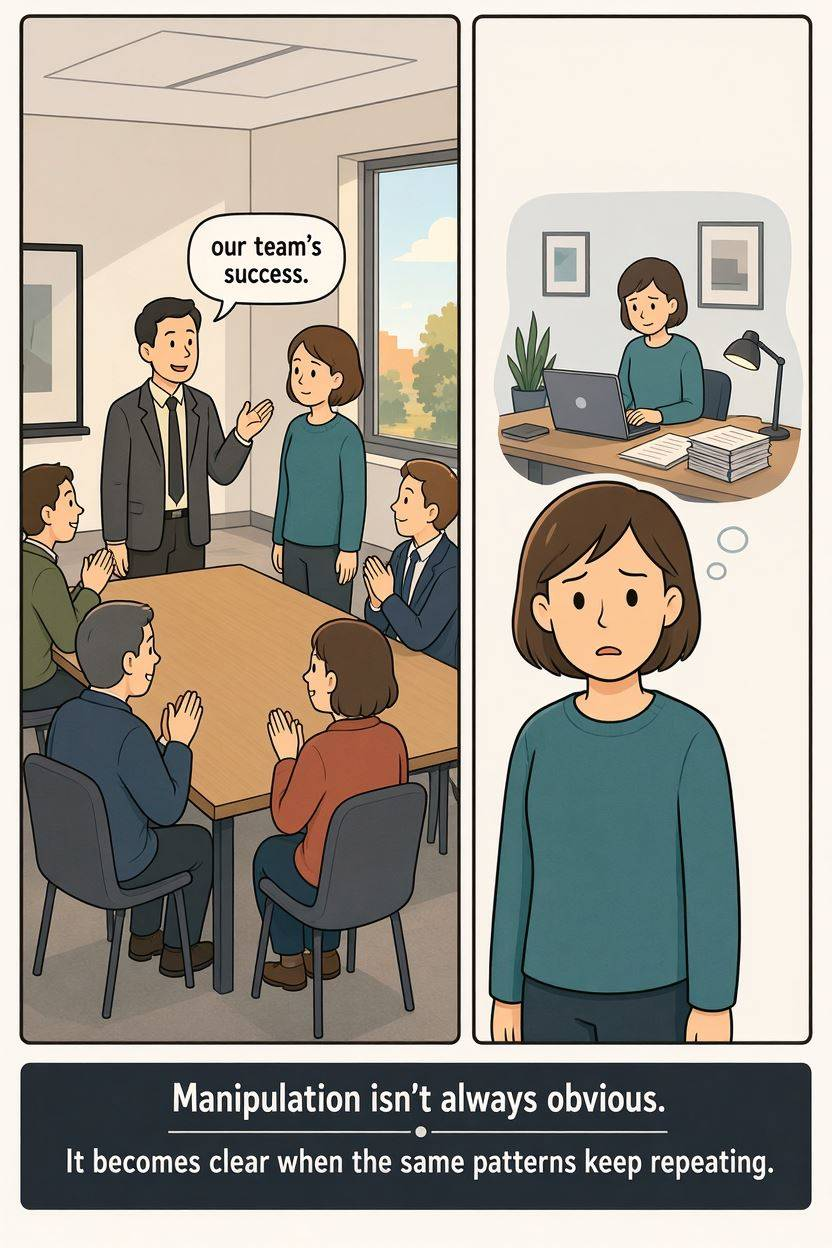
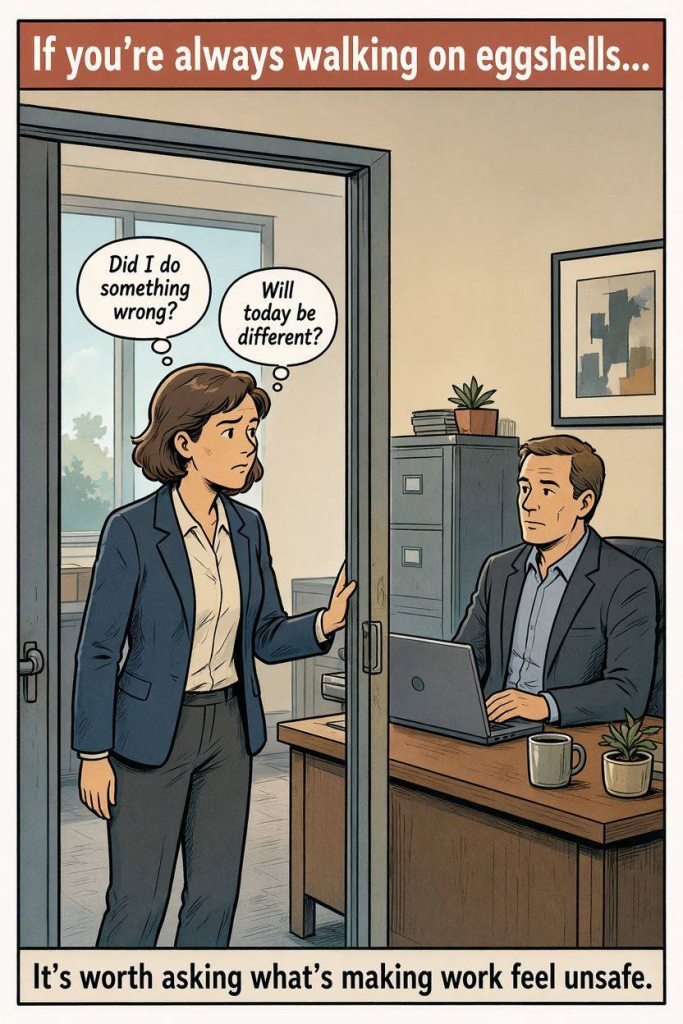
A manipulative boss is not always the person who yells or slams doors. More often, they are the one who leaves you replaying conversations at midnight, unsure if you did something wrong. Manipulation at work tends to be quiet, cumulative, and easy to dismiss as overreacting. Learning its real signs is the first step toward trusting yourself again.
Key Takeaways
- Manipulation at work is defined by a pattern of effect on you, not a single tense conversation. The real question is whether you feel steadier or shakier after talking to your boss.
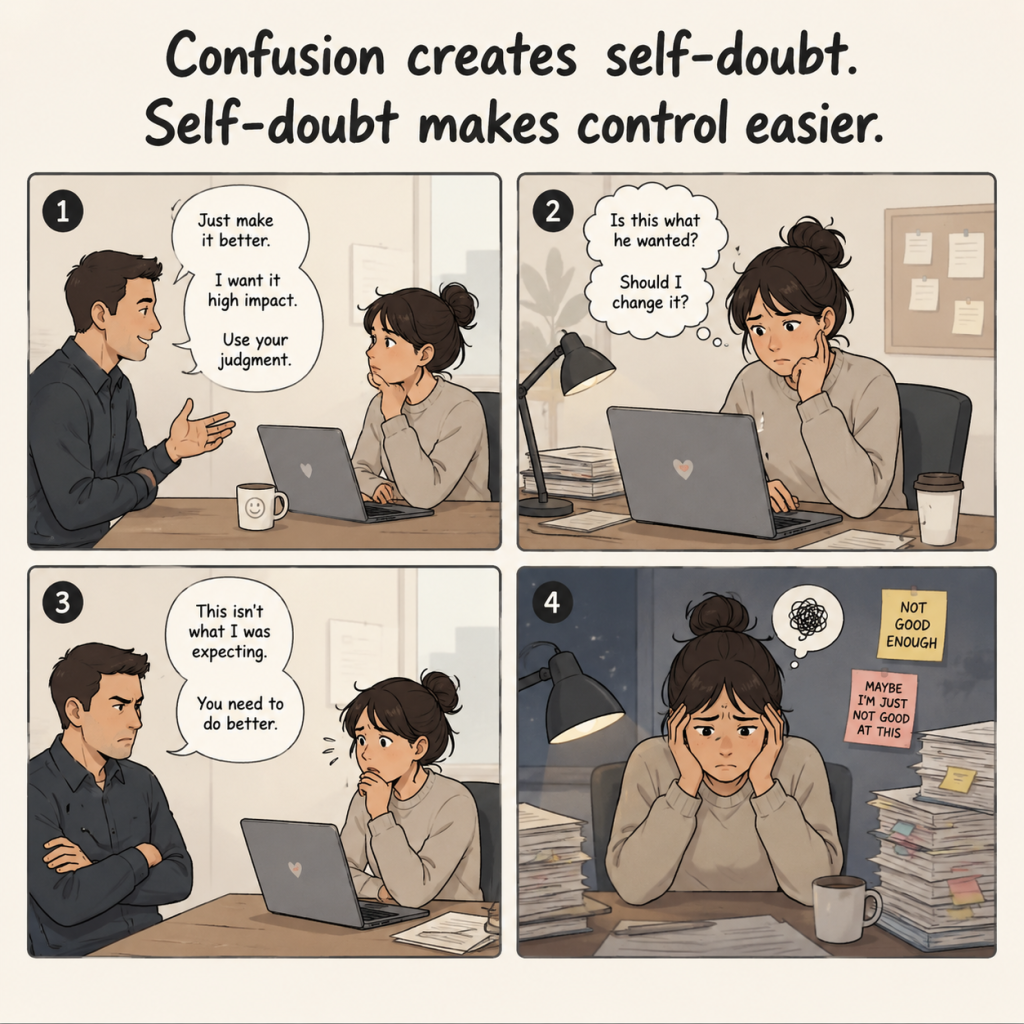
- Good leadership creates clarity and psychological safety, while manipulative leadership often creates uncertainty on purpose, because uncertainty is easier to control than confidence.
- Common quiet tactics include credit shifting, guilt-based compliance, shifting expectations without acknowledgment, and treating basic respect as conditional.
- The employees most affected are often the most conscientious ones, since self-reflective people instinctively look inward for blame before considering that the problem might sit with someone else.
- Naming the pattern, documenting it, and talking it through with someone outside the situation are what actually restore clarity, not confrontation on its own.
What a Manipulative Boss Actually Looks Like Day to Day

Most people picture a manipulative boss as someone loud, controlling, and obviously unreasonable. In reality, the more common version is far subtler.
It can look like a manager who quietly questions your judgment in front of others, who takes credit for your work in a meeting, or who uses guilt rather than direction to get compliance.
It can also look like expectations that shift without acknowledgment, so you are always slightly behind a goalpost that keeps moving.
None of these moments look dramatic enough to write down on their own. That is part of what makes them effective.
A single comment about your judgment is easy to shrug off. Ten of them over three months start to feel like evidence that something is wrong with you, when the truth is closer to something being wrong with the dynamic.
Manipulation Is a Pattern, Not a Single Moment
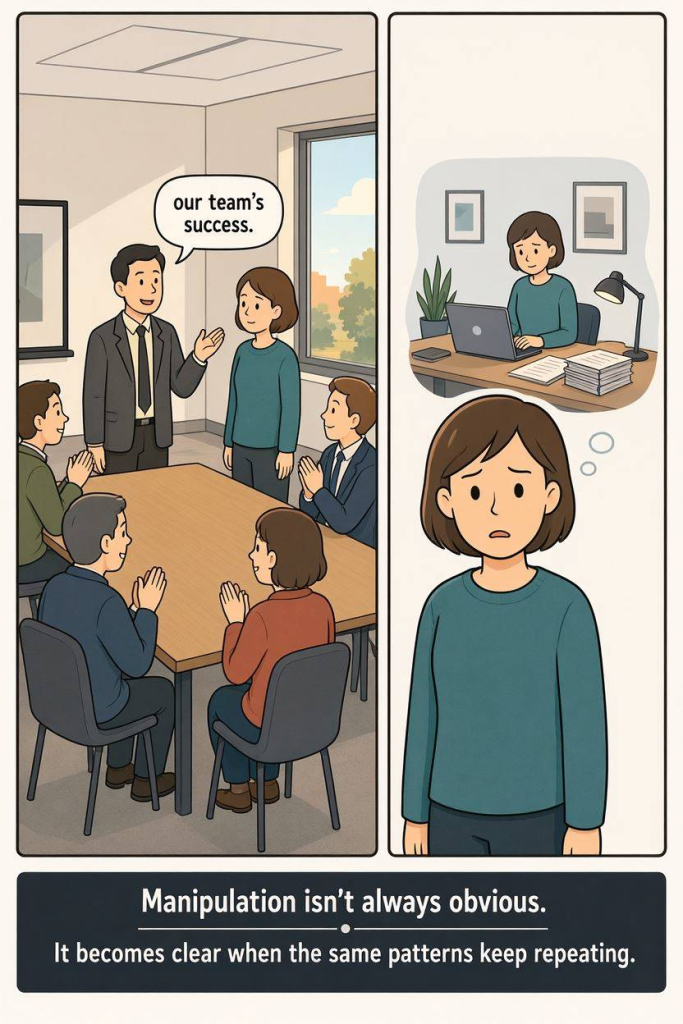
The most useful shift in thinking is to stop asking whether any one interaction was manipulative and start asking what interacting with this person does to you over time.
Do you leave conversations with your boss feeling clearer about what is expected of you, or more anxious about what might be expected next?
Do you feel trusted to make decisions, or like you are constantly waiting to be told you did something wrong?
Manipulation is rarely visible in a transcript. It is visible in the accumulation.
This is one of the more counterintuitive things about workplace manipulation: it often does not require the manager to say anything false. Vague feedback, inconsistent praise, and unclear priorities are not lies.
They are simply ambiguous enough that you have to fill in the gaps yourself, and most people fill those gaps by assuming they are the problem. If you have started to question your own memory of what was actually said or agreed to, it may help to read about the difference between self-gaslighting and a genuinely bad dynamic, since the two can feel identical from the inside.
The Difference Between a Demanding Boss and a Manipulative Boss
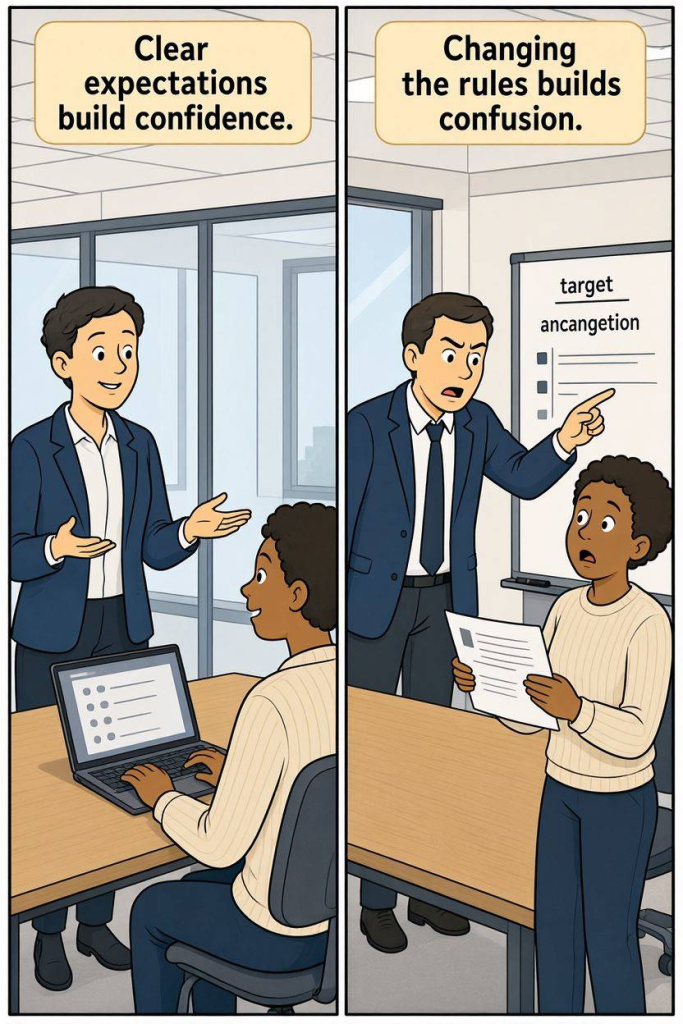
Good Leadership Creates Clarity
A demanding boss can push you hard and still be a good leader, as long as the demands come with clarity. You know what is expected, you know where you stand, and criticism, even sharp criticism, is aimed at the work rather than at your worth as a person.
Psychological safety, a concept studied extensively by Harvard Business School researcher Amy Edmondson, describes an environment where people feel safe to take risks, admit mistakes, and ask questions without fear of humiliation. High expectations and psychological safety are not opposites. The best managers hold both at once.
Manipulative Leadership Creates Uncertainty on Purpose
Manipulative leadership tends to erode that safety while keeping expectations foggy. Rules apply inconsistently. Praise arrives unpredictably, which keeps people chasing it rather than resting in it. Standards shift right after you meet them, with no mention that they ever changed.
Some of this may not even be conscious on the manager’s part, but the effect is the same either way: uncertainty keeps people compliant more efficiently than clear rules do, because a person who does not know exactly where the line is will stay further back from it than they need to.
Keeping people unsure, whether deliberately or by habit, becomes a way of maintaining control without ever having to state it outright.
Common Signs of a Manipulative Boss
Credit Shifting
This is the quiet reassignment of authorship. Your analysis becomes the team’s finding. Your idea becomes something the manager had been thinking about too. It rarely happens in a way dramatic enough to raise on its own, but its cumulative effect is that your name stops being attached to your best work, which makes you easier to overlook when it is time for recognition or advancement.
Guilt as Currency
Guilt is a faster lever than direction. A manager who implies they will just do it themselves after asking for something is using guilt, not management. Over time, guilt trains people to comply preemptively, agreeing to unreasonable requests before they are even fully made, just to avoid the discomfort of disappointing someone.
Moving Goalposts
Expectations that shift without acknowledgment are one of the clearest markers of manipulation, mainly because they make competence feel impossible to hold onto. You meet last month’s bar, only to learn the bar has quietly moved, with no mention that it ever changed. The message underneath is rarely spoken out loud: nothing you do will ever be quite enough.
Conditional Respect
Basic professional respect, being spoken to civilly, having your time acknowledged, having your ideas heard, should not need to be earned. When it is treated as a reward for good performance rather than a baseline, respect becomes another tool of control rather than a feature of the workplace.
Why Capable, Conscientious People Fall for It
It is tempting to assume manipulation only works on people who lack confidence.
The opposite is often closer to true. Conscientious, self-reflective employees are frequently more susceptible, not less, because their first instinct when something feels off is to examine their own behavior before questioning anyone else’s.
That habit is a strength in most contexts. In a manipulative dynamic, it becomes the exact mechanism the manipulation relies on.
What Living With a Manipulative Boss Does to You Over Time
Chronic uncertainty at work is not a minor irritation. It is a real stressor. Research on workplace psychological safety consistently links prolonged uncertainty with disrupted sleep, elevated stress hormones, and a gradual erosion of confidence that follows people home.
Many people describe feeling fine at first, only fine, and then noticing months later that they second-guess routine decisions, over-explain simple choices, or feel a flash of dread before opening their email.
If that sounds familiar, it is worth reading more about why workplace stress often needs more than a wellness program to actually resolve.
How to Regain Your Footing
One of the simplest, most protective habits is writing things down. A short note after a strange interaction, capturing what was said and how expectations were framed, does not need to become a formal file.
It simply gives you an external record to check your memory against, which matters when vague feedback has made your own recollection feel unreliable. Patterns are much easier to see on a page than in your head at eleven at night.
Boundaries are often framed as confrontation, but the more useful version is quieter than that. It looks like naming a limit once, calmly, and holding it without over-explaining or apologizing for it.
If pushing back at work makes you feel disproportionately guilty, that guilt is worth examining on its own terms, and learning to set boundaries without feeling like a bad person is a skill, not a personality trait you either have or do not.
Manipulative dynamics also take root fastest with people who default to accommodating everyone, since that instinct is easy to exploit.
Recognizing that pattern in yourself is not a character flaw. It is information, and unlearning the habit of people-pleasing is one of the more protective things a person can do for themselves at work, not just in their personal relationships.
When Talking It Through Helps
It is genuinely hard to see a manipulative pattern clearly while you are inside it, especially when the person involved also signs your paycheck.
A trusted colleague, a mentor, HR, or simply someone outside the situation entirely can offer a perspective you cannot access on your own, mostly because they are not absorbing the day-to-day uncertainty the way you are.
Saying the situation out loud to someone neutral is often the moment it stops feeling like your fault and starts looking like a pattern with a name.
For some people, that outside perspective comes from a friend or a family member.
For others, especially when the situation feels too complicated or too draining to bring into personal relationships again and again, having a confidential, non-clinical space to think out loud, like the peer support Callin offers, can make it easier to separate what actually happened from what a difficult work dynamic has made you believe about yourself.
A manipulative boss does not get the final word on your judgment, your worth, or your competence, even when it has felt that way for months. Clarity tends to return slowly, usually somewhere between naming the pattern, writing it down, and saying it out loud to someone who is not inside it with you. You are allowed to trust yourself again.
Frequently Asked Questions
How is a manipulative boss different from a strict boss?
A strict boss holds high standards while keeping expectations consistent and feedback focused on the work. A manipulative boss uses ambiguity, guilt, or inconsistency as tools of control, so the standard itself keeps shifting and feedback often targets you rather than the task.
What are the earliest signs of a manipulative boss?
Early signs tend to be small: vague or contradictory feedback, praise that never quite lands on you directly, or a sense that expectations depend on the manager’s mood rather than on the work itself. It is worth trusting your growing sense of unease even before you can name a specific incident.
Why do I doubt myself so much around my boss?
Chronic ambiguity trains people to look inward for explanations, since that feels more manageable than concluding that someone with power over your job is being inconsistent on purpose or out of habit. That self-doubt is a common response to an unclear environment, not evidence that you are actually failing.
Can a manipulative boss be unaware of their own behavior?
Yes. Some managers learned to lead through control because no one modeled anything else for them, and they may not recognize the effect their inconsistency has on people. Intent does not change the impact, but it can change how you approach a conversation about it.
Should I confront a manipulative boss directly?
A calm, specific conversation about one concrete pattern, tied to work outcomes rather than character, is usually more productive than a broad confrontation about their personality. Documenting incidents beforehand tends to make that conversation clearer for both people involved.
When should I involve HR?
HR is most useful once you have specific, documented examples rather than a general feeling that something is off, since HR processes generally respond to patterns of behavior rather than impressions.
How do I stop feeling guilty about pushing back?
Guilt after setting a reasonable boundary is common and does not mean the boundary was wrong. It usually fades with practice, once you see that consistent, calm limits rarely cause the disaster your guilt is predicting.

Leave a Reply