Callin Wellness Blog

  • Why the Most Empathic AI Is Still Making Us Lonelier

    AI emotional support

    AI emotional support provides temporary comfort through costless validation and frictionless interaction, but it ultimately deepens loneliness. True empathy requires mutual vulnerability, shared social stakes, and finite attention. Because AI lacks consciousness and relational risk, interacting with it creates an empty room effect. Relying heavily on these tools displaces genuine human connection and reduces our tolerance for everyday social friction.

    (more…)
  • When Talking to Friends Doesn’t Feel Like Enough Anymore

    Talking to friends nowadays doesn’t feel enough, because it seems as though most of your friends don’t “get” you.

    You have people in your life. You can pick up the phone. You have a group chat, a standing catch-up, a friend who reliably asks how you’re doing. And yet, there is a specific kind of quiet that settles after those conversations end. A sense that something you needed was passed around the table but never quite handed to you.

    (more…)
  • What To Do When You Need To Vent, But Not Therapy

    emotional support
    emotional support

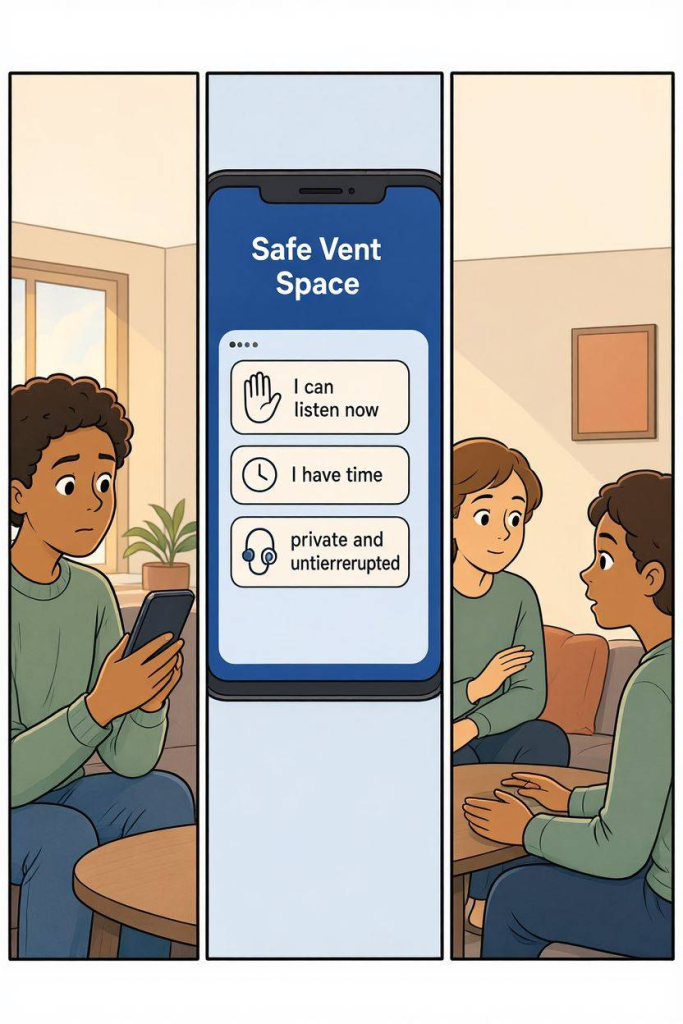
    When you need to vent but do not therapy? You can seek non-clinical emotional support. This includes peer support groups, warmlines, and structured listening services.

    These spaces offer dedicated time to process everyday stress and identity shifts without clinical labels. They rebuild lost informal support networks, providing a confidential environment for active listening and reflection. Using these platforms helps metabolize daily pressure effectively before it escalates into a crisis.

    (more…)
  • Why You Crave Connection But Withdraw From Relationships

    You find that you crave connection, but still avoid it. This is not a psychological dysfunction. It is a rational response to how modern relationships are structured.

    Today, connection demands exhausting emotional disclosure, continuous digital availability, and constant identity maintenance.

    Furthermore, seamless technology has made us intolerant of ordinary social friction. Because the structural cost of vulnerability has skyrocketed, overwhelmed people withdraw. To combat this, we need bounded spaces that lower the burdens of socializing.

    (more…)
  • Why Adult Emotional Needs No Longer Fit Traditional Relationship Categories

    Emotional Needs are no longer adequately met by the traditional relationship categories of romantic partners, friends, and therapists. Today, partners are overwhelmed by expectations to fulfill every role, while adult friendships have shifted toward light maintenance rather than deep processing.

    Meanwhile, everyday struggles are increasingly pathologized and routed to strained clinical therapy systems. This structural shift creates a massive support gap. Adults find themselves socially connected yet lacking a space to process life without clinical labels or burdening loved ones.

    Consequently, new relational infrastructure, like dedicated listening services, is emerging to hold the weight conventional relationships can no longer carry.

    (more…)
  • Why Shifting Emotional Expression Is a Sociological Necessity

    Shifting emotional expression across contexts is not evidence of a broken self. It is evidence of a working one.

    Human social life has always depended on context-specific behavior. What has changed is not human nature. What has changed is the architecture of modern life, which keeps merging contexts that used to stay separate. A colleague sees a personal post. A parent reads a text meant for a partner. A video call puts a living room behind a person during a work presentation.

    (more…)
  • Strong One for Everyone, But Who Is Supporting You?

    Being the strong one who feels responsible for other people’s emotions is kind. But at what cost? If you’ve asked yourself about how to stop carrying everyone’s problems or wondered why you feel responsible for the emotional temperature of every room you walk into, the problem is rarely a lack of willpower. It is usually a missing structure. This article explains why that structure goes missing and how to rebuild it.

    (more…)
  • Why Workplace Stress Needs More Than Wellness Programmes

    workplace stress support
    workplace stress support

    Workplace stress support means combining organisational change with confidential emotional support, not relying on wellness apps alone. It includes healthy workplace practices, personal wellbeing habits, and regular opportunities to process work pressure with another person. The goal is to treat stress as routine professional maintenance, not only a crisis response.

    (more…)
  • The Language of Connection: How Therapy Speak Changed Modern Relationships

    Key Takeaways

    • Therapy speak, the use of clinical and psychological terms in everyday conversation, has grown rapidly since the 2010s, driven by social media, the mainstreaming of therapy, and rising mental health awareness.
    • This shift has real benefits. It has given people vocabulary for experiences they once struggled to name, and it has helped normalise conversations about mental health.
    • The same language can also make relationships feel transactional when terms built for clinical or workplace contexts, such as emotional labour or capacity, are applied to friendships, families, and romantic partnerships.
    • Constant self-analysis does not always lead to better relationships. Psychological research on rumination shows that overthinking can increase distress without producing useful insight.
    • Many of the people who feel unseen in their relationships are not missing a framework. They are missing what researchers call witnessing: the experience of being heard without being diagnosed, optimised, or fixed.
    • Healthy communication usually means knowing when a clinical concept genuinely applies, and when ordinary patience, curiosity, and listening would serve the relationship better.
    (more…)
  • Living Alone Doesn’t Have to Mean Feeling Alone: Emotional Support for People Living Alone in an Age of Isolation

    Key Takeaways

    • More adults than ever live alone. In the United States, one-person households grew from 7.7% of all households in 1940 to 27.6% in 2020, according to the U.S. Census Bureau.
    • Feeling lonely while living alone is common and is not a personal failure. About half of U.S. adults reported loneliness even before the pandemic, per the U.S. Surgeon General’s 2023 advisory.
    • Solitude and isolation are different states. Solitude is chosen and restful. Isolation happens when a person cannot easily access connection, even if they wanted to.
    • Spontaneous connection has declined as informal “third places” such as pubs, clubs, and community centers close or shrink in number.
    • Consistency matters more than occasional socializing. Research links frequent, predictable contact, not just any contact, to lower loneliness.
    • Emotional support for people living alone now comes from many sources: friends, family, community groups, and newer options like structured peer listening and warmlines.
    • Building connection is a practice, not a personality trait. Small, repeatable habits create more reliable support than waiting for spontaneous interaction to happen.
    (more…)
  • Going Through a Breakup and Feeling Completely Lost: Emotional Recovery Steps

    If you are going through a breakup and feeling completely lost, you are not imagining it. It’s not all in your head. Even when it feels like a part of you has been torn away, you are not being dramatic.

    Think of it like this: “you are standing in the wreckage of a self that used to make sense.” Sounds poetic, but that is a way to describe the feeling.

    One day you knew exactly who you were. You knew your role in a shared story, what you’d be doing this weekend, who you’d call first with good news, whose voice you’d hear before falling asleep. Then it ended. Suddenly none of that exists anymore.

    The floor feels gone. Your thoughts feel scattered. Even simple decisions, like what to eat for dinner, feel strangely heavy.

    (more…)
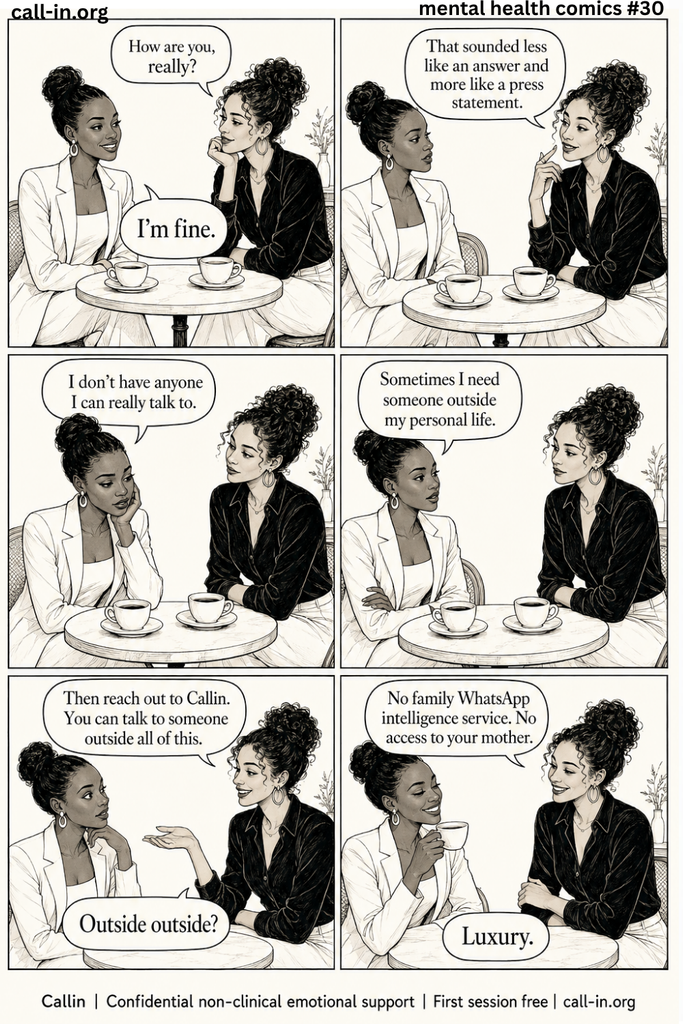
  • Why You Feel Lonely Even Though You Have Friends: Exploring the Support Gap

    It’s very normal to feel lonely even when you’re surrounded by people. And we talk about it on this episode of Callin Convos on Spotify.

    There is a support gap that has always existed. Only that it’s now obvious in today’s world. You’d think that with the way we’re more connected to each other through phones we’d be less lonely, right?

    Obviously, your phone has contacts. Your calendar has plans. And yet, when something is actually wrong, there is a hesitation before saying it out loud. A small calculation. Is this too much? Will I become the friend who always needs something?

    (more…)
  • I Need Someone To Talk To, Not Therapy

    someone to talk to

    Sometimes you don’t need advice. Sometimes you don’t need a diagnosis. Sometimes you don’t even need a solution.

    You just need someone to talk to.

    Modern life is busy, demanding, and often surprisingly isolating, even when you’re surrounded by people all day. You can have a full calendar and still feel like nobody actually knows what’s going on in your head.Wanting a conversation, a real one, doesn’t mean something is wrong with you. It means you’re human.

    (more…)
  • Why Modern Life Feels Emotionally Overwhelming

    It’s 7am and your phone already has eleven notifications. Three emails are waiting before you’ve had coffee.

    A news alert flashes across the lock screen. Somewhere in the back of your mind is a birthday you need to remember, a bill that’s due, a text you still haven’t answered. None of this is technically a crisis.

    And yet by mid-morning, you already feel like you’re behind.

    If you’ve ever asked yourself why life feels emotionally overwhelming even when nothing is technically wrong, you’re not imagining it, and you’re far from alone.

    Modern life places a kind of demand on our attention, emotions, and energy that simply did not exist a generation ago. Understanding why can be the first step toward feeling more in control again.

    (more…)
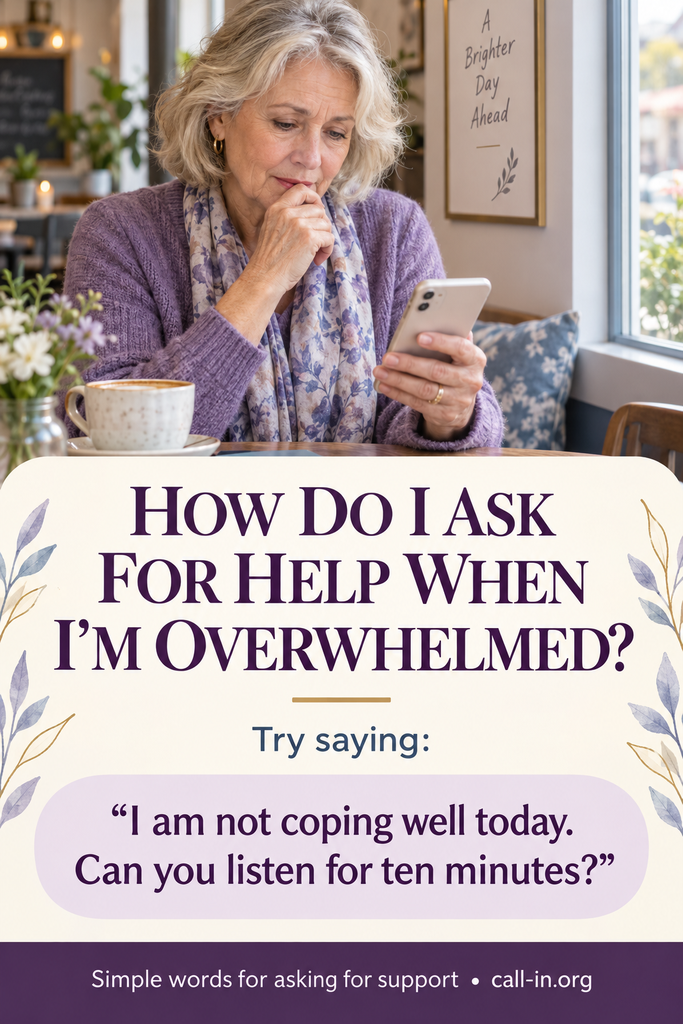
  • Feeling Overwhelmed but You Don’t Need Therapy? Helpful Tips

    Really, what do you when you’re feeling overwhelmed, but you know therapy is not the answer? We’ve all been there at one point or the other in our lives.

    Those moments you tell people you’re fine. But deep down, you’re not. You go through the motions – go to work, answer the emails, make dinner, show up for the people who need you.

    From the outside, everything looks normal. But underneath it, you’re running on fumes. You’re not in crisis. You’re not depressed, at least not in any way you’d put a name to. You just feel heavier than you used to, like you’re carrying something you can’t quite put down.

    (more…)
  • Stress Management Guide: 10 Proven Techniques to Reduce Stress

    stress management

    Stress management has become a big deal because stress has become an unavoidable part of modern life that affects millions of people worldwide. Whether it’s work deadlines, professional burnout, financial pressures, or personal relationships, chronic stress can take a serious toll on your physical and mental health. The good news? Effective stress management is a skill you can learn and master.

    This comprehensive guide will walk you through evidence-based strategies to manage stress, regain control of your life, and build lasting resilience.

    (more…)