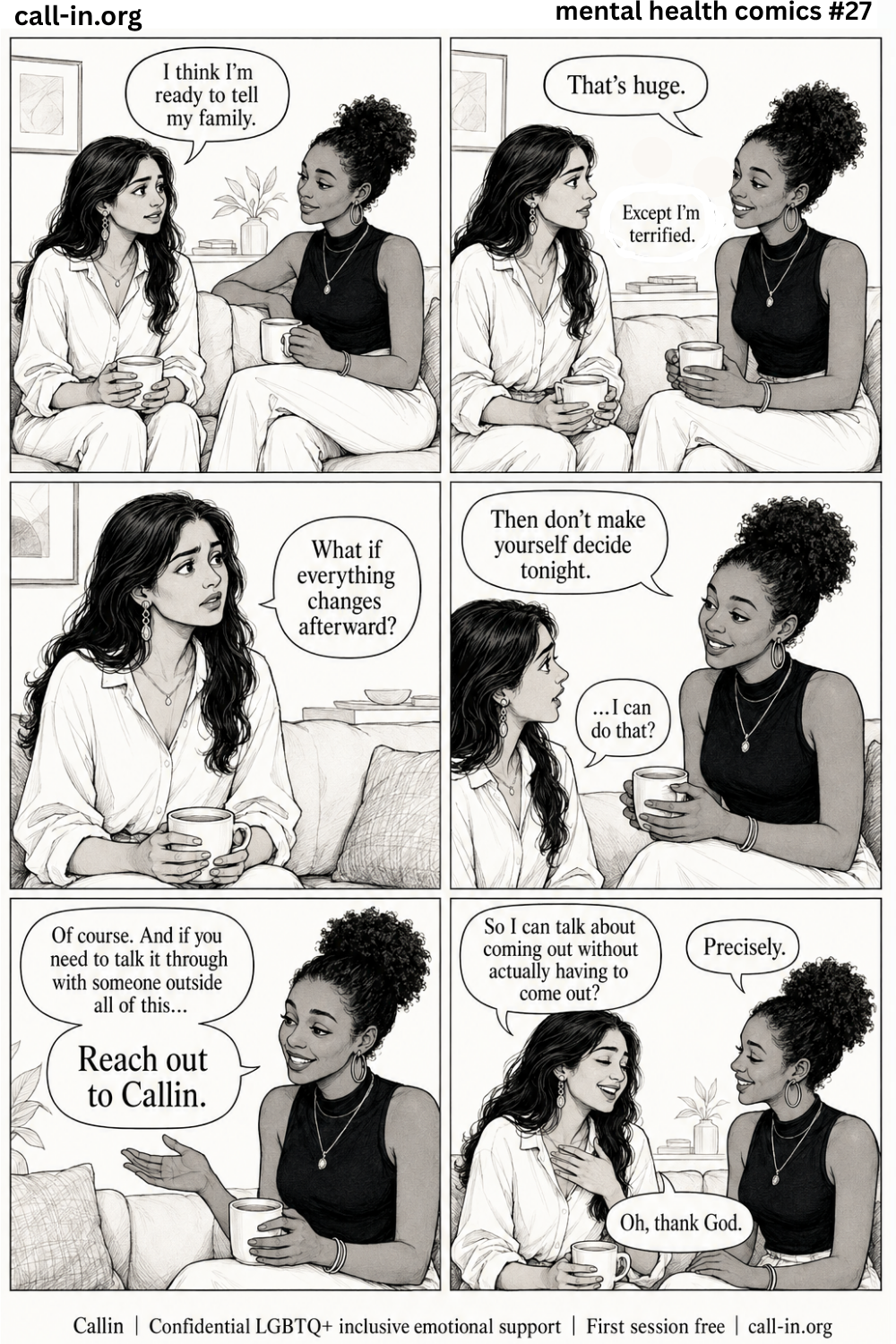
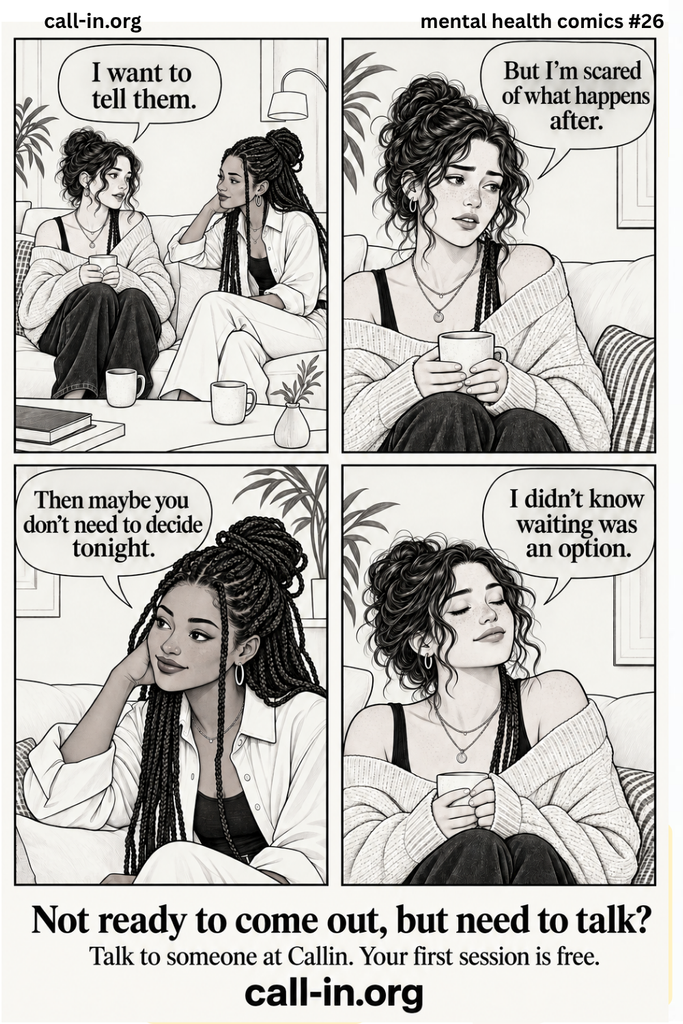
If you are LGBTQ+ and need someone to talk to, you do not have to be in crisis, out to your family, certain about your identity or ready for therapy before you are allowed support.
Maybe your girlfriend broke up with you and the people around you do not understand why the loss feels so enormous.
Maybe you think you might be gay, lesbian, bisexual, queer, trans, nonbinary or somewhere else entirely, and you have never said it aloud.
Maybe you feel guilty because you have not come out.
Maybe you cannot come out safely.
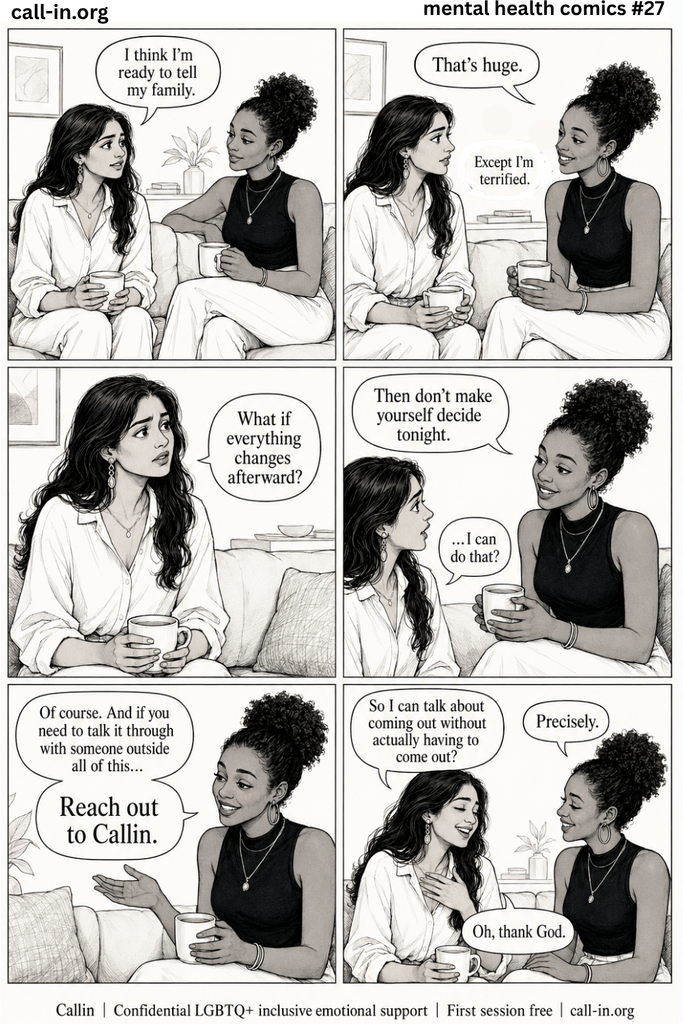
Maybe your family does not accept your relationship. Your faith and sexuality feel tangled together. Dating is exhausting. You feel lonely in a room full of people. Or perhaps being LGBTQ+ has absolutely nothing to do with what is wrong today.
You are still allowed somewhere to talk.
Callin offers confidential, LGBTQ+ inclusive emotional support online for adults who want a real person to listen without judging their sexuality, gender, relationships or choices.
You do not have to educate your listener.
You do not have to defend your relationship.
You do not have to choose a label.
And you do not have to turn your identity into the problem before somebody will care about how you feel.
Your first Callin session is free. It can last 20 minutes or up to one hour, depending on what you need in that moment, with no commitment to continue.
Key Takeaways
- If you need LGBTQ+ emotional support online, Callin offers private conversations with trained active listeners.
- You can talk about coming out, questioning your sexuality or gender, lesbian or queer breakups, dating, family rejection, loneliness, faith, identity, discrimination or ordinary life.
- You do not need to be out or certain about your identity before talking to someone.
- Same-sex and queer relationships are treated as real relationships, including when they end and you are grieving.
- Your listener will not pressure you to come out, choose a label, end a relationship or make another personal decision.
- Callin provides non-clinical emotional support rather than LGBTQ+ therapy, diagnosis or medical treatment.
- Where possible, you can continue speaking with the same dedicated listener instead of explaining your life again every session.
- You can book your first Callin session free now. There is no commitment to continue.
Where Can I Find LGBTQ+ Emotional Support Online?
If you need LGBTQ+ emotional support online, your options can include LGBTQ+ helplines, queer peer-support groups, community organisations, trained listening services, LGBTQ+ affirming therapists and mental health services.
The right support depends on what you need.
You might want community with people who share similar experiences.
You might need professional psychological treatment.
You might need practical advocacy.
You might need urgent help.
Or you might simply need a human being who will listen while you say something you have been carrying alone.
Callin provides the last of these.
We are an online, non-clinical emotional-support service connecting adults with trained active listeners for confidential conversations.
You can talk about LGBTQ+ life without your sexuality or gender being treated as something to diagnose, correct or explain away.
And you can talk about everything else too.
Sometimes the first thing you need is not an answer.
It is somewhere safe enough to finally say the question.
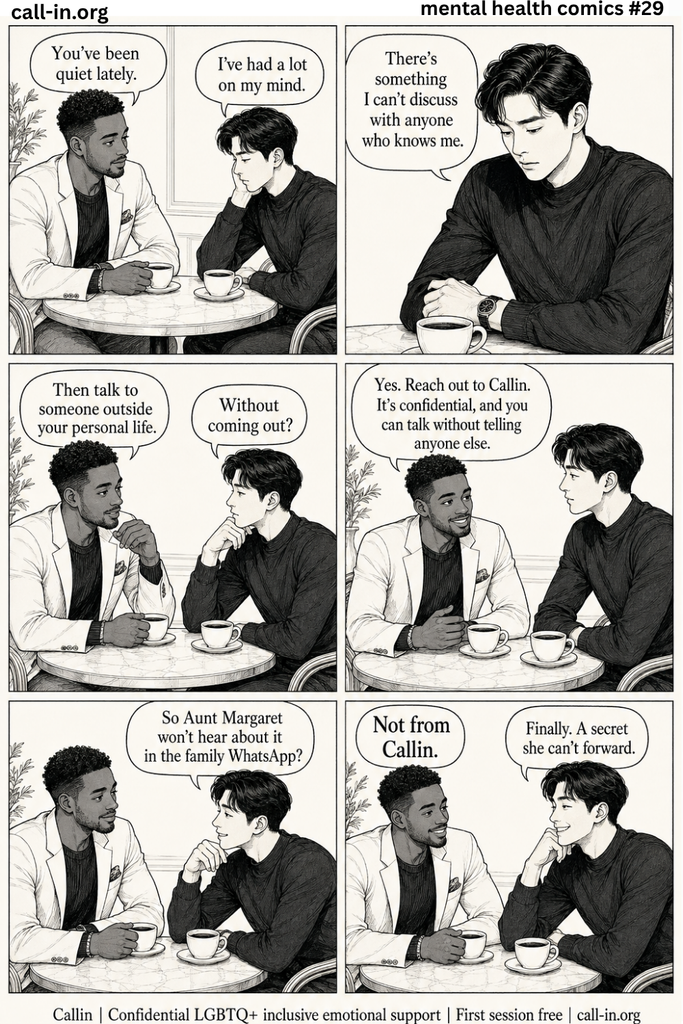
I’m LGBTQ+ and I Need Someone to Talk To
You can talk to someone even if you cannot neatly explain what is wrong.
Perhaps you are lonely.
Your relationship is complicated.
You are hiding part of yourself from your family.
You are questioning your sexuality.
You have come out and somehow feel worse rather than better.
You have not come out and feel guilty about it.
You’re exhausted from dating.
Someone made a comment that you cannot stop replaying.
You feel disconnected from the LGBTQ+ community and wonder whether you belong there at all.
Or you’ve simply had a terrible week.
Being LGBTQ+ does not mean every difficult emotion you experience is about your identity.
Sometimes a lesbian is just having an awful Tuesday.
You are allowed that too.
At Callin, you can talk about:
- questioning your sexuality or gender
- wondering whether, when or how to come out
- feeling guilty about not coming out
- lesbian, gay, bisexual and queer relationship breakups
- dating, intimacy, sex and trust
- family rejection or tension
- uncomfortable questions from relatives
- faith, religion, culture and LGBTQ+ identity
- being misgendered
- having a same-sex relationship minimised
- loneliness before or after coming out
- friendship and chosen family
- bisexual or pansexual invisibility
- asexual or aromantic experiences
- deciding who gets to know what about you
- discrimination or feeling misunderstood
- work and study
- stress and burnout
- grief
- overthinking
- difficult decisions
- or anything else you need somewhere to put into words
You do not have to make the conversation educational.
You should not have to spend your emotional-support session giving LGBTQ+ 101 before you’re allowed to discuss what actually hurts.
Respect comes first.
I’m a Lesbian and My Girlfriend Broke Up With Me. Who Can I Talk To?
If your girlfriend broke up with you and you need someone to talk to, you can reach out to an LGBTQ+ affirming friend, queer peer-support group, trained listener or LGBTQ+ affirming therapist.
And yes, a lesbian breakup is a real breakup.
You should not have to minimise your grief because somebody else does not understand the relationship.
You may be grieving your girlfriend.
But you might also be grieving your routines together, mutual friends, plans, intimacy, the future you imagined and the version of yourself that existed inside that relationship.
Queer breakups can also disrupt community.
Perhaps you have the same friends.
Go to the same places.
Belong to the same LGBTQ+ circles.
Now heartbreak comes with the awkward question of where you are supposed to belong.
At Callin, you do not have to hurry towards “moving on.”
You can be angry.
You can miss her.
You can love her and still know the relationship needed to end.
You can feel relieved and devastated at exactly the same time.
You can say the embarrassing thing you have already told your friends fourteen times but still cannot stop thinking about.
Your listener can stay with the conversation and help you hear your own thoughts more clearly.
If you want suggestions, you can ask.
If you just need to talk about your breakup without being rushed, that is enough.
I Feel Guilty About Not Coming Out. Who Can I Talk To?
If you feel guilty because you have not come out, you can talk confidentially with an LGBTQ+ support service, affirming therapist, trained listener or trusted person.
You are not doing LGBTQ+ identity incorrectly because you are private.
Coming out is not a debt.
You do not owe disclosure to your family, friends, coworkers, religious community or the world simply because you know something about yourself.
Safety matters.
Housing matters.
Money matters.
Culture matters.
Faith matters.
Family matters.
Your emotional readiness matters.
And sometimes you simply do not want somebody to know yet.
That matters too.
Privacy can protect you and still feel lonely.
Both things can be true.
At Callin, you can talk about the guilt, fear, loneliness or uncertainty without somebody turning the conversation into a campaign to make you come out.
Your listener will not tell you that you should disclose your identity.
They will not tell you that you should remain closeted either.
The decision stays yours.
I’m Scared to Come Out. Is There Someone I Can Talk To Confidentially?
Yes.
If you are scared to come out, you can seek confidential LGBTQ+ support before making any decision about disclosure.
You do not have to practise coming out by actually coming out.
Sometimes you need somewhere to say:
“I think I’m gay.”
“I think I’m bisexual.”
“I don’t know what I am.”
“I know exactly who I am, but my family cannot know.”
“I think my relationship would change if people knew.”
“I’m scared.”
A confidential conversation can give you room to hear yourself without requiring you to take the next step.
At Callin, you control what you disclose.
You do not have to tell your whole story in the first conversation.
You can use the name you feel comfortable using, explain only what feels safe and take the conversation at your own pace.
I Think I Might Be Gay. Who Can I Talk To?
If you think you might be gay, lesbian, bisexual, queer or another sexual orientation and need someone to talk to, you do not have to settle on a label first.
Questioning is enough.
Perhaps you know who you are attracted to but do not know what to call it.
Perhaps a feeling surprised you.
Perhaps something you have known quietly for years has suddenly become impossible to ignore.
Perhaps you are wondering whether you’re “really” queer enough to use a particular label.
Or perhaps labels simply do not interest you.
A supportive conversation should not become an identity quiz.
Nobody listening to you should decide your sexuality for you.
At Callin, you can talk about attraction, uncertainty, relationships, fear, curiosity and what acknowledging those feelings might change.
The conversation does not have to end with a conclusion.
Sometimes saying, “I don’t know yet” is the conclusion for now.
I’m Questioning My Gender. Who Can I Talk To?
If you are questioning your gender and want someone to talk to, you can speak with an LGBTQ+ affirming therapist, gender-support organisation, peer-support service, trusted person or trained listener.
You do not need to arrive knowing whether you are transgender, nonbinary, genderfluid, cisgender or anything else.
You may simply have questions.
A good listener should not decide your gender identity for you, pressure you towards a particular label or treat uncertainty as something that needs to be fixed.
At Callin, you can think aloud.
You can talk about what feels comfortable, what does not, what you are curious about and what scares you.
Your identity belongs to you.
Can I Talk to Someone About LGBTQ+ Family Rejection?
Yes.
Family rejection can hurt even when you expected it.
It can also be complicated when the people involved genuinely love you in other ways.
Perhaps your family refuses to acknowledge your partner.
Perhaps somebody insists your sexuality is a phase.
Perhaps they use the wrong name or pronouns.
Perhaps conversations about marriage, grandchildren, faith or “what people will think” leave you exhausted.
Perhaps nobody has explicitly rejected you, but you know enough about their beliefs to fear what would happen if they knew.
Family relationships do not become emotionally simple because you are LGBTQ+.
You can love someone and feel hurt by them.
You can want acceptance and need distance.
You can understand where somebody’s beliefs came from without accepting the way those beliefs affect you.
Sometimes you need somewhere to say all of that without being told to forgive, confront, leave or reconcile before you are ready.
Can I Talk About Faith and Being LGBTQ+?
Yes.
Faith and LGBTQ+ identity can coexist in deeply personal, complicated ways.
Some people find affirmation inside their religious communities.
Others experience rejection.
Some leave their faith.
Some stay.
Some are rebuilding a relationship with spirituality after being hurt by religious institutions.
Others feel caught between family, culture, belief and identity.
You do not need somebody else to decide which part of you should win.
You can talk about the conflict without being mocked for your faith or judged for your sexuality or gender.
Do I Need an LGBTQ+ Therapist or Just Someone to Talk To?
An LGBTQ+ affirming therapist or counsellor may be appropriate when you want clinical assessment, psychological treatment, structured therapeutic work or support for mental-health symptoms that significantly affect daily life.
But sometimes you do not need therapy.
Sometimes you need to talk.
A non-clinical listening service may suit you when you mainly want human presence, emotional relief, an objective perspective or a confidential place to think aloud.
Callin is not LGBTQ+ therapy.
Our listeners do not diagnose mental-health conditions, provide psychotherapy, prescribe medication or replace qualified healthcare professionals.
Callin can instead provide somewhere to talk before therapy, alongside professional support, while waiting for therapy, or when therapy is not what you are looking for.
You do not have to turn an ordinary human need for connection into a diagnosis before you’re allowed to seek it.
What Does LGBTQ+ Inclusive Emotional Support Mean at Callin?
Being LGBTQ+ inclusive means more than putting a rainbow on a webpage.
It means your sexuality, gender and relationships are not treated as problems to correct.
Your name and pronouns are respected.
Lesbian, gay, bisexual, transgender and queer relationships are taken seriously.
We do not assume your partner’s gender.
We do not assume monogamy.
We do not assume marriage is your goal.
We do not assume what family should look like.
We do not assume that you’re out.
We do not assume that you want to be.
We do not assume that questioning means you need somebody to provide an answer.
And we do not assume that because you’re LGBTQ+, being LGBTQ+ is what you want to talk about.
You are a whole person.
Queerness may be central to today’s conversation.
Tomorrow you might want to complain about your manager.
Both conversations belong here.
Is Callin Confidential If I’m Not Out?
Callin conversations are private and treated confidentially, subject to limited legal and safeguarding exceptions.
You decide what you disclose.
You do not have to share your entire identity, relationship history or situation immediately.
You do not have to settle on a label.
You do not have to reveal something before you are ready.
Confidentiality does have limits where serious safeguarding concerns or legal duties require action. Those boundaries should be clear so you can make an informed choice about what you share.
Being closeted does not disqualify you from support.
Will I Have to Explain Everything Again Next Time?
Normally, no.
Where possible, Callin connects you with the same dedicated listener over time.
That continuity can matter enormously when opening up already feels difficult.
You should not have to begin every conversation with:
“So, I’m gay…”
“So, my parents don’t know…”
“So, this was my girlfriend…”
“So, these are my pronouns…”
“So, here’s everything that happened…”
Again.
And again.
And again.
A continuing listener can remember the context and allow the conversation to deepen at your pace.
What Happens in My First Callin Session?
Your first Callin session is completely free.
There is no commitment to continue.
The conversation can last 20 minutes or up to one hour depending on what you need in that moment.
You do not need to prepare.
You do not need a diagnosis.
You do not need a dramatic story.
You do not need to prove that you’re struggling enough.
You do not even have to disclose that you’re LGBTQ+ immediately.
You can begin with:
“My girlfriend left me and I don’t know who to talk to.”
“I think I might be queer.”
“I can’t come out safely.”
“My family doesn’t accept my relationship.”
“I don’t know what I am.”
Or simply:
“I need someone to listen.”
That’s enough.
The first conversation lets you experience Callin and decide whether the service feels right for you.
If it does, onboarding follows.
If Callin is not the right kind of support for what you need, we can signpost you towards something more appropriate.
No audition for compassion.
No sales performance.
Just a conversation.
Where Else Can LGBTQ+ Adults Find Support?
Callin is one option, not the only option.
Different needs deserve different kinds of support.
An LGBTQ+ peer group can provide community and shared experience.
An identity-specific helpline can offer specialised listening.
A GP, counsellor, psychologist or therapist can provide clinical assessment and treatment when needed.
In the UK, Switchboard provides LGBTQIA+ support from volunteers within the LGBTQIA+ community. LGBT Foundation also provides services including talking therapies.
If You Need Urgent Help
Callin is not a crisis service and is not continuously monitored.
If you are in immediate danger, think you may harm yourself or somebody else, or cannot keep yourself safe, use emergency or crisis support where you are.
In the UK, call 999 or go to A&E if there is immediate danger. You can call Samaritans free on 116 123, text SHOUT to 85258, or call NHS 111 and select the mental-health option for urgent mental-health support when there is no immediate danger.
Outside the UK, contact the emergency or crisis service available in your location.
You Deserve Somewhere You Don’t Have to Edit Yourself
Maybe you change your partner’s pronouns when telling stories.
Maybe you call your girlfriend your “friend.”
Maybe nobody knows.
Maybe everybody knows.
Maybe you’re out and proud but tired of feeling as though you have to be certain and confident about everything.
Maybe you haven’t found the words yet.
Maybe you don’t want words.
There is room for you before certainty.
There is room for you after heartbreak.
There is room for complicated family love.
There is room for loneliness.
There is room for joy.
And there is room for the completely ordinary mess of being human.
You do not have to make yourself easier to understand before asking to be heard.
Book your first Callin session free.
Talk for 20 minutes or up to one hour, depending on what you need.
No commitment.
No judgment.
No unsolicited advice.
Just somewhere to start.
Frequently Asked Questions About LGBTQ+ Emotional Support Online
Where can I find LGBTQ+ emotional support online?
LGBTQ+ emotional support online is available through LGBTQ+ helplines, peer groups, community organisations, affirming therapists and trained listening services. Callin provides confidential, non-clinical emotional support online for adults who mainly need somewhere to talk with a trained listener.
Is Callin LGBTQ+ friendly?
Yes. Callin is an LGBTQ+ inclusive emotional-support service for adults. You can talk about sexuality, gender, coming out, relationships, family, loneliness, heartbreak or anything else without your LGBTQ+ identity being treated as a problem.
I’m gay and need someone to talk to. Can I use Callin?
Yes. You do not have to be in crisis or need therapy before talking to someone. Callin provides confidential conversations with trained active listeners for adults who want non-clinical emotional support.
I’m a lesbian and my girlfriend broke up with me. Who can I talk to?
You can talk to an LGBTQ+ affirming friend, queer peer-support group, trained listener or therapist. Callin offers private online conversations where you can process a lesbian or queer breakup without having the relationship minimised or being rushed towards moving on.
I think I might be gay. Who can I talk to?
You can speak with an LGBTQ+ affirming therapist, support organisation, trusted person, peer-support service or trained listener. You do not need to choose a label before having the conversation. Callin listeners will not decide your sexuality for you.
Who can I talk to if I’m questioning my sexuality?
You can talk to an affirming friend, LGBTQ+ support organisation, therapist, peer group or trained listener. Questioning your sexuality is enough reason to want a confidential conversation. You do not have to know what your identity means yet.
Who can I talk to if I’m questioning my gender?
You can speak with a gender-support organisation, LGBTQ+ affirming therapist, trusted person, peer-support service or trained listener. A supportive listener should give you room to explore rather than deciding your identity for you.
I’m scared to come out. Can I talk to someone confidentially?
Yes. You can seek confidential LGBTQ+ support without coming out publicly. At Callin, you control what you disclose and can talk about fear, family, relationships, safety or uncertainty without being pressured to come out.
Is it wrong that I don’t want to come out?
No. Coming out is a personal decision. Safety, housing, finances, family, culture, faith, privacy and emotional readiness can all affect whether or when someone chooses to disclose their LGBTQ+ identity.
Can I get LGBTQ+ support without therapy?
Yes. Depending on what you need, non-therapy LGBTQ+ support can include peer groups, helplines, community organisations, trained listening services and other non-clinical emotional-support options. Callin provides non-clinical listening rather than psychotherapy or diagnosis.
Is LGBTQ+ emotional support confidential?
Confidentiality depends on the service. Callin treats conversations as private and confidential, subject to limited legal and safeguarding exceptions. You decide how much of your identity or situation you want to disclose.
Will Callin tell me whether I should come out?
No. Your listener will not tell you to come out or remain private. They can listen while you explore your feelings, circumstances and options. Advice is only offered when requested, and personal decisions remain yours.
Do I have to talk about being LGBTQ+?
No.
You can book a Callin session and spend the entire thing talking about your boss.
We promise not to be offended.

Leave a Reply