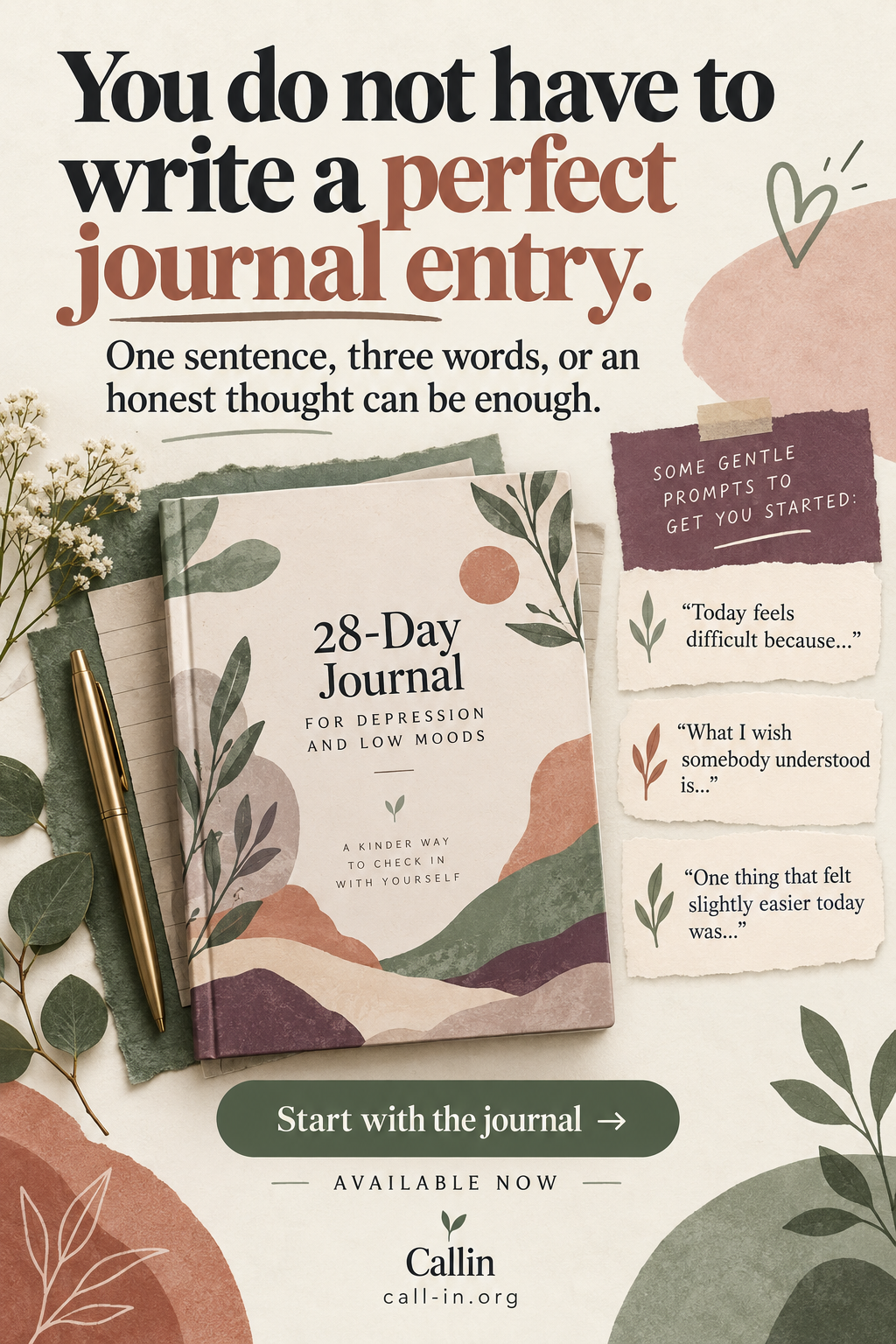
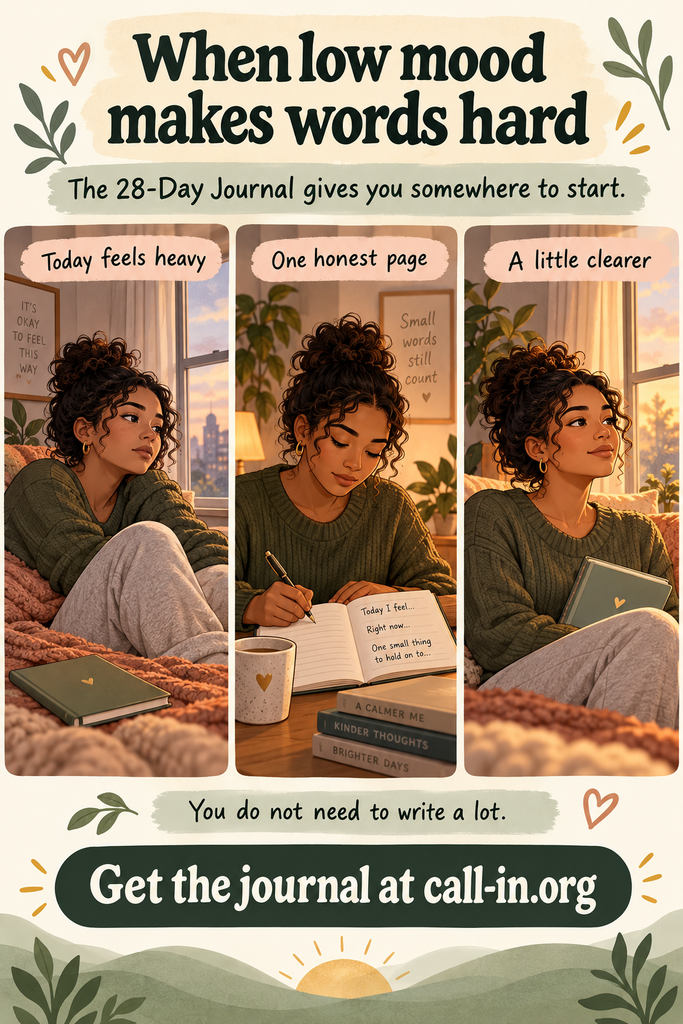
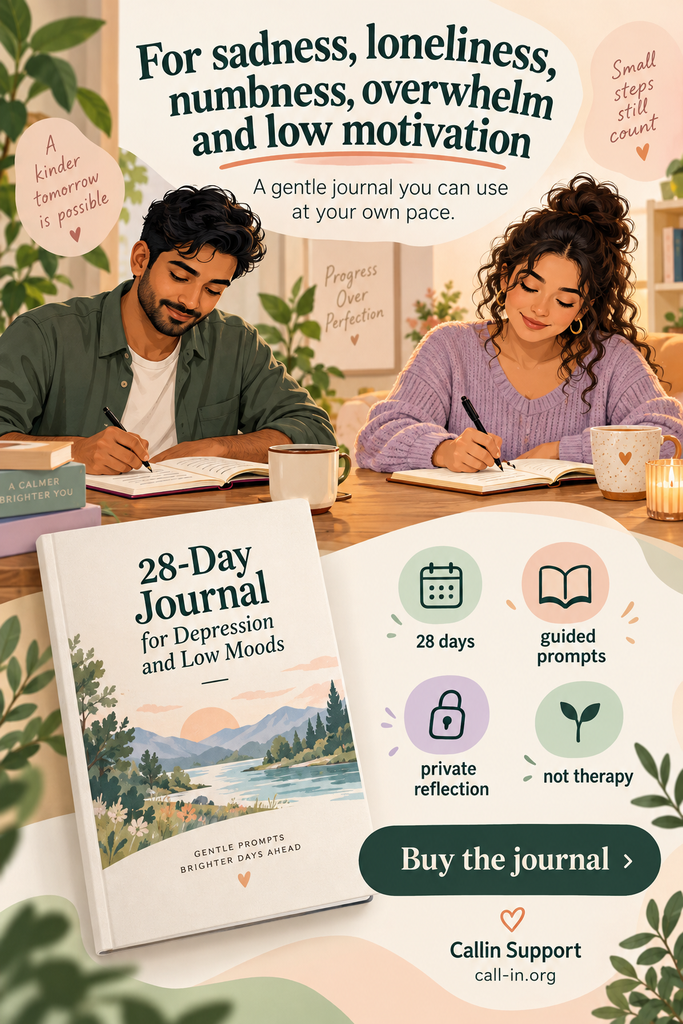
The 28-Day Journal for Depression and Low Moods is a guided self-reflection journal for people experiencing sadness, low motivation, emotional exhaustion, loneliness, numbness, overwhelm, or difficult periods of low mood.
It gives you one private place each day to slow down, put your thoughts into words, notice patterns, and understand what you may need.
You do not need to be positive.
You do not need to force yourself to feel better.
You do not need to know exactly why you feel the way you do.
You simply need somewhere to begin.
28 days. One honest page at a time.

Key takeaways
- This is a guided journal for depression and low moods, designed to support reflection rather than diagnose or treat a mental health condition.
- You get 28 days of gentle journal prompts covering emotions, thoughts, relationships, routines, stress, needs, coping, connection and moments of relief.
- You do not have to write a lot. A sentence, a few words, or one honest thought can be enough for the day.
- You can use the journal at your own pace. Skip a day, repeat a prompt, pause, or come back when you are ready.
- The journal can be used independently or alongside other appropriate support, including therapy, medical care or emotional support.
- It is suitable for people experiencing low mood, sadness, loneliness, emotional numbness, overwhelm or periods of feeling disconnected from themselves.
- It is not therapy or a treatment for depression. If you need clinical mental health care, speak with an appropriately qualified professional.
What is a depression journal?
A depression journal is a private writing tool that can help you reflect on your thoughts, emotions, experiences and patterns during periods of depression or low mood.
Some journals give you blank pages.
This one gives you somewhere to start.
Each day includes a gentle prompt designed to help you notice what is happening in your emotional life without demanding that you fix it immediately.
You might write about what has been weighing on you.
What you have been avoiding.
What makes the day slightly easier.
Who you feel connected to.
What has been draining your energy.
Or what you wish somebody would ask you.
The purpose is not to analyse yourself until you find the perfect answer.
It is to create enough space to hear yourself more clearly.
Can journaling help when I feel depressed or low?
Journaling can give some people a structured way to express difficult thoughts, notice patterns and reflect on what they are experiencing. It is not a replacement for depression treatment or professional mental health care.
Sometimes thoughts feel different once they are outside your head.
Writing something down can help you notice:
“I have been saying I am fine, but I am exhausted.”
“I feel worse after certain situations.”
“I have stopped doing things that used to make me feel connected.”
“I am lonely, but I have been withdrawing from people.”
“I keep expecting myself to function as though nothing is happening.”
You may not discover a dramatic answer.
That is not the goal.
Sometimes noticing is enough for today.
What is inside the 28-Day Depression and Low Mood Journal?
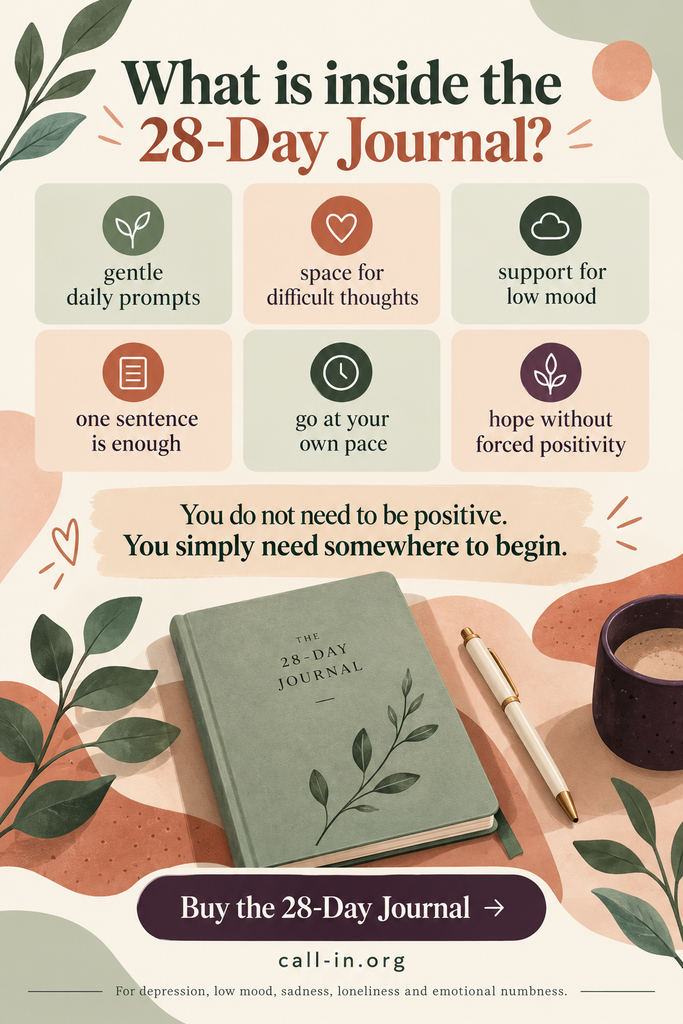
The journal contains 28 days of guided self-reflection prompts designed for people experiencing low mood and emotionally difficult periods.
The prompts gently explore areas such as:
- How you are actually feeling
- Thoughts you have been carrying quietly
- Stress and emotional exhaustion
- Loneliness and connection
- Relationships and boundaries
- Your daily routines
- What has been taking energy from you
- What gives you small moments of relief
- Things you may need more of
- Things you may need less of
- Coping patterns
- Self-talk
- Rest
- Support
- Hope without forced positivity
- What moving forward might look like for you
You are not expected to solve your life in 28 days.
This is not a transformation challenge.
It is a place to meet yourself honestly.
What should I write in a journal when I feel depressed?
When you feel depressed or low, you can write about what feels heavy, what happened that day, what you need, what you have been avoiding, or what feels difficult to explain to other people.
You do not need a profound journal entry.
You could begin with:
“Today feels difficult because…”
“The thought I keep coming back to is…”
“What I wish somebody understood is…”
“The thing taking most of my energy right now is…”
“Something I miss is…”
“One thing that felt slightly easier today was…”
“If I could ask for one kind of support right now, it would be…”
The 28-Day Journal gives you a different guided starting point each day so you do not have to stare at an empty page wondering what to write.
What if I have no motivation to journal?
You do not need motivation to write a perfect journal entry. You can write one sentence, three words, or nothing at all and return another day.
Low mood can make even small tasks feel enormous.
That includes journaling.
This journal is not another habit for you to fail at.
There are no streaks.
No gold stars.
No rule saying you have to complete 28 consecutive days.
If today’s entire entry is:
“Today was hard.”
That counts.
If you skip four days and come back on the fifth, that counts too.
The journal belongs to you.
Use it in the way that feels manageable.
Is this a journal for sadness, loneliness and emotional numbness too?
Yes. The 28-Day Journal can also be used during periods of sadness, loneliness, emotional numbness, overwhelm, low motivation or feeling disconnected from yourself.
Low mood does not always feel like obvious sadness.
Sometimes it feels like not caring.
Sometimes everything irritates you.
Sometimes you feel lonely even when people are around.
Sometimes you are exhausted but cannot explain what you are tired from.
Sometimes you are doing everything you normally do, but nothing feels quite like you.
The journal gives you somewhere to explore those experiences without requiring you to label them first.
Can I use this journal if I am already in therapy?
Yes. You can use a self-reflection journal independently while receiving therapy or other professional support, provided you follow any guidance your healthcare or mental health professional has given you.
The journal does not replace your therapist.
It does not provide treatment.
It does not tell you what your symptoms mean.
It simply gives you a private place to write.
If something comes up while journaling that you would like to discuss with your therapist or another qualified professional, you can decide whether you want to bring it into that conversation.
Is this depression journal a replacement for therapy?
No. The 28-Day Journal for Depression and Low Moods is a self-reflection resource, not therapy, diagnosis, medical care or treatment for depression.
Some people experiencing low mood may benefit from therapy.
Some may need medical support.
Some may need changes in their circumstances.
Some may want emotional support.
Some may use several forms of support together.
A journal is one tool.
It does not need to pretend to be everything.
What makes this different from a blank mental health journal?
This journal gives you guided questions for the days when knowing what to write is part of the difficulty.
A blank notebook can be wonderful.
It can also feel like another demand when your mind is already tired.
Where do you start?
What are you supposed to write?
Are you meant to analyse the day?
Write gratitude lists?
Set goals?
This journal removes some of that pressure.
You open the day’s page.
There is a question waiting for you.
You answer as much or as little as you want.
Then you close it.
Who is this 28-day mental health journal for?
This journal is for adults who want a gentle, structured way to reflect during periods of depression, low mood or emotional difficulty.
It may feel particularly relevant if you have been thinking:
“I do not feel like myself lately.”
“I feel low and I do not know why.”
“I am tired of keeping everything in my head.”
“I feel emotionally numb.”
“I have no motivation.”
“I feel lonely.”
“I am overwhelmed.”
“I want to understand what is going on with me.”
“I find talking difficult, but I can write.”
You do not need to identify with every experience.
You do not need a diagnosis to use a journal.
You only need to want somewhere private to put your thoughts.
How long does the depression journal take each day?
There is no required amount of time. You can spend a few minutes with a prompt or write for longer when you have more to say.
The journal is deliberately flexible.
Some entries may come easily.
Others may not.
You can write one paragraph and stop.
You can fill the page.
You can return to an earlier question because something has changed.
You are not being graded.
The aim is reflection, not performance.
What happens after the 28 days?
After 28 days, you can look back at what you wrote, notice patterns that stand out, revisit useful prompts, or simply put the journal away.
You do not need a dramatic conclusion.
You may notice that certain situations regularly affect your mood.
You may recognise something you need to talk about.
You may see that some days were not as identical as they felt while you were living them.
You may realise that you need more support.
Or you may simply have 28 days of honest writing that helped you give words to a difficult period.
That is enough.
What if writing in a journal does not feel like enough?
If low mood is persistent, significantly affecting your daily life, or you are concerned about your mental health, consider speaking with a qualified healthcare or mental health professional.
You do not have to choose between journaling and support.
You may want therapy.
You may want to speak with your doctor or another healthcare professional.
You may want support from people you trust.
And sometimes you may simply want somewhere confidential to talk through what has been on your mind.
Callin offers one-to-one, non-clinical emotional support with trained human listeners for people who want someone to talk to without being diagnosed or treated.
Callin is not therapy or a replacement for clinical mental health care.
If you are in immediate danger or unable to keep yourself safe, contact an appropriate emergency or crisis service where you live.
Where can I buy the 28-Day Journal for Depression and Low Moods?
You can buy the 28-Day Journal for Depression and Low Moods through our Gumroad store and begin whenever you are ready.
There is no perfect first day.
You do not need to wait until Monday.
You do not need to promise yourself that the next 28 days will be different.
Open the first page.
Answer what you can.
Come back when you are ready.
Twenty-eight days. One honest page at a time.
[BUY THE 28-DAY JOURNAL]
Prefer talking to writing?
Sometimes writing is enough.
Sometimes you reach a page and realise what you really want is another human being.
Callin provides confidential, one-to-one, non-clinical emotional support with trained human listeners.
You can talk about low mood, loneliness, burnout, heartbreak, relationships, grief, work stress, feeling overwhelmed, or simply whatever has been sitting heavily in your mind.
Eligible new clients can start with a free first session.
Callin. Breathe out. Feel heard.
Frequently asked questions
What is a depression journal?
A depression journal is a writing tool used to reflect on thoughts, emotions, experiences and patterns during periods of depression or low mood. It is not a diagnostic or treatment tool.
What should I write when I feel depressed?
You can write about what feels heavy, what happened that day, what you need, what you are worried about, what has been draining you, or anything you have found difficult to say aloud.
Do I have to journal every day?
No. You can use the journal at your own pace. Missing a day does not mean you have failed or need to start again.
Can I use the journal if I have depression?
Yes, you can use a self-reflection journal if you have depression, but it should not replace treatment or professional care you need.
Can journaling cure depression?
No. This journal does not claim to cure, treat or diagnose depression. It is designed to support self-reflection and emotional awareness.
Is this journal suitable for low mood without a depression diagnosis?
Yes. You do not need a diagnosis to use the journal. It can also be used during periods of sadness, loneliness, overwhelm, emotional exhaustion or feeling disconnected.
Can I use this journal alongside therapy?
Yes. A self-reflection journal can be used independently alongside appropriate professional support. Follow any guidance given by your healthcare or mental health professional.
Important note
The 28-Day Journal for Depression and Low Moods is an educational and self-reflection resource. It is not therapy, medical advice, diagnosis or treatment for depression or any other mental health condition.
If you are concerned about your mental health or persistent changes in your mood, speak with an appropriately qualified healthcare or mental health professional.
If you are in immediate danger or unable to keep yourself safe, contact emergency or crisis services where you live.

Leave a Reply