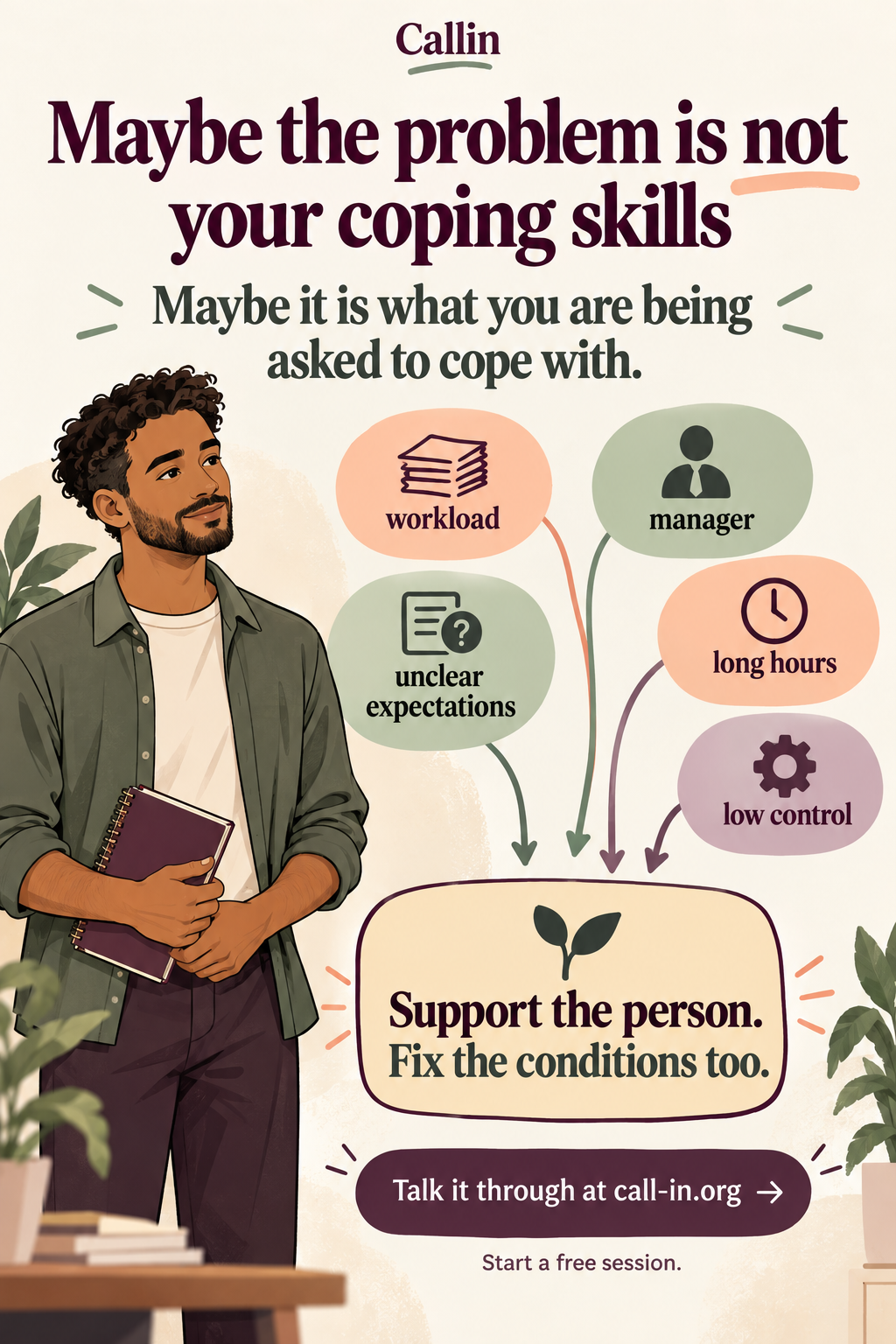

When you hate going to work and feel like crying at the thought of showing up at work, it can signal that you’re experiencing workplace stress or emotional exhaustion. Learn what may be happening and what can help you.
First of all, this is very common. And there’s nothing wrong with you for feeling like this. And if you need to talk about burnout, stress, and emotional situations at work, you can always start with your first Callin session. It’s free.
Key takeaways
- Dreading work and feeling like crying can be a sign that work is placing you under significant emotional strain. It does not automatically mean you hate your career or have a mental health condition.
- Burnout is specifically linked to chronic workplace stress. The World Health Organization describes it through exhaustion, growing mental distance or cynicism toward work, and reduced professional effectiveness. PSNet
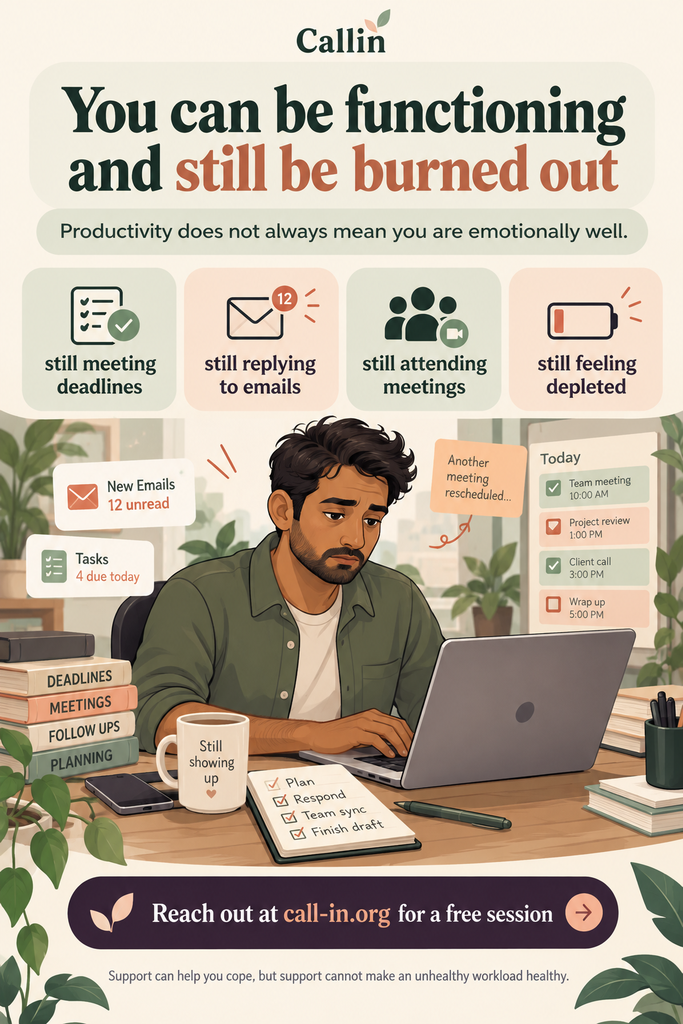
- Emotional exhaustion can appear before you completely stop functioning. You may still meet deadlines, attend meetings and look capable while feeling depleted underneath.
- The useful question is not only “How do I cope?” but “What is creating the strain?” Workload, low control, unclear expectations, management, conflict, long hours and insufficient resources can all matter. CDC
- Support can help you cope, but support cannot make an unhealthy workload healthy. Sometimes the person needs support and the working conditions need to change.
- You do not automatically need therapy because work is overwhelming you. Therapy may be appropriate for some people, while others may need workplace changes, rest, non-clinical emotional support, career coaching, an EAP or several forms of support together.
- You do not have to wait until you break down to take work stress seriously. Preventive support matters while you are still functioning too.
If you dread going to work and feel like crying, something about your current experience deserves attention.
Maybe you do not hate your profession.
Maybe you do not even hate your job.
You may simply be tired of what work is asking you to carry.
You wake up and your first thought is work. Sunday evening feels heavy. Small requests irritate you. Your inbox makes your stomach drop. You finish one task and another three appear.
And because you are still showing up, replying to emails and getting things done, everybody assumes you are fine.
You may not feel fine at all.
Callin provides confidential, one-to-one, non-clinical human support for people who need somewhere to talk through work stress, burnout, career uncertainty and other difficult parts of life. It is not therapy, counseling, diagnosis, medical or psychiatric care, or crisis support.
Sometimes the first step is simply having somewhere to say:
“Work is getting to me, and I need to work out why.”
Why do I dread going to work every day?
You may dread going to work because your brain has started associating work with pressure, exhaustion, conflict, lack of control or another source of repeated stress. Dreading work does not automatically mean you are lazy, ungrateful or in the wrong career.
Pay attention to what the dread is attached to.
Is it the amount of work?
Your manager?
One particular colleague?
Constant interruptions?
Impossible expectations?
The commute?
Fear of making mistakes?
Having no control over how your work gets done?
Being expected to remain available long after your working day should have ended?
Or has the job simply stopped fitting the life you want?
The National Institute for Occupational Safety and Health defines job stress as harmful physical and emotional responses that can occur when job requirements do not match a worker’s capabilities, resources or needs. CDC
That distinction matters.
Sometimes the question is not:
“Why can’t I cope?”
It is:
“What am I being asked to cope with?”
Why do I feel like crying before work?
Feeling like crying before work may be an emotional response to stress, exhaustion, anxiety, conflict, overwhelm or another difficulty associated with your job. One episode does not tell you exactly what is wrong, but repeated distress is worth paying attention to.
Perhaps you are already tense before you open your laptop.
You sit in the car outside work trying to gather yourself.
A notification appears and you immediately feel overwhelmed.
Or you are getting ready in the morning and suddenly think:
“I cannot do another day of this.”
Crying itself is not a diagnosis.
It also does not tell you whether the problem is burnout, anxiety, depression, workplace stress, exhaustion, something happening outside work, or several things interacting at once.
But you do not have to dismiss the reaction simply because you are still capable of working.
You can be functioning and struggling at the same time.
Am I burned out or just tired?
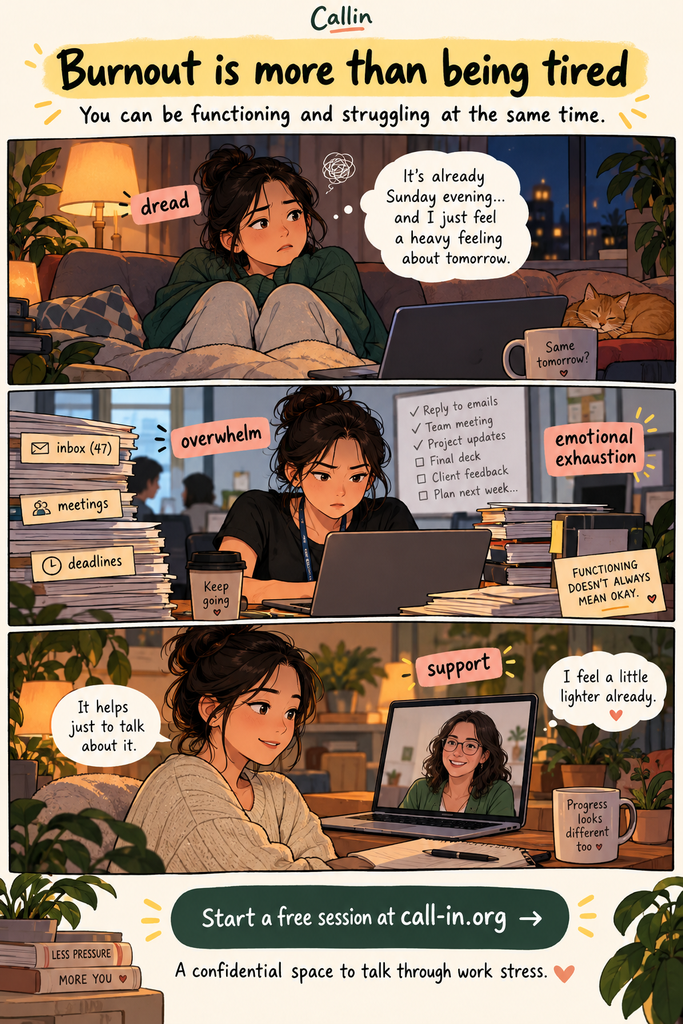
Ordinary tiredness usually improves with adequate rest, while burnout involves a more persistent pattern of work-related exhaustion, detachment or cynicism, and reduced professional effectiveness.
The World Health Organization describes burnout as an occupational phenomenon resulting from chronic workplace stress that has not been successfully managed. Its three dimensions are energy depletion or exhaustion, increased mental distance or negativity toward work, and reduced professional efficacy. PSNet
That means burnout is more than having a brutal Tuesday.
You might notice that rest no longer seems to reset you.
Work that once interested you now feels irritating or meaningless.
You are emotionally checking out.
Your concentration is poorer.
You procrastinate on tasks that previously felt manageable.
You are doing the work, but increasingly feel like you have nothing left to give it.
You do not need to diagnose yourself with burnout to decide that something needs attention.
What are the signs of emotional exhaustion at work?
Emotional exhaustion at work can include persistent depletion, irritability, difficulty concentrating, feeling overwhelmed by ordinary demands, detachment and having very little emotional energy left after work.
You might recognise it in small changes first.
You stop replying to friends after work because conversation feels like another task.
You stare at a simple email for twenty minutes.
You become unusually irritated when somebody asks for “one quick thing.”
You finish work and have no energy for the rest of your life.
You may also notice that you are becoming more cynical about work or withdrawing from colleagues.
NIOSH describes serious burnout-related exhaustion as going beyond ordinary daily fatigue and notes that people can become worn out, emotionally reactive and mentally disconnected from their work. CDC
The important point is not to create a checklist and diagnose yourself.
It is to notice the pattern.
Can work stress make you cry?
Yes, significant work stress can contribute to strong emotional responses, including feeling tearful or overwhelmed, although crying can have many causes and does not prove that work is the only factor involved.
Work affects people emotionally as well as practically.
Chronic occupational stress can affect mental wellbeing, and workplace psychosocial hazards can include conditions such as high demands, low control and other pressures that create strain. CDC
Sometimes crying is the moment when everything you have been containing becomes difficult to contain.
The presentation.
The manager.
The deadline.
The client.
The understaffing.
The expectation that you remain pleasant throughout all of it.
Then somebody asks one harmless question and suddenly you are fighting tears.
The final request may not be the whole problem.
It may simply be the point where your available emotional resources run out.
Why am I still getting my work done if I’m burned out?
Being productive does not necessarily mean you are emotionally well. People can continue meeting deadlines and performing competently while experiencing significant workplace stress or exhaustion.
This is one reason strain can go unnoticed.
You are still attending meetings.
Still answering Slack.
Still hitting targets.
Still helping everybody else.
So externally, there is no obvious emergency.
Internally, you may feel as though you are surviving the working week and spending the weekend trying to recover from it.
Performance is not a perfect measure of wellbeing.
Sometimes highly responsible people compensate for a long time before anyone notices how much the effort is costing them.
You deserve support before your ability to perform disappears.
What causes burnout at work?
Burnout is usually better understood by looking at the relationship between workplace demands and the resources available to meet them, rather than assuming the individual simply needs to become more resilient.
NIOSH research describes stress as particularly likely when demands repeatedly exceed the resources available to deal with them. Those resources can include time, staffing, information, autonomy, equipment, social support and emotional energy. CDC
Your situation might involve:
- Too much work for the available time
- Constant urgency
- Long working hours
- Lack of control
- Unclear responsibilities
- Poor management
- Difficult workplace relationships
- Job insecurity
- Inadequate staffing
- Being permanently reachable
- Emotional labour
- Effort that never seems recognised
- Values that conflict with the organisation
- Work that has expanded without additional resources
This is why another productivity hack is not always the answer.
If the bucket has a hole in it, pouring water faster does not repair the bucket.
What if my workload or manager is causing my stress?
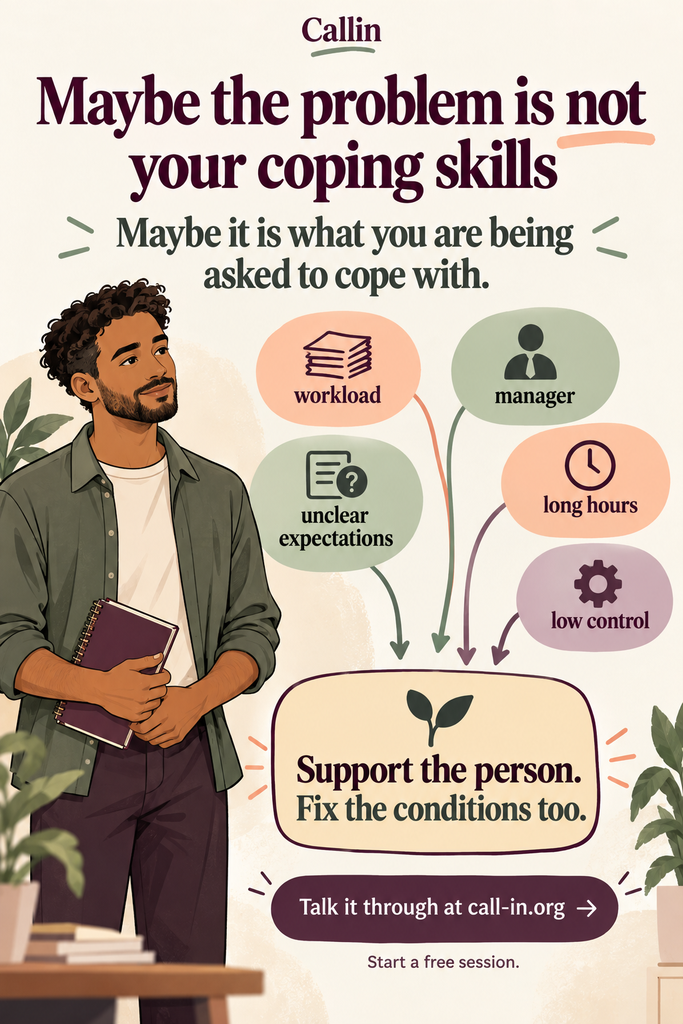
If workload, management behaviour or working conditions are driving your distress, individual coping strategies may help you manage the emotional impact, but they cannot remove the underlying workplace problem.
This is an important distinction in workplace wellbeing.
Meditation may help you regulate after a difficult meeting.
Talking to someone may help you process what happened.
Time away may give you room to recover.
But none of those things transforms an unreasonable workload into a reasonable one.
Support the person.
Then examine the system.
Where appropriate, that might mean discussing workload, responsibilities, deadlines, boundaries, staffing or flexibility with someone who has the ability to change them.
Depending on your organisation and location, that could involve your manager, another manager, HR, occupational health, a union or employee representative, or another workplace route available to you.
Your emotional response matters.
So do the conditions creating it.
Can an EAP help with burnout and work stress?
An Employee Assistance Programme can provide useful confidential support, counseling or referrals for employees experiencing work or personal difficulties, but an EAP cannot by itself fix organisational causes such as excessive workload, poor management or unclear roles.
If your employer has an EAP, it may be worth exploring what is actually available.
You may have access to short-term counseling, information, referrals, wellbeing resources or other forms of support depending on the provider and your employer’s package.
Use what is useful.
But remember the distinction between supporting someone through a difficult environment and changing the environment.
A credible workplace mental health strategy should be able to answer both:
What support can this employee access right now?
And:
What needs to change so the same conditions keep pushing fewer people toward exhaustion?
Callin can also complement workplace support by giving people access to non-clinical human conversation before, during or alongside other appropriate services.
It does not replace organisational responsibility.
Do I need therapy for work burnout?
You do not automatically need therapy because work is exhausting you, but therapy may be appropriate if you want psychological treatment, your distress is persistent or significant, or other mental health difficulties are affecting your life.
Therapy can be valuable.
So can medical care, occupational health support, an EAP, career coaching, workplace adjustments, rest, practical changes and non-clinical emotional support.
The right option depends on what you actually need.
Ask yourself:
Do I want clinical or psychological treatment?
Do I need help assessing a persistent mental health concern?
Do I mainly need somewhere to talk through what is happening?
Do I need my employer to change something?
Do I need help deciding whether this career still fits me?
Do I need several of these things at once?
Support does not have to come in one shape.
What should I do if my job is affecting my mental health?
If your job is affecting your mental health, take the change seriously, identify what seems to be driving it and consider both personal support and workplace changes rather than relying only on endurance.
Start by getting specific.
Instead of:
“Work is awful.”
Try:
“I have had three people’s responsibilities since July.”
Or:
“I feel anxious every time my manager messages me.”
Or:
“The job itself is fine, but I am expected to be reachable constantly.”
Or:
“I no longer want this career, but I am frightened to leave.”
Specificity creates options.
You can then ask what belongs to you and what belongs to the workplace.
You may need rest.
The company may need to reduce workload.
You may need stronger boundaries.
Your manager may need to respect them.
You may need emotional support.
You may also need a career plan.
Two things can be true at once.
How do I cope with work stress when I can’t quit my job?
If quitting is not financially or practically possible right now, focus on reducing unnecessary strain, protecting recovery time, finding support and creating a realistic longer-term plan rather than expecting yourself to simply tolerate everything indefinitely.
Not everyone can resign because a job is hurting them.
There may be rent.
Children.
Visa requirements.
Debt.
Healthcare.
Family responsibilities.
Or simply no suitable job waiting on the other side.
You can still look for what is changeable.
Can one deadline move?
Can one responsibility be clarified?
Can you stop checking work messages during one protected part of the evening?
Can you take leave you are entitled to?
Can you document unrealistic workload?
Can you begin exploring other jobs without resigning tomorrow?
Can you tell somebody what has actually been happening?
Coping is not the same as surrendering to an unsustainable situation.
Sometimes coping means creating enough breathing room to make your next decision clearly.
Should I quit my job because of burnout?
Burnout can be a reason to reconsider your job, but feeling exhausted does not automatically mean resignation is the only or best next step. Try to understand whether the problem is the role, workload, manager, organisation, career direction or a combination of factors before making the decision where possible.
Ask a more precise question than:
“Should I quit?”
Try:
“What would need to change for this job to become sustainable?”
If the answer is realistic, there may be something to work with.
If the answer requires the company, manager or job to become something it has repeatedly shown no willingness to become, that is useful information too.
You might also discover that the organisation is not the central problem.
Maybe you have outgrown the work.
Maybe your priorities changed.
Maybe you want something entirely different.
That becomes a career question, not simply a burnout question.
Callin’s career coaching for professionals can help you explore career options, decisions and practical next steps without deciding for you.
Can talking to someone help with work stress and burnout?

Talking to someone can provide space to organise your thoughts, identify what is weighing on you and consider possible next steps, but conversation alone cannot fix structural workplace problems or clinically treat a mental health condition.
Sometimes your mind is too crowded to think clearly inside it.
You have been having the argument with your manager in your head for three days.
You are trying to decide whether you are overreacting.
You are wondering whether everyone feels this exhausted.
You keep asking friends whether you should quit and receiving six different answers.
A confidential conversation can slow things down.
What actually happened?
What keeps happening?
Which part affects you most?
What have you already tried?
What would make the situation more manageable?
What is outside your control?
What might you want to do next?
You remain the person making the decisions.
Where can I talk to someone about work stress without being judged?
If you want somewhere outside your workplace and personal relationships to talk about work stress, Callin provides confidential, one-to-one, non-clinical emotional support with trained human listeners.
Sometimes you do not want to talk to your colleagues because they are part of the situation.
You may not want to worry your partner.
Your friends may immediately tell you to resign.
Your family may tell you that a stable job is something you should simply be grateful for.
You might just want somewhere to say:
“I am exhausted, and I need to understand what this job is doing to me.”
Callin gives you room for that conversation.
A listener can listen, reflect, ask thoughtful questions and help you explore the context underneath what you are experiencing and the options you see ahead.
Callin does not diagnose burnout, anxiety, depression or another condition.
It does not prescribe treatment.
It does not tell you whether to quit your job.
The conversation remains yours.
What does Callin mean by looking at the root cause of work stress?
Looking at the root cause means exploring the circumstances that may be contributing to your stress as you understand them, not clinically diagnosing why you feel the way you do.
For one person, the problem might be workload.
For someone else, it is a manager.
Another person may realise that their job no longer reflects their values.
Someone else may discover that work became unbearable because they were already carrying grief, relationship stress or financial pressure outside it.
Human experiences are rarely neat.
Exploring what sits underneath the pressure can help you decide what kind of response makes sense.
Not a diagnosis.
A conversation.
What if I keep thinking “I can’t do this anymore” before work?
If “I can’t do this anymore” means you feel exhausted by the job, it is worth taking the strain seriously and looking for support and practical change. If it means you may harm yourself, cannot keep yourself safe or are in immediate danger, seek urgent crisis or emergency support instead.
Language matters because the same sentence can mean very different things.
Sometimes it means:
“I cannot keep working under these conditions.”
Sometimes it means:
“I am completely overwhelmed.”
And sometimes it signals something more urgent.
If you are unsure, err toward getting appropriate professional help.
Callin is not a crisis or emergency service. If you are in immediate danger or may harm yourself or someone else, contact emergency services where you live. Find A Helpline can help you locate crisis resources internationally.
How can I prevent burnout before I reach breaking point?
Burnout prevention is easier when warning signs are taken seriously before exhaustion becomes severe, and when both the individual and the workplace address the demands and resources involved.
You do not have to earn support by collapsing first.
You can reach out while you are still productive.
While you are still attending meetings.
While your performance review still says you are doing brilliantly.
Preventive support might mean noticing that you are becoming increasingly irritable.
Talking before the Sunday dread turns into daily dread.
Setting boundaries before you become too exhausted to defend them.
Having the workload conversation before you completely disengage.
Exploring another career before resentment makes every working day miserable.
Or simply having a consistent place to talk about what is happening.
Support does not have to begin at breaking point.
What happens if I talk to Callin about work burnout?
A Callin conversation gives you a confidential, non-clinical space to talk about what is happening at work, how it is affecting you and what you think you may need next.
You do not need a diagnosis.
You do not need to know whether you are officially “burned out.”
You do not need a five-point recovery plan.
You can begin with:
“I dread going to work and I don’t know what to do.”
Your listener can help you slow the situation down, reflect on what you are experiencing and explore the circumstances underneath it.
Wherever possible, you can continue with the same dedicated listener through Callin’s Human Continuity™ approach, so you do not have to explain your manager, team, workload and entire career history again every time.
If what emerges is primarily a career decision, you can also explore career coaching.
If clinical care appears to be the more appropriate route, Callin remains honest about that boundary.
The goal is not to keep you inside Callin.
The goal is to help you find the kind of support that actually fits.
Frequently asked questions
Is dreading work a sign of burnout?
Dreading work can occur alongside burnout, but dread alone does not establish that you are burned out. Look at the wider pattern, including persistent exhaustion, growing detachment or cynicism toward work and reduced professional effectiveness.
Why do I cry when I think about going to work?
You may feel like crying because work has become associated with stress, anxiety, exhaustion, conflict or overwhelm, but there can be other explanations too. If it is persistent or significantly affecting your life, consider speaking with an appropriate health professional.
Can burnout happen even if I like my job?
Yes. Burnout is associated with chronic workplace stress, so you can value your profession or organisation and still become exhausted by the demands surrounding the work.
Do I need therapy for burnout?
Not necessarily. Some people benefit from therapy, while others primarily need workplace changes, rest, emotional support, career coaching, an EAP or another intervention. If you need clinical assessment or treatment, seek a suitably qualified professional.
Can Callin treat burnout?
No. Callin does not diagnose or treat burnout or mental health conditions. It provides confidential, non-clinical human support where you can talk about work stress, exhaustion and the circumstances contributing to what you are experiencing.
Can an EAP fix workplace burnout?
An EAP can support an employee, but it cannot single-handedly fix organisational causes such as unreasonable workload, inadequate staffing, poor management or unclear roles. Individual support and workplace change may both be necessary.
What if I don’t know whether I should quit?
You do not have to make the decision immediately. Exploring what is actually making the job unsustainable can help you distinguish between a problem with the role, workplace, manager, workload or broader career direction.
You don’t hate your job. You may be tired of what it’s doing to you.
Sometimes the most important shift is moving away from:
“Why can’t I handle this?”
toward:
“What is happening here, what is it costing me, and what needs to change?”
Maybe the answer is rest.
Maybe it is a workload conversation.
Maybe it is a boundary.
Maybe you need therapy.
Maybe you need occupational support.
Maybe you need career coaching.
Maybe you need a different job.
Or maybe, before making any of those decisions, you need somewhere to talk through what is going on without being judged.
You do not need to wait until you stop functioning.
You do not need to reach breaking point.
And you do not have to carry the emotional weight of work entirely by yourself.
Callin offers confidential, affordable, one-to-one, non-clinical emotional support with trained human listeners.
Your first session is free, with no obligation to continue.
Callin. Breathe out. Feel heard.

Leave a Reply