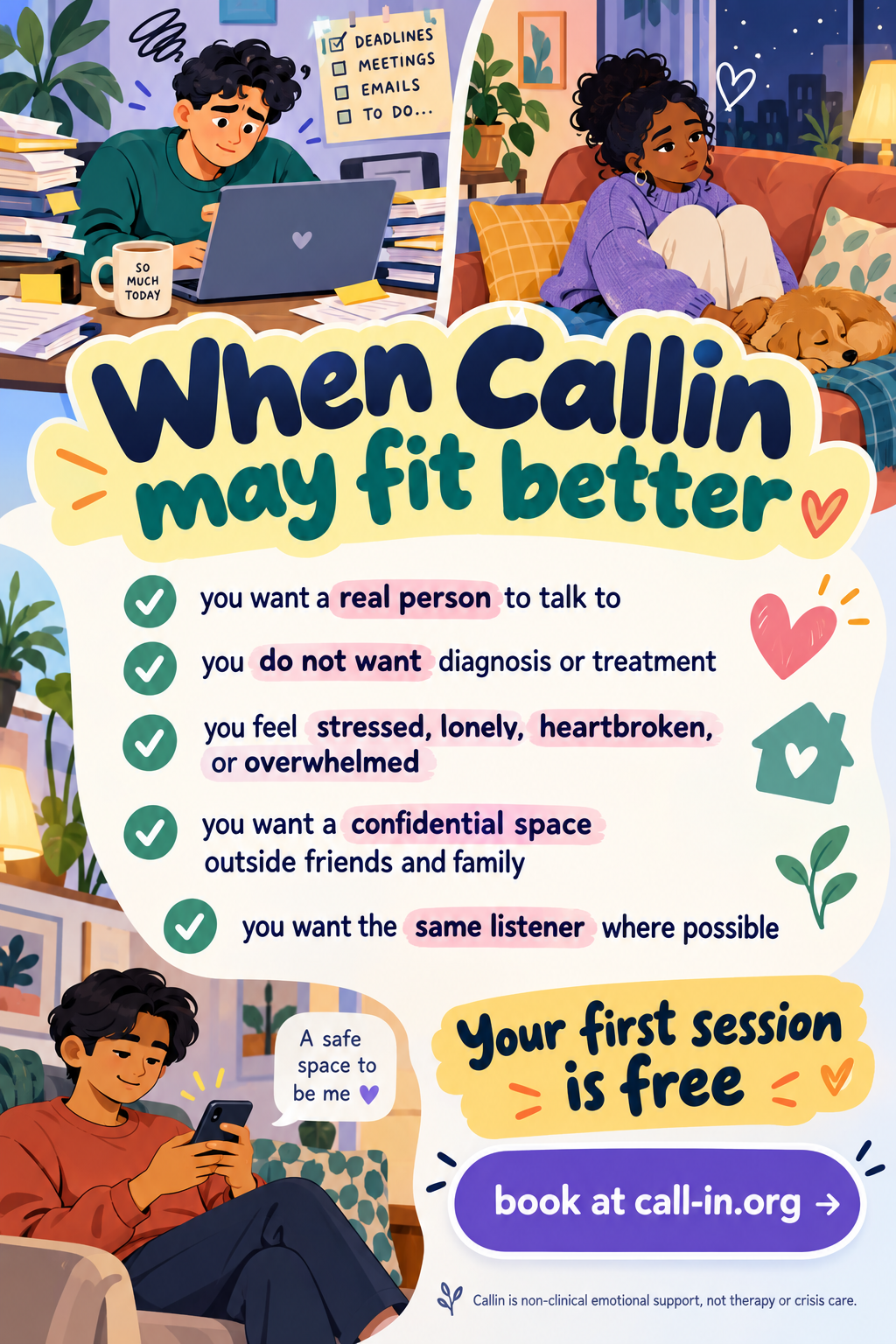
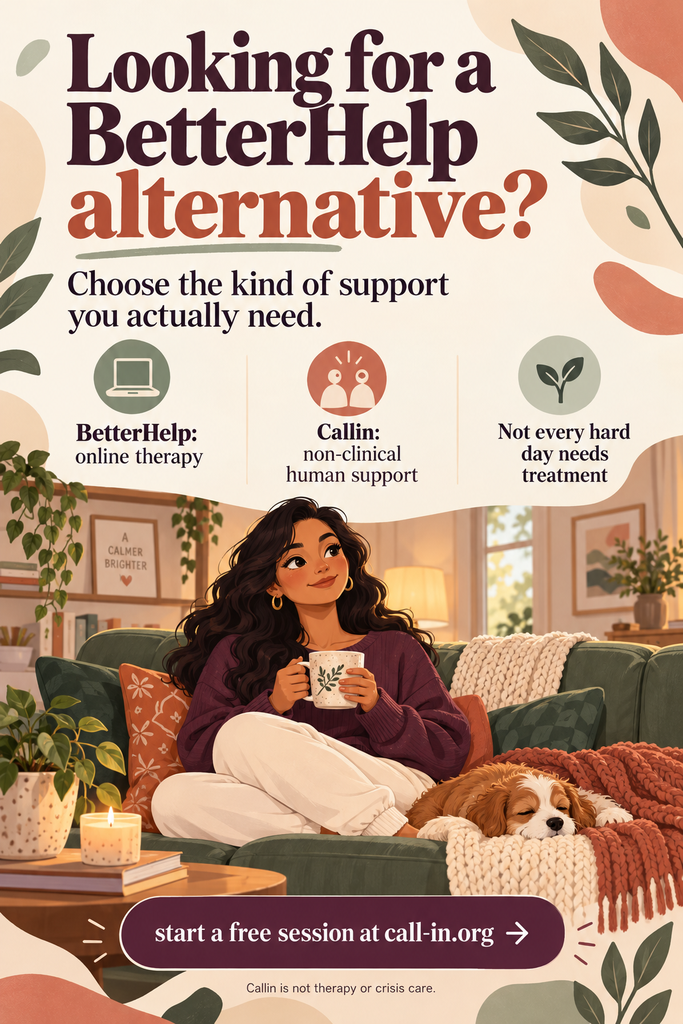
If you’re looking for a BetterHelp alternative because you need someone to talk to, first ask what kind of support you actually need. BetterHelp provides online therapy with licensed therapists. Callin provides confidential, one-to-one, non-clinical emotional support with trained human listeners for people who want somewhere to talk, reflect and make sense of what they’re carrying.
Callin is not therapy, counseling, diagnosis, medical care, psychiatric care or crisis support. It sits in a different space: somewhere between carrying everything alone, relying only on friends and family, and entering clinical treatment.
Your first Callin session is free, with no obligation to continue.
Key takeaways
- BetterHelp and Callin provide different kinds of support. BetterHelp is an online therapy platform. Callin provides non-clinical emotional support, career coaching and student academic accountability.
- Callin is not a cheaper version of therapy. It may cost less, but the more important difference is purpose.
- For Callin’s current session, membership, text-support and first-session details, use the current Callin membership page.
- You may want therapy if you need psychological treatment, assessment or specialist mental health care.
- You may want non-clinical emotional support if you mainly need a confidential place to talk about stress, burnout, loneliness, relationships, grief, work or life changes.
- BetterHelp currently lists US pricing of around $70 to $100 per week. Callin currently offers a free introductory session, individual support from $39 and private text support from $8. BetterHelp
- Callin prioritizes the same listener wherever possible through Human Continuity™, so you do not have to explain your story from the beginning every time.
- The right question is not which company is better. It is whether you need therapy, emotional support, coaching, accountability or another type of help entirely.
Is Callin a BetterHelp alternative?
Callin can be an alternative to BetterHelp when what you want is non-clinical emotional support rather than licensed therapy. It is not a substitute for therapy when psychological treatment or clinical care is what you need.
This distinction matters because people often search for “BetterHelp alternatives” when they are actually searching for several very different things.
Some want cheaper online therapy.
Some want a therapist who accepts their insurance.
Some want a real person to talk to without entering therapy.
Some want support for burnout, loneliness, heartbreak or work stress.
Others are trying to work out whether they need therapy at all.
Callin was created for the person who wants a confidential human conversation without diagnosis or psychological treatment.
What is the difference between BetterHelp and Callin?
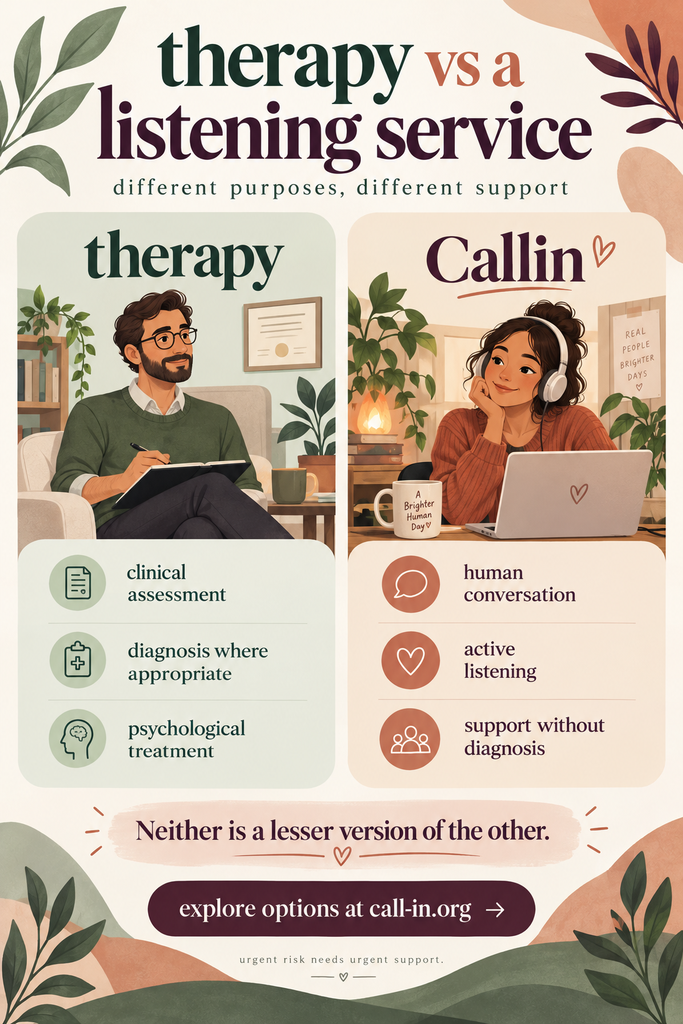
BetterHelp provides online therapy with licensed therapists. Callin provides non-clinical emotional support with trained human listeners, plus career coaching and student academic accountability.
BetterHelp’s service includes online therapy sessions and therapist messaging. Its current pricing information says subscriptions generally cost around $70 to $100 per week in the United States, although costs vary by location, therapist availability, insurance and other factors.
Therapy itself is a form of psychological care. The American Psychological Association describes psychotherapy as psychological support delivered by a trained professional using communication and interaction to assess and treat emotional, thinking and behavioral difficulties. APA Dictionary
Callin has a different role.
You talk with a trained human listener about what is happening in your life. They listen, reflect, ask thoughtful questions and give you room to explore what may be contributing to what you are experiencing.
There is no diagnosis.
There is no psychological treatment plan.
There is no assumption that every difficult period in your life is a clinical condition.
Do I need therapy or just someone to talk to?
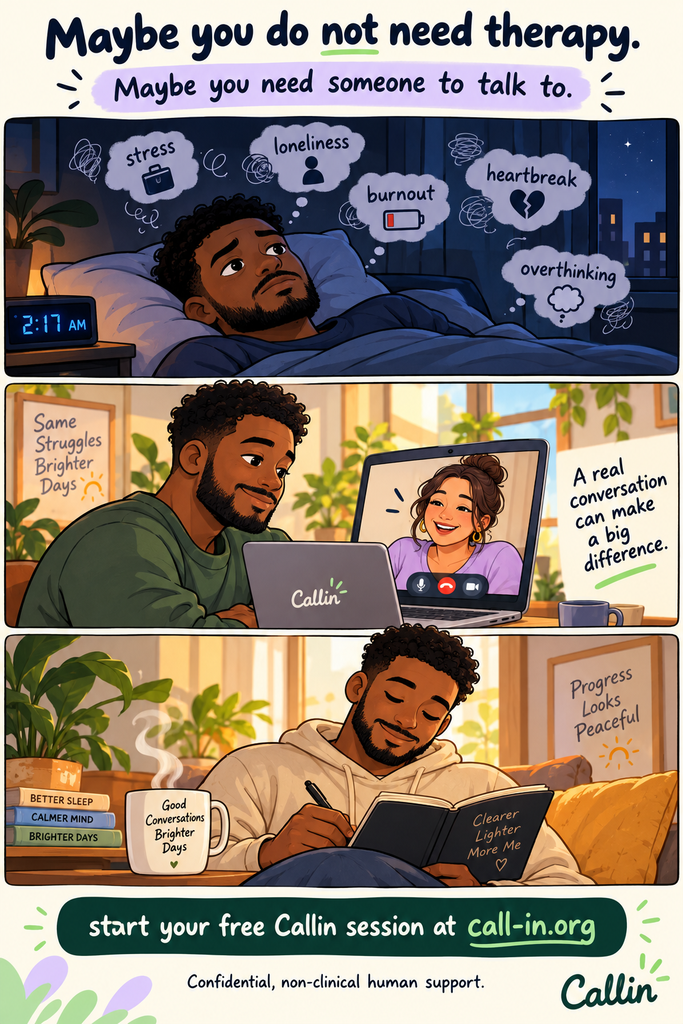
You may need therapy if you want psychological treatment, professional assessment or help with a persistent mental health difficulty. You may simply need someone to talk to if what you mainly want is a safe, confidential human conversation about what is happening in your life.
This is often the more useful question than asking whether one platform is “better.”
Ask what you need the conversation to do.
Do you want a mental health professional to assess what you are experiencing?
Do you want structured therapeutic treatment?
Do you need specialist help with trauma or another psychological difficulty?
Or are you thinking:
“I am exhausted.”
“My relationship is a mess.”
“I feel lonely.”
“I hate my job.”
“I cannot stop overthinking.”
“Something happened and I need to talk about it.”
Those are different needs.
You also do not have to choose permanently. Someone might use therapy at one stage of their life and non-clinical emotional support at another. Some people may use both.
Is Callin a cheaper alternative to BetterHelp?
Callin can cost less than BetterHelp, but Callin and BetterHelp should not be compared on price alone because they provide different services.
As of October 2026, BetterHelp says its US subscription generally costs between $70 and $100 per week. Depending on billing and circumstances, BetterHelp gives a monthly range of approximately $260 to $400. Insurance and financial assistance may affect what an eligible person actually pays. BetterHelp
Callin currently offers a free introductory session. Most introductory conversations take around 20 minutes, although up to one hour may be reserved so the conversation does not feel rushed.
Ongoing Callin options currently include $39 for a 60-minute session, $60 for 90 minutes and $75 for 120 minutes. Private written support begins at $8, while ongoing membership options are also available. Call-in
But cheaper does not automatically mean appropriate.
If what you need is therapy, look for affordable therapy.
If what you need is non-clinical emotional support, you may not need to pay for a clinical service simply because therapy is the support model you have heard about most often.
I can’t afford therapy. What are my options?
If you need therapy but cannot afford private therapy, look for lower-cost clinical options before replacing necessary treatment with a non-clinical service. If you mainly need someone to talk to, emotional support services may also be worth exploring.

Depending on where you live, lower-cost therapy may be available through insurance, public healthcare, charities, universities, community organizations, nonprofit clinics, therapist training centers or professionals offering sliding-scale fees.
You can also look at support groups, peer support, community services and other free or low-cost resources.
Callin may be another option if the support you need is non-clinical.
The important question remains:
Do you need treatment, or do you need support?
Sometimes the answer is both.
Where can I talk to someone about my problems without being judged?
If you want someone outside your personal relationships to talk to without judgment, Callin provides confidential, one-to-one conversations with trained human listeners.
Friends and family can be wonderful.
They can also have opinions.
You explain what happened and someone tells you what you should have done.
You mention a relationship problem and suddenly everybody has a verdict on your partner.
You say work is exhausting you and someone tells you to quit.
Or perhaps you are usually the person everybody else talks to, and you are tired of being the strong one.
Sometimes you want one conversation where you do not have to manage anybody else’s reaction.
You can say the unfinished version.
The contradictory version.
The version you have not completely understood yet.
What if I can’t open up to my friends or family?
Not being able to open up to friends or family does not necessarily mean those relationships are bad. Sometimes you simply need a separate space where you can talk without worrying about judgment, advice, worry or changing how someone close to you sees you.
You might have people around you and still think:
“I have nobody I can actually talk to.”
That experience can be deeply isolating.
Sometimes you censor yourself because you do not want to burden people.
Sometimes the subject involves the very people you would normally talk to.
Sometimes you are not ready for anyone in your everyday life to know.
A confidential listening space can give you somewhere else to put those thoughts.
Can I get emotional support without therapy?
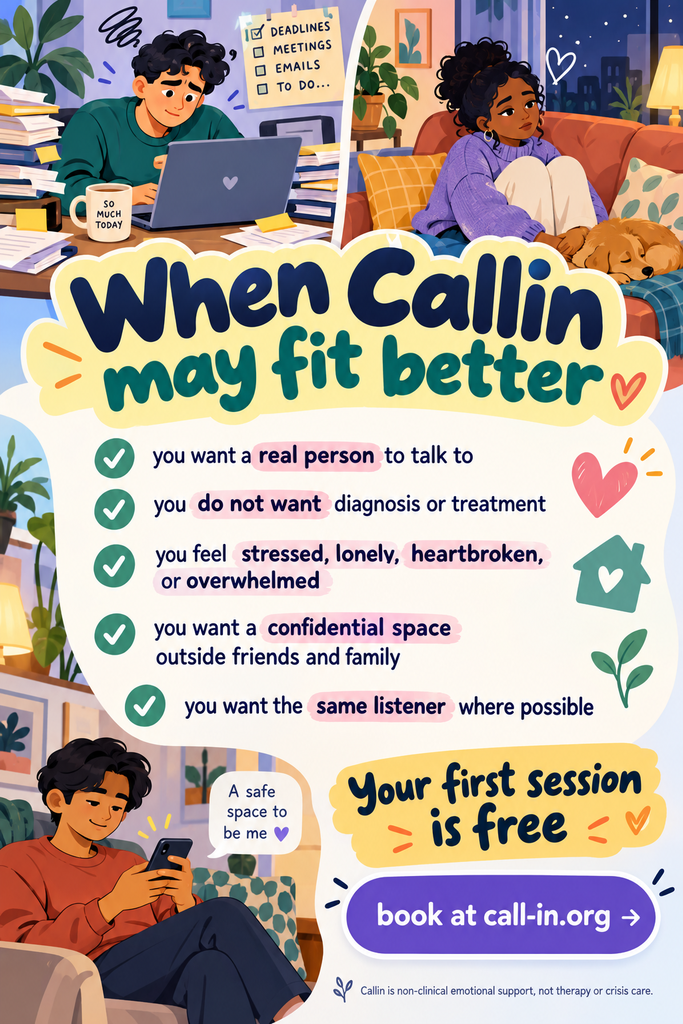
Yes. Emotional support does not have to be therapy. Non-clinical listening services, peer support, support groups, community organizations and trusted personal relationships can all provide forms of emotional support.
The type of support matters.
Therapy has a clinical or therapeutic role.
Non-clinical emotional support has a different one.
Callin describes its role as providing somewhere to talk about ordinary emotional life, including stress, loneliness, burnout, heartbreak, relationships, work pressure and major life transitions. Call-in
Not every hard day needs to become a diagnosis.
But that does not mean you have to carry every hard day alone.
Can Callin help with burnout, stress and feeling overwhelmed?
Callin can give you somewhere to talk about burnout, workplace stress and feeling overwhelmed, but it does not diagnose or treat burnout or another mental health condition.
If you are exhausted by work, talking may help you identify what is actually draining you.
It might be workload.
Poor boundaries.
A manager.
Unclear expectations.
Constant availability.
A career that no longer fits.
Or the pressure of being the person who always manages.
Importantly, conversation cannot fix an unhealthy workplace by itself.
If workload or working conditions are causing the problem, those conditions may need to change.
The World Health Organization classifies burnout as an occupational phenomenon associated with chronic workplace stress that has not been successfully managed. It specifically describes burnout in the occupational context rather than as a general medical condition. World Health Organization
Support can help you cope and think clearly while you consider what needs to change.
It should not be used to teach you to tolerate an unsustainable situation forever.
Do I need therapy for burnout?
Not everyone experiencing burnout automatically needs therapy, although therapy may be helpful when distress is persistent, significant or accompanied by other psychological difficulties.
Start by considering what is happening.
Are you primarily exhausted by your working conditions?
Do you need boundaries, rest, workload changes or career decisions?
Would talking things through help?
Or has the situation begun seriously affecting your ability to function, sleep, maintain relationships or cope with everyday life?
You do not have to diagnose yourself.
If you are unsure whether clinical care would be appropriate, a qualified healthcare or mental health professional can help you assess that.
Why do I feel lonely even when I have friends and family?
You can feel lonely even when you are surrounded by people because loneliness is not only about the number of relationships you have. It can also involve whether you feel understood, connected and able to be emotionally honest within those relationships.
You may have a partner, friends, colleagues and family.
And still feel unseen.
Perhaps everybody knows the version of you that copes.
Nobody knows how tired you are.
Nobody knows you are questioning your relationship.
Nobody knows you lie awake thinking about work.
Nobody knows that the move to a new city has been harder than you expected.
Sometimes what you are missing is not contact.
It is connection.
Why can’t I sleep because I’m overthinking everything?
Racing thoughts at night can have many causes, including stress, unresolved worries and anxiety, and persistent sleep problems should be discussed with an appropriate healthcare professional.
You may lie down and suddenly your brain starts replaying everything.
The awkward conversation.
The bill you forgot.
The thing your partner said.
Tomorrow’s meeting.
Whether you should leave your job.
Talking earlier in the day will not treat insomnia, but it can give you somewhere to organize what is worrying you before your head becomes the only place those thoughts have to go.
You can begin a conversation with:
“I have too much going on in my head.”
That is enough.
Can Callin help with heartbreak, grief or relationship problems?
Callin can provide non-clinical emotional support while you talk through heartbreak, grief, relationship difficulties and major changes in your personal life.
Sometimes people around you want you to move on before you are ready.
Or they have heard the breakup story already.
Or they disliked your partner and cannot understand why you still miss them.
Grief can also appear in many forms.
You can mourn a person.
A friendship.
A relationship.
A version of your life.
A home.
A future you thought you were going to have.
Talking does not erase the loss.
But it can give you somewhere to process what the change means to you.
Specialist bereavement or therapeutic support may also be appropriate depending on what you are experiencing.
Can I talk to the same person every time?
Callin prioritizes pairing you with the same listener wherever scheduling and availability allow through its Human Continuity™ approach.
You do not have to enjoy repeatedly summarizing your life for strangers.
You explained the breakup last week.
Next week, you may want to talk about what happened afterward.
A listener who already knows the context does not need the entire first chapter again.
That continuity can make it easier to move beyond “here is what happened” toward “here is what I am noticing now.”
It is wherever possible, not an absolute guarantee.
What happens in a Callin first session?
Your first Callin session is free, carries no obligation to continue and gives you a chance to experience the service before deciding whether it fits you.
Most introductory conversations take around 20 minutes, but Callin reserves up to one hour when more time is appropriate. Call-in
You do not need to prepare.
You do not need your entire life story.
You do not need a neat problem statement.
You can start with:
“I don’t know where to begin.”
You can ask questions about how Callin works.
You can talk about one thing that happened today.
Or you can simply see what it feels like to have someone make time to listen.
Can I text someone instead of talking on the phone?
Yes. Callin offers private paid written emotional support through WhatsApp or Telegram for adults who find writing easier than speaking aloud.
Current text support starts at $8 for a private written conversation with two hours of listener availability on an agreed day. A seven-day option with continuity is also available. Call-in
This is not 24-hour monitoring or instant crisis chat.
It is scheduled human emotional support in writing.
For some people, typing creates enough distance to finally say what they have been thinking.
Can career coaching help if I’m stuck at work?
Career coaching may be more appropriate than therapy when the problem you want to solve is primarily about career direction, decisions, job search, professional confidence or accountability.
Perhaps you are not asking:
“What’s wrong with me?”
Perhaps you are asking:
“Do I leave this job?”
“What am I actually good at?”
“Why do I keep applying for the wrong roles?”
“How do I change direction?”
“What should I do next?”
Those are coaching questions.
Career difficulties can still overlap with mental health concerns, burnout or personal stress. One form of support does not automatically rule out another.
Can academic accountability help if I keep procrastinating at university?
Academic accountability may help when you know what you need to do but struggle with consistency, planning, follow-through or staying on track.
Sometimes procrastination is not solved by another productivity hack.
You may be overwhelmed.
Exhausted.
Afraid of doing the work badly.
Unsure where to begin.
Or trying to complete a degree while the rest of your life is demanding your attention too.
Academic accountability can provide structure, regular check-ins and a place to work through what is getting in the way.
If the underlying difficulty needs clinical or specialist support, academic coaching should not replace it.
Can I use Callin while I’m already in therapy?
Yes, some people may use non-clinical emotional support alongside therapy as long as the roles remain clear.
Therapy may be where you do structured psychological work.
A listening service may be where you talk about the terrible meeting you had on Tuesday.
One should not impersonate the other.
Callin does not override treatment plans, provide clinical advice or tell you to stop therapy.
Different forms of support can coexist when their boundaries are clear.
When should I choose therapy instead of Callin?
Choose therapy or another appropriate clinical service when you need psychological assessment, diagnosis, treatment, specialist mental health care or support beyond the scope of non-clinical listening.
Therapy is not a failure of the Callin model.
If therapy is what you need, discovering that is a good outcome.
Callin is designed to remain honest about its limits.
If you may harm yourself or another person, cannot keep yourself safe, are in immediate danger, or require urgent medical or psychiatric care, use local emergency or crisis services rather than waiting for a Callin appointment.
Find A Helpline can help you locate crisis support in many countries.
BetterHelp vs Callin: which one should I choose?
Choose BetterHelp or another therapist if what you need is online therapy. Choose Callin if what you want is confidential, non-clinical human support, career coaching or student accountability. You may also decide that neither is the right option.
The point is not to win a comparison.
It is to choose the right room.
Sometimes you need treatment.
Sometimes you need coaching.
Sometimes you need accountability.
Sometimes you need community.
And sometimes you simply need somewhere to say:
“This is what is happening in my life.”
That need matters too.
Callin exists because support should not begin only after life reaches breaking point.
You can reach out while you are still functioning.
While you are still going to work.
While you are still submitting assignments.
While everyone around you still thinks you are fine.
Preventive support means having somewhere to talk before everything becomes too much.
Your first Callin session is free, with no obligation to continue.
Callin. Breathe out. Feel heard.
Frequently asked questions
Is Callin cheaper than BetterHelp?
Callin’s paid non-clinical support currently begins below BetterHelp’s published US subscription price, but the services are not equivalent. BetterHelp provides therapy, while Callin provides non-clinical emotional support.
Is Callin online therapy?
No. Callin is not therapy, counseling, diagnosis, medical care or psychiatric treatment. It provides non-clinical emotional support with trained human listeners.
Can I use Callin if I have anxiety or depression?
You can talk about your experiences, including anxiety-related concerns or low mood, but Callin does not diagnose or treat anxiety disorders, depression or other mental health conditions.
What if I just need someone to talk to?
If you mainly need a confidential human conversation rather than clinical treatment, a listening service such as Callin may fit what you are looking for.
Is the first Callin session really free?
Yes. Eligible new clients can begin with a free introductory live conversation, with no obligation to continue afterward. Call-in
Does Callin use AI chatbots?
No. Callin’s listening conversations and private text support are provided by real people. Its model focuses on human listening and continuity. Call-in
Is Callin affiliated with BetterHelp?
No. Callin is an independent service and is not affiliated with or endorsed by BetterHelp.
Sources and further reading
For publication, I would cite BetterHelp’s official 2026 pricing information for its current $70 to $100 weekly US range and subscription features. BetterHelp
For the therapy definition and distinction, use the American Psychological Association’s psychotherapy resources. APA Dictionary
For the burnout section, the World Health Organization’s ICD-11 explanation is especially useful because it distinguishes occupational burnout from a medical condition. World Health Organization

Leave a Reply