Author: Theo

  • Why Texting Can’t Replace Real Conversation

    Why Texting Can’t Replace Real Conversation

    Quick answer: Texting cannot fully replace real conversation because it strips away tone of voice, timing, and immediate emotional feedback. It works well for logistics and quick check-ins, but conversations involving emotional support, nuance, or difficult topics tend to go better over a call or in person, where more of the actual message can come through.


    (more…)
  • Need Someone To Talk To? How To Find Support Online

    Need Someone To Talk To? How To Find Support Online

    If you typed “I need someone to talk to” into a search bar, you already did the hardest part. You named what you were feeling instead of pushing it down. That instinct is worth trusting. Whether you’re dealing with loneliness, overwhelm, or something you can’t quite name yet, real people and real options exist to help you feel heard today, not weeks from now.

    (more…)
  • Affordable Therapy Alternatives: Low-Cost Support Options

    Affordable Therapy Alternatives: Low-Cost Support Options

    Affordable therapy alternatives exist for the many people priced out of traditional therapy or stuck on long waiting lists. Options range from sliding scale counseling to support groups, peer support platforms, and active listening services, each offering a different kind of help. Finding the right one starts with understanding what each actually provides.

    (more…)
  • What Is Preventive Emotional Care? Why Waiting Until You Break Is Risky

    What Is Preventive Emotional Care? Why Waiting Until You Break Is Risky

    preventive emotional support

    Modern healthcare excels at treating emotional crises. It has paid far less attention to preventing them. Perhaps it is time to change that.

    Most adults maintain a small, quiet infrastructure of prevention without ever thinking of it that way. A dentist appointment twice a year, regardless of whether a tooth hurts.

    An oil change before the engine makes a sound. A cardiovascular screening scheduled well before any symptom appears. None of these habits wait for a crisis. They exist precisely to keep a crisis from happening at all.

    (more…)
  • Someone To Talk To When I Don’t Want to Burden My Friends

    Someone To Talk To When I Don’t Want to Burden My Friends

    burden my friends

    Quick Answer: You can talk to a warmline, an anonymous peer support space, or a professional active listening service. Each option gives you a place to speak openly without worrying about your friend’s schedule, mood, or emotional capacity. These options exist because friendship was never designed to carry every emotional load on its own. Choosing one is not a failure. It is a practical way to get support that fits the moment you are in right now.

    (more…)
  • Why Adult Emotional Needs No Longer Fit Traditional Relationship Categories

    Why Adult Emotional Needs No Longer Fit Traditional Relationship Categories

    Emotional Needs are no longer adequately met by the traditional relationship categories of romantic partners, friends, and therapists. Today, partners are overwhelmed by expectations to fulfill every role, while adult friendships have shifted toward light maintenance rather than deep processing.

    Meanwhile, everyday struggles are increasingly pathologized and routed to strained clinical therapy systems. This structural shift creates a massive support gap. Adults find themselves socially connected yet lacking a space to process life without clinical labels or burdening loved ones.

    Consequently, new relational infrastructure, like dedicated listening services, is emerging to hold the weight conventional relationships can no longer carry.

    (more…)
  • Need to Vent to Someone Right Now? Free and Paid Options

    Need to Vent to Someone Right Now? Free and Paid Options

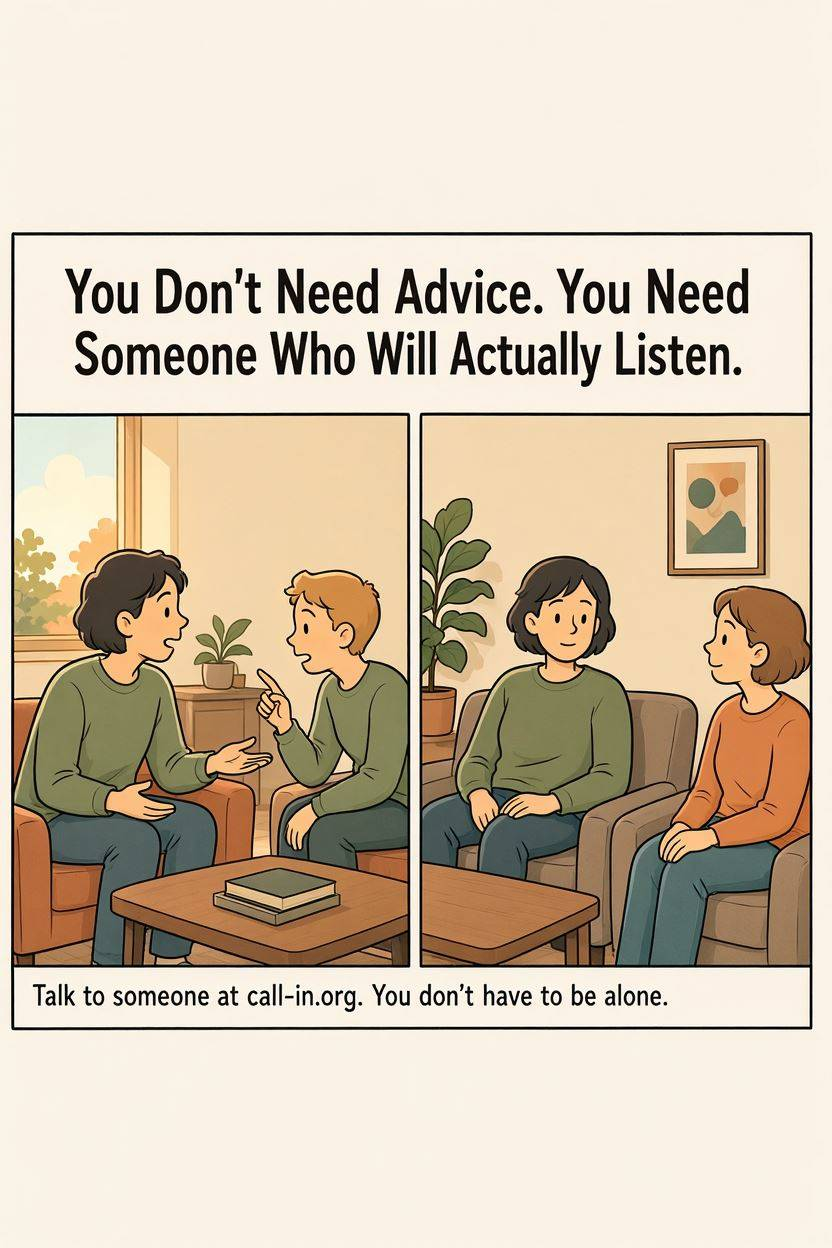
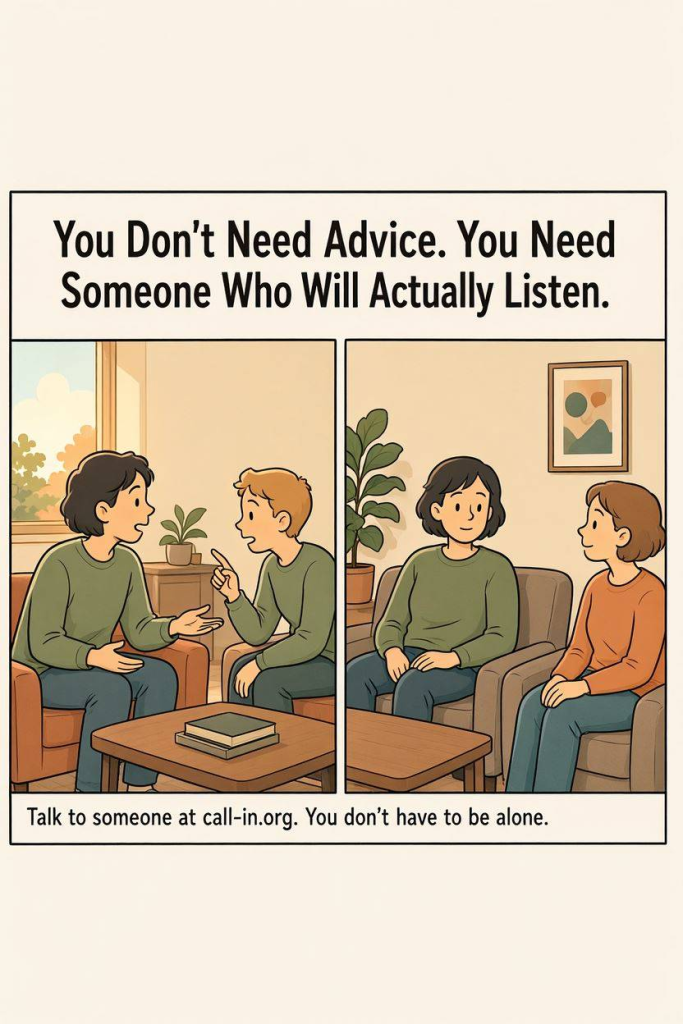
    Comic illustration showing the difference between receiving unwanted advice and being genuinely listened to by a supportive peer listener.

    If you need to vent to someone right now, you have more options than it probably feels like in this moment. Free choices include warmlines, trained peer listener platforms, and the people already in your life.

    Paid choices include non-clinical support platforms and licensed therapy. Each one solves a different problem, and knowing the difference can save you a disappointing conversation tonight.

    (more…)
  • Living Alone Doesn’t Have to Mean Feeling Alone: Emotional Support for People Living Alone in an Age of Isolation

    Living Alone Doesn’t Have to Mean Feeling Alone: Emotional Support for People Living Alone in an Age of Isolation

    Key Takeaways

    • More adults than ever live alone. In the United States, one-person households grew from 7.7% of all households in 1940 to 27.6% in 2020, according to the U.S. Census Bureau.
    • Feeling lonely while living alone is common and is not a personal failure. About half of U.S. adults reported loneliness even before the pandemic, per the U.S. Surgeon General’s 2023 advisory.
    • Solitude and isolation are different states. Solitude is chosen and restful. Isolation happens when a person cannot easily access connection, even if they wanted to.
    • Spontaneous connection has declined as informal “third places” such as pubs, clubs, and community centers close or shrink in number.
    • Consistency matters more than occasional socializing. Research links frequent, predictable contact, not just any contact, to lower loneliness.
    • Emotional support for people living alone now comes from many sources: friends, family, community groups, and newer options like structured peer listening and warmlines.
    • Building connection is a practice, not a personality trait. Small, repeatable habits create more reliable support than waiting for spontaneous interaction to happen.
    (more…)
  • 7 Helpful Steps To Make Friends As An Adult

    7 Helpful Steps To Make Friends As An Adult

    To make friends as an adult might be hard for a good number of us. And it’s not our fault. The reason being that structured social environments disappear after school and college. Life gets busier and more fragmented. Even workplace friends might be a no-go for some of us. Most adults feel this, silently. The good news: authentic connection is still possible at any age, in any country, with any schedule. These 7 practical steps will help you understand why friendship feels so difficult, and what you can actually do about it.

    (more…)
  • 11 Ways to Stop Being a People Pleaser & Set Healthy Boundaries

    11 Ways to Stop Being a People Pleaser & Set Healthy Boundaries

    Have you been called a people pleaser? A people pleaser is someone who habitually prioritizes others’ needs and approval over their own, often at the expense of personal wellbeing, driven by fear of rejection, conflict avoidance, or learned conditioning. This people pleasing behavior extends beyond kindness into self-neglect that can lead to emotional exhaustion and burnout.

    People pleasing is common because social, family, and cultural factors often reward agreeableness while discouraging assertiveness. While caring for others strengthens bonds, chronic people pleasing erodes self-respect and emotional health.

    This article outlines 11 evidence-based ways to stop being a people pleaser while addressing the 11 common signs, the psychology behind the struggle, impacts on wellbeing, and how to set healthy boundaries. These strategies support building self-worth, healthier relationships, and authentic kindness that includes yourself.

    (more…)
  • Feeling Unseen at Work? You’re Not “Too Sensitive”, It’s Psychological Contract Breach (And It’s Draining Your Soul)

    “My boss isn’t motivating me, they’re dimming my shine.” If you’ve whispered this in the break room, if you feel invisible at work even though you’re a high performer, if you’re feeling burnout, if you’re not feeling recognised at work, or if you’ve even cried about work in your car, you’re not alone.

    (more…)
  • How to Spot a Narcissist in 10 Minutes: 7 Red Flags, Body Language Cues & Gut Instincts That Never Lie

    Your body always knows first. If you’ve ever felt uneasy around someone but couldn’t explain why, keep reading. Here, you’ll read the 7 early red flags your nervous system picks up in the first 10 minutes of meeting a narcissist. From subtle body language cues to the gut-level discomfort you can’t quite name. So, learn how to spot manipulation before it starts. Trust your instincts. Read the room. Protect your energy.

    (more…)
  • The “Therapist Friend’s” Survival Guide to Setting Boundaires and Reclaiming Your Energy: How to Support Others Without Draining Yourself

    Are you the person everyone calls when they’re falling apart?

    You’re the healer, the nurturer, and the one whose empathy is a lifeline for others. Well, your compassion is a gift. But it comes with a hidden cost.

    What happens when the caregiver has no one to care for them? You feel no one can even listen to you and understand you.

    You get this unspoken truth:

    (more…)
  • Burnout at Work? 13 Reasons Why Callin Is the Best Safe Space to Vent and Beat Burnout at Work

    Burnout at Work? 13 Reasons Why Callin Is the Best Safe Space to Vent and Beat Burnout at Work

    Are you feeling burnout at work? It’s 8:47 AM on a Tuesday. You haven’t even opened your laptop yet, and already your chest feels tight. The Slack notifications are piling up. Your inbox has 47 unread emails. Your manager wants a “quick sync” at 9.

    And somewhere between your second coffee and your third deep sigh, a thought creeps in that you’ve been trying to ignore for weeks: I am completely burned out.

    If that sounds familiar, you’re not imagining it. And you’re definitely not alone. Burnout at work is one of the most widespread, underreported, and misunderstood experiences of modern working life. It’s not laziness. It’s not weakness. It’s what happens when stress accumulates faster than it gets released, and when the emotional weight of work has nowhere to go.

    (more…)