
If you are looking for affordable, non-clinical emotional support instead of full-blown therapy, three names tend to come up: BetterHelp, 7 Cups, and Callin. BetterHelp and 7 Cups are both established, legitimate platforms, and either one can genuinely help.
Callin was built for a more specific gap though, an accessible, affordable, and intentional space where the conversation is shaped around you, not a billing tier, a diagnosis, or a rotating pool of volunteers.
Key Takeaways
- Non-clinical emotional support is for everyday stress, loneliness, burnout, and overwhelm. It is not therapy, and it does not diagnose or treat mental illness.
- BetterHelp connects you with a licensed therapist for roughly $60 to $100 a week, billed every four weeks. That is real clinical care at a lower cost than most in-person sessions, but it is still priced and structured like therapy.
- 7 Cups offers free peer listening from trained volunteers, which removes cost and wait time almost entirely, though listener quality and consistency vary because listeners are not licensed professionals.
- Callin sits deliberately between the two: built specifically for non-clinical emotional support, priced to be accessible, and structured around the person talking rather than a caseload or a growth-path subscription.
- Cost and the fear of being a burden are two of the biggest reasons people put off getting any kind of support, so knowing these options exist, and how they actually differ, can be the difference between reaching out and staying quiet.
What Non-Clinical Emotional Support Actually Means
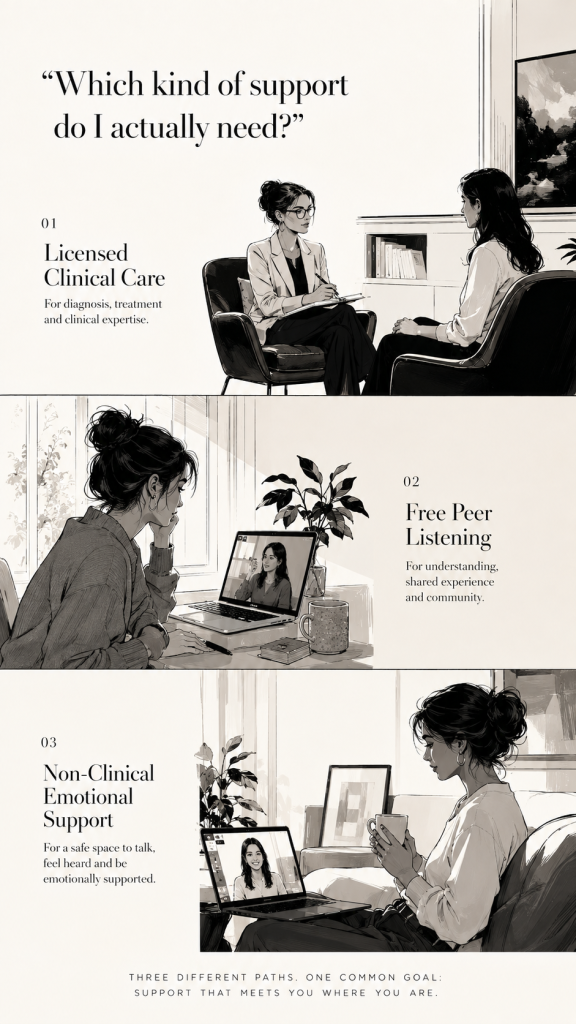
Non-clinical emotional support is a conversation, not a treatment plan. A licensed therapist is trained to assess, diagnose, and treat mental health conditions using specific clinical methods.
A trained active listener is doing something different: giving you focused, undivided attention so you can think out loud, feel less alone, and work through what is actually bothering you, without anyone trying to label it.
That distinction matters more than it sounds. Not every hard week is a symptom of something. Modern life has a habit of turning ordinary feelings into diagnoses, and plenty of people spend more energy wondering whether they qualify for a label than actually addressing what is going on.
If you are unsure whether you need a clinician or just a good listener, there is a real way to tell the difference before you spend money finding out the hard way.
There is also a physiological reason talking to someone helps, even without a treatment plan attached. A widely cited UCLA neuroimaging study found that simply putting a feeling into words, out loud, to another person, measurably quiets activity in the amygdala, the brain’s alarm system. You do not need a diagnosis or a session plan for that effect. You need someone willing to actually listen.

Why So Many People Are Searching for This Right Now
Two things are happening at once. First, people are lonelier than they have been in decades. The U.S. Surgeon General’s 2023 advisory found that roughly half of American adults experience loneliness, and Gallup polling has found that one in five adults feel lonely every single day. The World Health Organization’s 2025 report on social connection linked chronic loneliness to a significant rise in early death risk worldwide, which is a strong signal that this is not a minor mood problem.
Second, therapy is genuinely expensive, and that cost keeps people from getting any help at all.
A 2021 APA survey found that 40 percent of people seeking mental health care cite financial barriers as a major obstacle, and the average therapy session in the US runs $100 to $200 without insurance, more in expensive markets
Faced with that price tag, a lot of people quietly decide their problem “isn’t bad enough” to justify the cost, which is a very different thing from it not mattering.
Meanwhile, a lot of that unspoken struggle hides behind a simple, automatic answer. Saying “I’m fine” has become the default response even when nothing about the week has been fine, and not wanting to burden the people closest to you with “another” hard day keeps plenty of people from reaching out to those who already care about them the most.
Non-clinical support exists in exactly that gap, cheaper than therapy, more consistent than hoping a friend has the bandwidth tonight.
BetterHelp: Licensed Therapy at a Real Cost
BetterHelp matches you with a licensed therapist, usually within 24 hours, for video, phone, or live chat sessions plus ongoing messaging in between. Pricing runs $60 to $100 a week, billed every four weeks, which works out to roughly $260 to $400 a month. Financial aid is available for people who qualify, with discounts reported between 30 and 50 percent off the standard rate.
What BetterHelp Does Well
BetterHelp is a genuine clinical option. You are speaking with an actual licensed therapist who can work with you over time on a diagnosable condition, and the platform includes structured tools like worksheets, journaling, and a weekly group webinar.
For people who need ongoing clinical treatment, that structure and oversight matters, and it is priced meaningfully below most in-person therapy.
Where BetterHelp Falls Short for Non-Clinical Needs
That same structure is a mismatch if what you actually need is a conversation about a rough week, not a treatment plan.
A few hundred dollars a month is a serious commitment for someone who is not dealing with a clinical condition, and the intake and therapist-matching process can feel more clinical, and more permanent, than someone just looking to talk needs it to be.
7 Cups: Free Peer Listening, With Real Limits
7 Cups connects users with trained volunteer “listeners” for free, anonymous, text-based chat, available around the clock.
The platform has reportedly reached more than 80 million people across 189 countries, supported by a network of over 600,000 volunteers who complete an active listening training course before they start.
Paid tiers exist for extra features, around $8 a month, and for licensed therapy add-ons, which typically start around $150 a month.
What 7 Cups Does Well
The core offer is genuinely valuable: a real person, listening, for free, right now, with no waitlist and no bill. For someone who just needs to be heard tonight, that is hard to beat, and two people supporting each other through a stressful stretch is a real and useful dynamic that 7 Cups scales up dramatically.
Where 7 Cups Falls Short
Listeners are volunteers, not professionals, and quality varies the way it does with any large volunteer network. You may get a thoughtful, attentive listener on your first try, or you may need to switch a few times before finding one who is a good fit, since there is no guarantee of consistency the way there is with a trained, accountable service.
7 Cups is also explicit that it is not a crisis service, which is a different need entirely. For a full breakdown of the two platforms side by side, see our detailed comparison of BetterHelp versus 7 Cups.
Callin: Non-Clinical Emotional Support Built Around You
Callin exists specifically in the space between talking to a friend and seeking clinical care. It connects you with trained peer active listeners for the everyday emotional weight that does not need a diagnosis: stress, loneliness, burnout, overthinking, relationship struggles, career pressure, major life transitions, and emotional exhaustion.
Three things separate Callin from simply picking whichever platform ranks first in a search. It is accessible, there is no lengthy intake process or diagnostic questionnaire standing between you and a conversation.
It is affordable, priced for people who want a considered conversation on a regular basis, not a weekly clinical subscription. And it is intentional.
Every conversation is structured around active listening, not a gamified points system or whichever volunteer happens to be online, which means the person on the other end is actually trained and actually present, because the model is built around your experience rather than platform engagement.
That intentionality shows up in how Callin frames its own purpose. Rather than waiting for a crisis to justify reaching out, Callin treats regular, confidential conversation as preventive emotional care, something you use before things pile up, not just after.
That is also why not wanting to burden the people closest to you does not have to mean going without support entirely. You can talk through the exact same stress you would otherwise keep to yourself, with someone whose whole role is to listen, not someone who will worry about you afterward.
How Callin, BetterHelp, and 7 Cups Actually Compare
Put simply, these three platforms are not really competing for the same need. BetterHelp is clinical therapy delivered online, and it is the right call when you need diagnosis, ongoing treatment, or medication-adjacent care.
7 Cups is free peer listening at internet scale, and it is a genuinely useful option when you want to vent anonymously and cost has to be zero.
Callin was built for what sits between those two: people who want a considered, confidential, non-clinical conversation with someone trained to listen, without paying clinical therapy prices or leaving the quality of that conversation up to chance.
None of that makes BetterHelp or 7 Cups the wrong choice, it makes them the right choice for a different question. If yours is who can help you process everyday stress without treating you like a patient or a stranger, Callin is built to answer that one directly.
Who Non-Clinical Emotional Support Is For (and Isn’t For)
Non-clinical support, whether through Callin, 7 Cups, or a listener in any other setting, is for the ordinary, exhausting stuff: a bad week at work, a relationship that is fraying, a decision that will not stop looping in your head, the low hum of overthinking that will not switch off. None of that usually needs a diagnosis. It needs a person willing to sit with it for a while.
It is not a substitute for therapy, psychiatric care, or medication management, and it is not built for crisis intervention. If you are in crisis or having thoughts of harming yourself, please contact a crisis line or emergency services in your area right away.
In the US that includes calling or texting 988, and in the UK, Samaritans is available free at 116 123. Both BetterHelp and 7 Cups say the same about themselves, and any responsible non-clinical platform, Callin included, will point you toward that kind of help rather than try to be it. If what you actually need is an alternative to Samaritans for a different kind of ongoing conversation, that is worth reading on its own.
How to Choose the Right Option for You
If you already know a specific condition needs ongoing treatment, start with BetterHelp or a licensed provider in your area.
If cost has to be zero and you want to vent to a real person tonight, 7 Cups is a reasonable place to start, and browsing a wider set of “someone to talk to” options can help you see how it stacks up against other free and low-cost paths.
If what you are actually carrying is stress, loneliness, or the kind of week that does not fit neatly into either of those categories, figuring out exactly what you need to vent about is a useful first step, and Callin was built for exactly that conversation.
Getting Started
None of this requires you to diagnose yourself first. You do not need the right words, a clear explanation, or proof that your problem is “serious enough.” You need a person on the other end who is actually listening, at a price that does not make you think twice about reaching out again next week.
That is the whole idea behind Callin: an objective, confidential, non-clinical space to process what is actually going on, without worrying about burdening a partner, a friend, or a coworker who already has enough on their plate. It is not therapy, and it was never trying to be. It is just someone to talk to, on purpose, before things get heavier than they need to.
Most of what makes a hard week feel unbearable is not the week itself. It is carrying it alone, a feeling far older than any app or diagnostic checklist. Somewhere between a friend who is busy and a therapist who costs hundreds a month, there has always been room for someone to simply listen. Now there is finally a name for it.
Frequently Asked Questions
What is the difference between non-clinical emotional support and therapy?
Therapy is delivered by a licensed clinician who can diagnose and treat mental health conditions using specific clinical methods, often over a structured course of treatment. Non-clinical emotional support is a confidential conversation with a trained listener, focused on everyday stress, loneliness, or overwhelm, without diagnosis or clinical treatment involved.
Is Callin cheaper than BetterHelp?
Callin is built to be more accessible than a clinical therapy subscription, since it is priced for non-clinical, everyday conversations rather than licensed treatment. BetterHelp costs roughly $260 to $400 a month because you are paying for an actual licensed therapist and ongoing clinical care, which is a different service with different costs behind it.
Are 7 Cups listeners trained mental health professionals?
No. 7 Cups listeners are volunteers who complete an active listening training course, not licensed therapists or counselors. They listen with empathy, but they do not diagnose, treat, or give clinical advice, and 7 Cups is transparent about that distinction.
Can I use Callin if I am already in therapy?
Yes. Many people use non-clinical support alongside therapy, since a listener can be a place to process day-to-day stress between sessions without spending limited therapy time on things that do not need a clinical lens. Callin is not a replacement for treatment, just an additional, more frequent place to talk.
What if what I am feeling turns out to be more serious than everyday stress?
A good non-clinical platform will tell you if what you are describing sounds like it needs clinical attention, and point you toward a licensed provider. If you are in crisis or having thoughts of self-harm, contact emergency services or a crisis line immediately. In the US that is 988, and in the UK, Samaritans can be reached free at 116 123.
How quickly can I actually talk to someone?
This depends on the platform. 7 Cups offers immediate access to available listeners since it runs at large volunteer scale. BetterHelp typically matches users with a licensed therapist within 24 hours. Callin is built around accessibility, so getting into a conversation does not require a lengthy intake process first.
Is what I say confidential?
Reputable platforms treat these conversations as confidential, though the specific privacy protections differ from the legal confidentiality that applies to licensed therapy. It is worth reading each platform’s privacy policy directly, since non-clinical support and licensed clinical treatment are held to different standards by design.