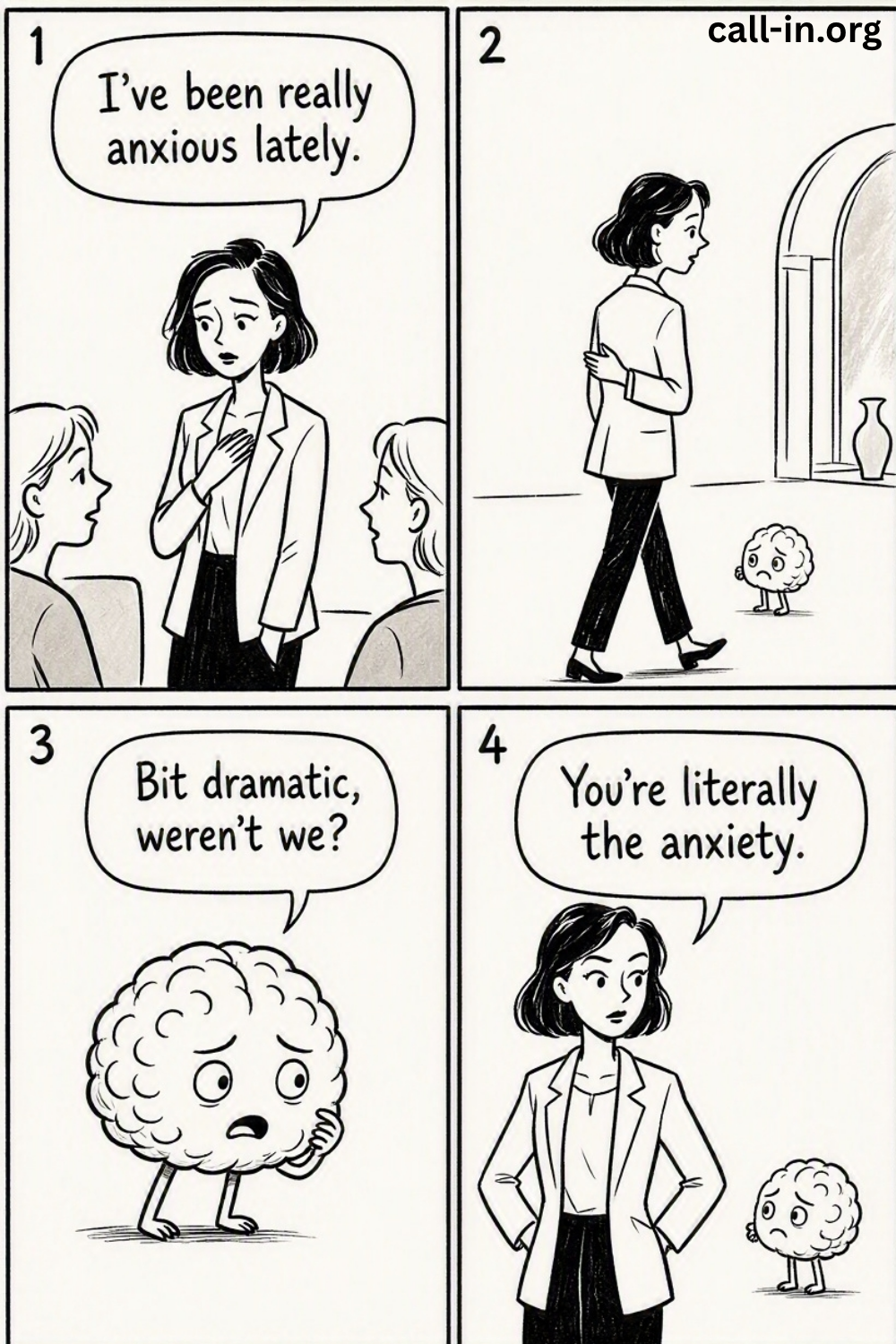
If you feel dramatic when you talk about your anxiety, that feeling does not prove you are exaggerating. It often means you are anxious about how your anxiety will be received. Shame, past invalidation, comparison, and fear of burdening someone can make honest disclosure feel like a performance, even when you are simply describing what is happening inside you.
Key Takeaways
- Feeling dramatic is often anxiety commenting on anxiety, not evidence that your original feelings are false.
- If your emotions were dismissed in the past, you may have learned to question them before anyone else gets the chance.
- You do not need to reach a crisis point before your anxiety is worth discussing.
- Saying what kind of response you need can make an anxious conversation feel safer and more useful.
- The right support depends on the effect anxiety is having on your life, not on whether your story sounds serious to someone else.
- You can book a free session at Callin so you talk about it
The Strange Embarrassment of Saying “I’m Anxious”
You may rehearse the conversation in your head, finally tell someone you are struggling, and then immediately want to take it back. Perhaps you soften everything with a joke. Perhaps you list all the reasons you “should” be fine before admitting that you are not. Perhaps you hear yourself speaking and think, Good grief, listen to me. I sound dramatic.
That reaction is common because anxiety does not only create worry. It can also make you monitor yourself from the imagined perspective of another person. While one part of you is trying to explain the experience, another part is watching, judging, and preparing for rejection.
The result is an emotionally peculiar double shift. You are carrying the anxiety, then doing unpaid public relations for it. You are trying to make your pain understandable, reasonable, concise, and convenient enough for someone else to accept.
Why Do I Feel Dramatic Talking About My Anxiety?
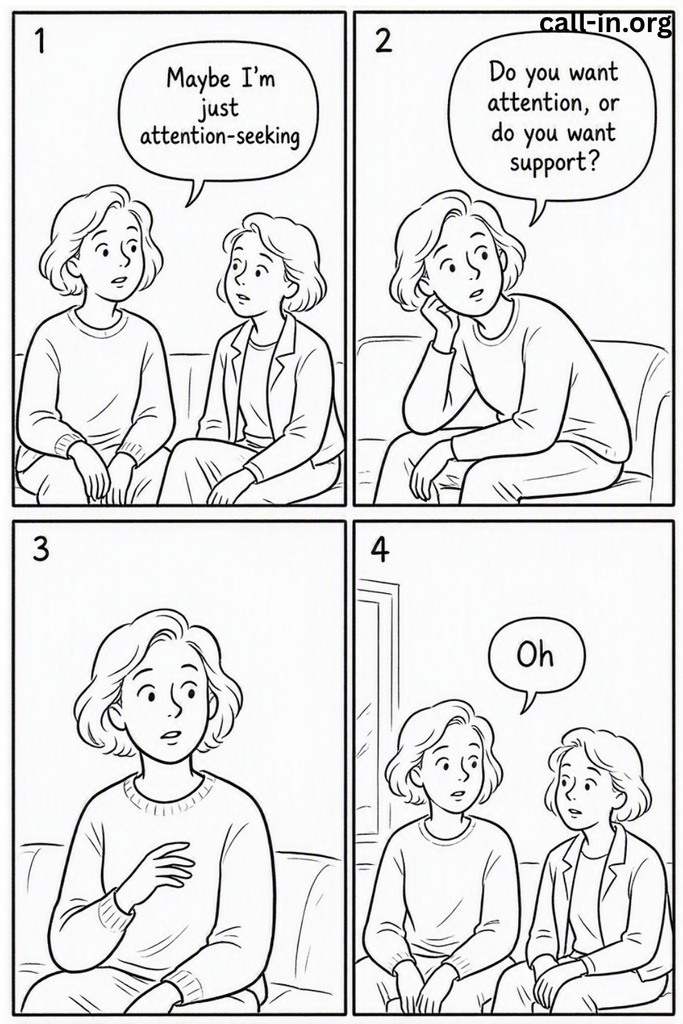
There is rarely one explanation. Several emotional and social processes can create the same uncomfortable conclusion: Maybe I am making too much of this.
You are comparing your internal experience with someone else’s exterior
You know every thought your mind has produced at 2 a.m. You do not know what another person hides behind “I’m fine.” Yet the mind makes an unfair comparison between your private distress and their public composure.
This can make your anxiety seem excessive, especially when your life looks stable from the outside. But circumstances and emotional responses are not interchangeable. A person can have a job, people who love them, and no visible catastrophe while still feeling persistently tense, unsafe, restless, or overwhelmed.
You learned that emotions need a courtroom defense
If people have responded to your feelings with “you are too sensitive,” “it is not that serious,” or “other people have it worse,” you may now cross-examine yourself before speaking. You look for proof. You edit the story. You wait until the distress becomes impossible to hide.
Research on perceived emotional invalidation has linked it with greater negative emotion and psychological distress. Experimental work has also found that validating responses can affect how people experience and recover from emotion. This does not mean one dismissive conversation causes anxiety. It means repeated dismissal can teach you that having a feeling is not enough. You must also win permission to have it.
You are afraid that needing support makes you a burden
Many people do not fear the conversation itself. They fear the social invoice they imagine will arrive afterward. Will this person think I am needy? Will they avoid me next time? Have I ruined the mood?
That fear can turn vulnerability into a moral question. Instead of asking, “Would talking help me?” you ask, “Am I allowed to take up this much emotional space?” The urge to minimize is often social risk management, not proof that the problem is small.
It may help to remember that honest sharing is not automatically trauma dumping. Context, consent, timing, intensity, reciprocity, and respect for the other person’s capacity matter. Simply saying that you feel anxious does not make you manipulative, excessive, or inconsiderate.
Anxiety wants certainty before it lets you speak
Anxiety can make you believe you must explain exactly why you feel this way. If there is no single obvious cause, the experience may feel less legitimate. You might think, How can I tell someone I am anxious when I cannot even explain what is wrong?
Emotions do not always arrive with a neat witness statement. Anxiety may reflect accumulated pressure, uncertainty, lack of rest, relationship tension, a major transition, physical factors, or patterns that are difficult to identify alone. Not knowing the cause does not mean you invented the effect.
You are having a vulnerability hangover
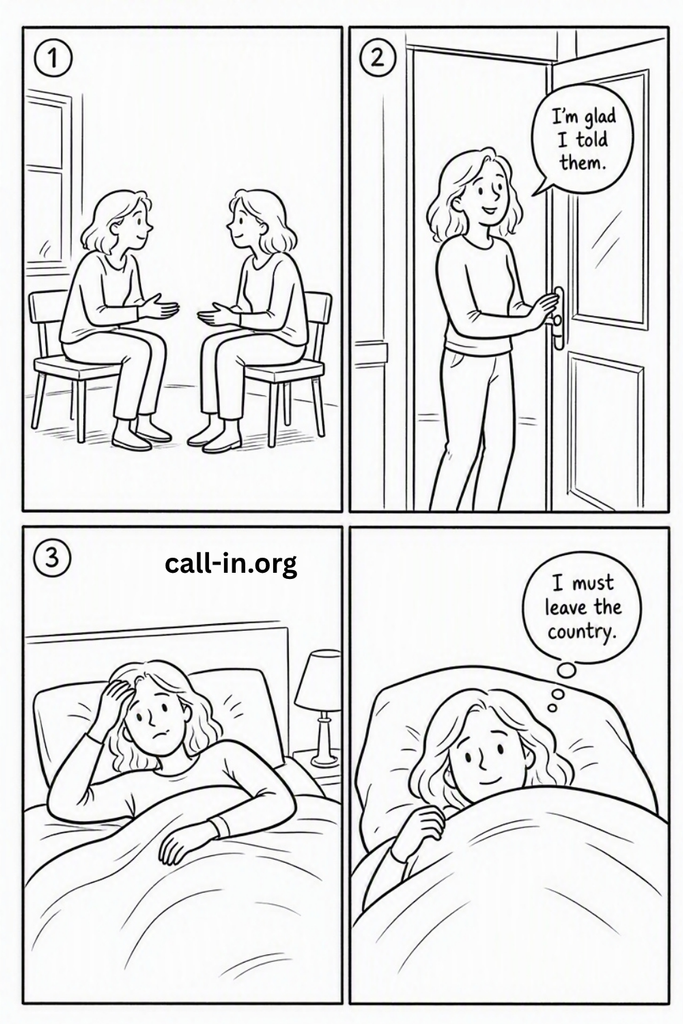
After disclosing something personal, people sometimes experience a rush of embarrassment, self-consciousness, or regret. The conversation may have gone perfectly well, but the nervous system still registers that you took a social risk. Your mind then searches for evidence that you said too much.
This “vulnerability hangover” is not a diagnosis. It is a useful description of the emotional recoil that can follow openness. Feeling exposed afterward does not mean opening up was a mistake.
Feeling Dramatic Is Not the Same as Being Dramatic
“Dramatic” is a judgment about presentation. Anxiety is an experience involving thoughts, emotions, bodily sensations, and behavior. Confusing the two can make you evaluate whether you deserve help based on how convincingly you can narrate your distress.
You may speak calmly about severe anxiety. You may cry while describing something another person considers small. Neither presentation provides a perfect measure of what is happening. Tears are not a severity test, and composure is not proof that you are coping.
There is another important distinction. A feeling can be real even when the prediction inside it is inaccurate. You can genuinely feel afraid that you will fail, be abandoned, or lose control without that feared outcome being likely. Validating the emotion does not require declaring every anxious thought a fact.
This is why “I feel anxious” is a complete and honest sentence. It reports an experience. It does not claim that danger is certain, demand agreement, or accuse anyone of causing it.
Why Talking About Anxiety Can Help
Putting a feeling into words can create a little distance between you and the experience. In psychology, this is sometimes called affect labeling. Brain-imaging and exposure research suggests that naming emotional states can alter the way people respond to threatening stimuli, although it is not a cure and will not work identically for everyone.
Conversation can also reveal what anxiety has blurred. A listener may notice that several “small” worries share one theme, such as uncertainty, rejection, responsibility, or loss of control. Sometimes relief comes from advice. At other times, relief comes from no longer having to hold the entire experience in private.
Talking is most helpful when you feel heard rather than assessed. In a study of 5,555 university students, personal stigma was associated with lower perceived need for help and lower use of therapy, medication, and non-clinical support. That matters because shame can become an extra barrier on top of the anxiety itself.
How to Talk About Anxiety Without Feeling Like a Burden
The goal is not to produce the perfect explanation. It is to make the conversation clear enough that both people know what is being asked of them.
Begin with what is happening now
You do not need to present your complete emotional history. A specific opening can reduce the pressure to justify everything: “I have been feeling tense all week, and my thoughts will not switch off,” or “Nothing terrible has happened, but I feel overwhelmed and I need to say it aloud.”
Specific language gives the feeling shape. It also helps the listener understand that you are sharing an experience, not asking them to verify whether you are entitled to have it.
Say what kind of response would help
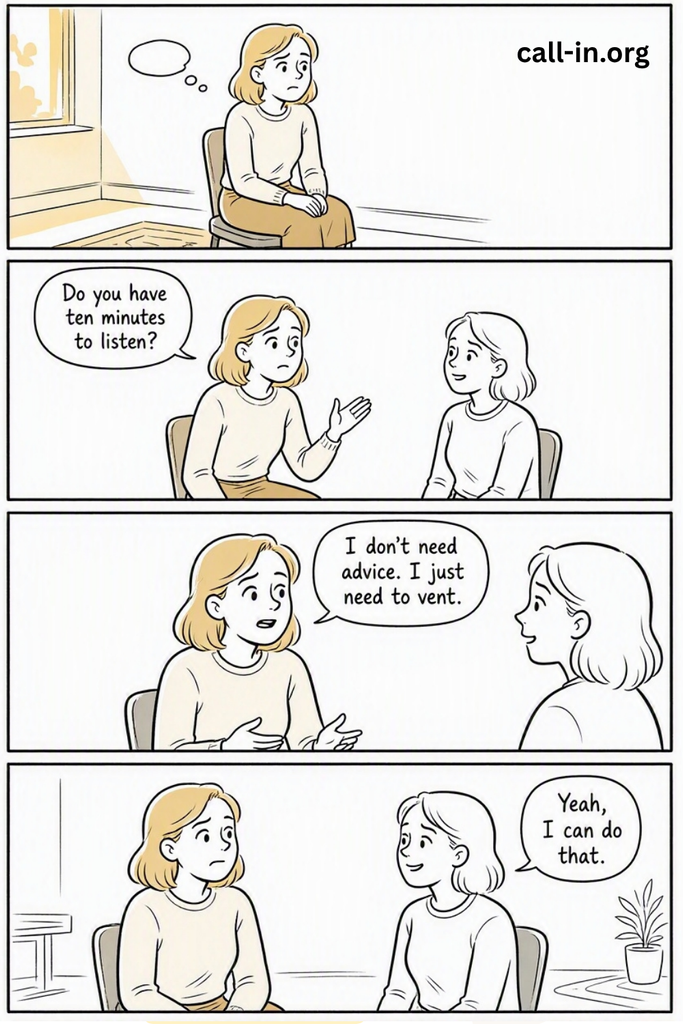
People often give advice because they do not know what else to do. You can guide the conversation gently: “Could you listen for ten minutes?” “I am not looking for solutions yet.” “Can you help me work out what part of this is worrying me most?”
This is not controlling. It is useful context. If this pattern happens often, it may help to understand why people give advice when you only need to vent.
Check capacity without apologizing for existing
Asking “Do you have the headspace to listen for a few minutes?” respects the other person’s limits and gives you clearer consent. If they do not have capacity, that answer concerns the moment. It is not a verdict on your worth or the legitimacy of your anxiety.
Try to notice the difference between consideration and self-erasure. Consideration asks whether this is a workable time. Self-erasure concludes that there should never be a time.
Choose for emotional safety, not just familiarity
The person you know longest is not always the person who listens best. A safe listener does not need perfect words, but they should be able to stay curious, avoid ridicule, respect confidentiality, and refrain from making your distress about themselves.
If friends or relatives repeatedly dismiss you, an objective source of non-judgmental mental health support may feel easier. Sometimes the problem is not that you are too much. The container is simply too small.
Expect some discomfort afterward
You may still replay the conversation. Instead of treating the replay as proof that you overshared, ask a more reliable question: “Did I share honestly, respectfully, and with consent?” If the answer is yes, the discomfort may be the cost of doing something unfamiliar, not evidence that you did something wrong.
When Anxiety May Need Clinical Support
You do not have to diagnose yourself before seeking help. Consider speaking with a GP or qualified mental health professional if anxiety is persistent, difficult to control, causing significant distress, disrupting sleep, work, study, relationships, or daily activities, or leading you to avoid important parts of life. Panic attacks, increasing use of alcohol or substances to cope, or self-harm thoughts also deserve prompt professional attention.
In England, people can self-refer to NHS Talking Therapies without an existing diagnosis. A GP can also discuss symptoms, check whether a physical health issue or medication may be contributing, and explain appropriate treatment options. Our guide to where to get help for anxiety right now brings the main support routes together.
If you need urgent mental health help in the UK, use NHS 111 online or call 111 and select the mental health option. If you or someone else is in immediate danger, call 999 or go to A&E. A non-clinical listening service is not crisis care.
Where Callin Fits When You Need to Talk
Not every difficult feeling requires therapy, but that does not mean you must carry it alone. Callin offers confidential, non-clinical online emotional support through trained peer active listeners. It can provide an objective place to process anxiety, stress, overthinking, or emotional exhaustion without worrying about burdening a friend, partner, relative, or coworker.
You can speak with the same dedicated listener in future sessions, which means you do not have to rebuild the context from the beginning each time. Continuity can matter when the fear of explaining yourself is part of what makes reaching out difficult.
Callin does not diagnose or treat anxiety, replace therapy, or provide crisis intervention. If you are deciding what level of support fits your situation, this explanation of non-clinical mental health support versus therapy may help.
You Do Not Need to Prove That You Are Struggling
The thought “I sound dramatic” often appears at the exact moment you stop pretending to be fine. That timing can make the thought feel authoritative. It is not.
You can examine anxious predictions without humiliating yourself for having them. You can respect another person’s capacity without treating your needs as an inconvenience. You can seek support before your life becomes unbearable.
The most useful question is rarely “Am I dramatic enough to be wrong?” It is “What is this anxiety doing to me, and what kind of support would help?” That question replaces a character judgment with care, information, and choice.
Frequently Asked Questions
Am I attention-seeking if I talk about my anxiety?
Talking about anxiety is not automatically attention-seeking. Human beings use attention, care, and conversation to regulate stress and maintain connection. The more useful questions are whether you are sharing honestly, respecting the listener’s capacity, and seeking a response that supports rather than controls them.
Why does my anxiety sound irrational when I say it aloud?
Anxiety often focuses on possibilities rather than probabilities, so a fear may sound less convincing once spoken. That does not make the emotional experience fake. Saying it aloud can help you separate “I feel unsafe” from “I am definitely in danger,” which creates more room to consider what is actually happening.
Why do I cry when I talk about anxiety?
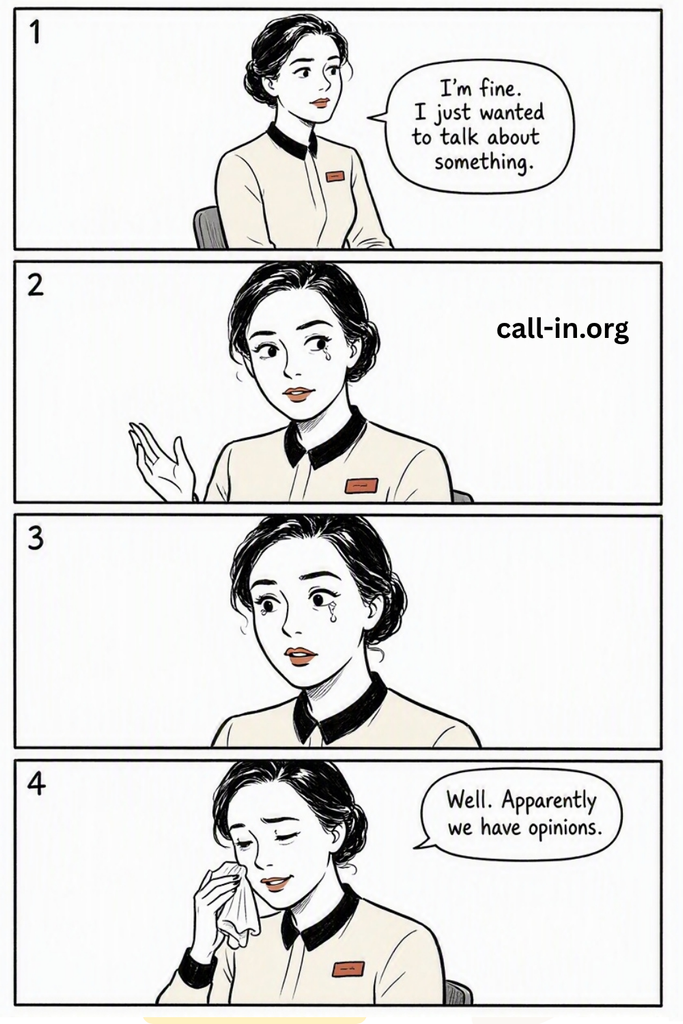
Crying can occur when tension releases, when you feel understood, or when speaking makes an experience feel more real. It does not reliably show how severe a problem is, and it is not proof that you are performing. You can pause, breathe, take a sip of water, or continue when you feel ready.
How can I ask to vent without burdening someone?
Try a clear, bounded request: “Do you have ten minutes to listen? I do not need advice right now.” This gives the person a genuine choice and tells them what support means. If they say no, consider another trusted person, a peer listener, or an appropriate support service rather than concluding that you should stay silent.
Should I talk to a friend, a peer listener, or a therapist?
A friend may offer familiarity and mutual care. A trained peer listener can offer a more objective, confidential, non-clinical space. A qualified therapist is appropriate when you want clinical assessment or treatment, symptoms are persistent or significantly affecting daily life, or you need help with complex or severe difficulties.
Can I get support for anxiety if I do not want therapy?
Yes. Depending on your needs, options can include trusted friends, support groups, helplines, peer listening, wellbeing services, and non-clinical emotional support. These options do not replace professional care when symptoms require it, but they can provide a valuable place to talk before, alongside, or outside therapy.
Book Your First Free 20 Minutes
If you would like a calm, confidential place to talk without having to prove that your anxiety is “serious enough,” you can book your first free 20-minute session with Callin.
Research Sources
- Eisenberg, D., Downs, M. F., Golberstein, E., & Zivin, K. (2009). Stigma and help seeking for mental health among college students. Medical Care Research and Review, 66(5), 522–541.
- Kircanski, K., Lieberman, M. D., & Craske, M. G. (2012). Feelings into words: Contributions of language to exposure therapy. Psychological Science, 23(10), 1086–1091.
- Kuo, J. R., Fitzpatrick, S., Metcalfe, R. K., & McMain, S. (2022). The who and what of validation: An experimental examination of validation and invalidation of specific emotions. Frontiers in Psychology, 13, 818616.
- Zielinski, M. J., Veilleux, J. C., Fradley, M. F., Skinner, K. D., & Baker, D. E. (2023). Perceived emotion invalidation predicts daily affect and stressors. Anxiety, Stress, & Coping, 36(2), 214–228.
- NHS. Get help with anxiety, fear or panic.
- NHS. Where to get urgent help for mental health.